— 11 —
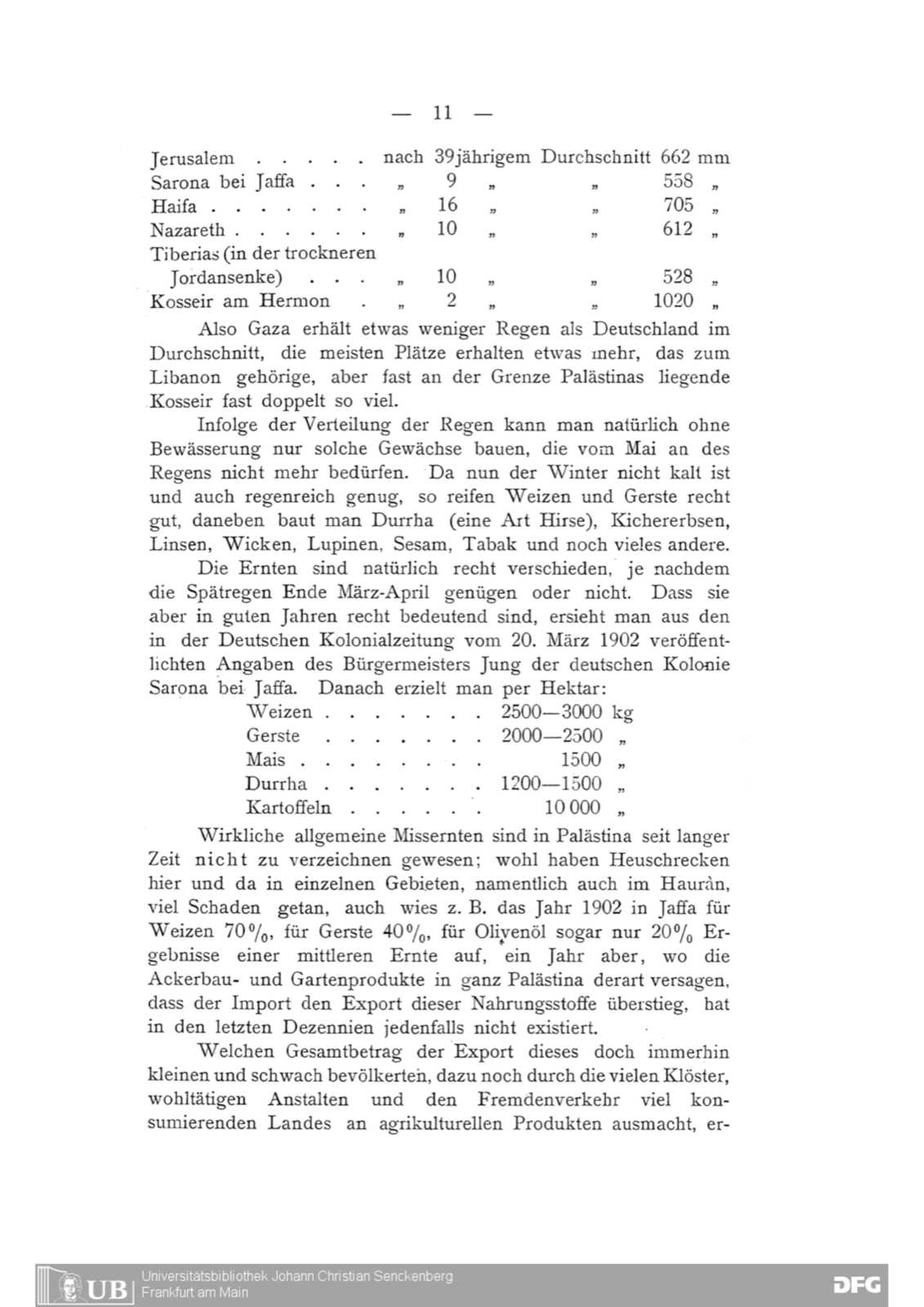
Jerusalem . . . . . . by a 39-year average . . . 662 mm Sarona near Jaffa . . . by a 9-year average . . . 558 mm Haifa . . . . . . . . . by a 16-year average . . . 705 mm Nazareth . . . . . . . by a 10-year average . . . 612 mm Tiberias (in the drier Jordan trough) . . . by a 10-year average . . . 528 mm Kosseir on Hermon . . . by a 2-year average . . . 1020 mm
Gaza, then, receives somewhat less rain than Germany on the average; most places receive somewhat more; and Kosseir — which belongs to the Lebanon but lies almost on the border of Palestine — almost twice as much.
In consequence of the distribution of the rains, one can of course cultivate without irrigation only such plants as no longer require rain from May onward. Since the winter is not cold and is also sufficiently rainy, wheat and barley ripen quite well; alongside these one grows durra (a kind of millet), chickpeas, lentils, vetch, lupins, sesame, tobacco, and much else besides.
The harvests are naturally quite variable, according as the late rains at the end of March and in April suffice or not. But that in good years they are quite considerable may be seen from the figures, published in the Deutsche Kolonialzeitung of 20 March 1902, of Bürgermeister Jung of the German colony of Sarona near Jaffa. According to these, one obtains per hectare: Wheat . . . . . . . 2500–3000 kg Barley . . . . . . . 2000–2500 kg Maize . . . . . . . 1500 kg Durra . . . . . . . 1200–1500 kg Potatoes . . . . . . 10,000 kg
Real general crop-failures have not been recorded in Palestine for a long time; locusts have indeed done much damage here and there in particular districts, notably in the Hauran as well, and the year 1902, for instance, showed in Jaffa, for wheat 70%, for barley 40%, for olive-oil indeed only 20% of the yield of an average harvest; but a year in which the field- and garden-produce throughout the whole of Palestine should fail so far that the import of these foodstuffs exceeded their export has, at all events, not occurred in the last decades.
What total amount the export of agricultural products of this — after all small and thinly peopled — country amounts to (a country which moreover consumes much through its many monasteries, its charitable institutions, and the tourist traffic), one