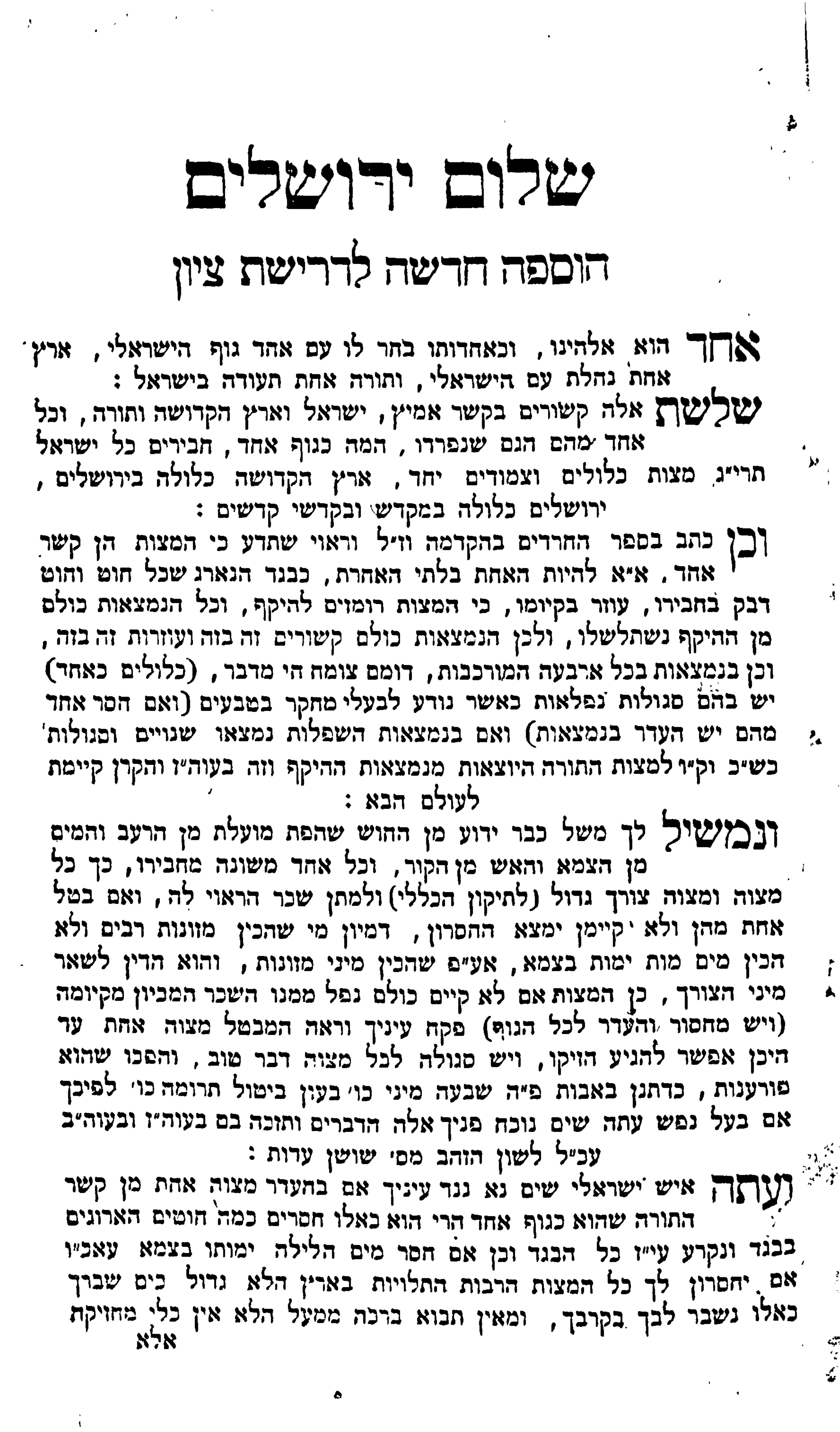
The Peace of Jerusalem
A New Addition to Seeking Zion
One is our God, and in accordance with His oneness He chose for Himself one people, the body of Israel; one land, the inheritance of the people of Israel; and one Torah, a testimony in Israel.
These three are bound with a strong bond, Israel and the Holy Land and the Torah; and each one of them, even though they have been separated, they are as one body: all Israel are fellows; the six hundred and thirteen commandments are included and joined together; the Holy Land is included in Jerusalem, Jerusalem is included in the Sanctuary and in the Holy of Holies.
And so the book Haredim wrote in its Preface, and these are its words: "And it is fitting that you should know that the commandments are one bond. It is impossible for one to be without the other, like a woven garment in which every single thread clings to its fellow and helps to sustain it; for the commandments allude to the encompassing sphere, and all existing things together descended by degrees from the encompassing sphere, and therefore all existing things are bound to one another and help one another. And so too in the existing things of all four compound kinds, mineral, vegetable, animal and speaking (included as one), there are wondrous properties, as is known to those who investigate the natures of things (and if one of them is lacking there is a deficiency in the existing things). And if in the lower existing things changes and properties are found, all the more so, and by an argument from the lesser to the greater, in the commandments of the Torah, which issue from the existing things of the encompassing sphere; and this is in this world, while the principal remains for the world to come."
Let us offer you a parable. It is already known from the senses that bread avails against hunger, and water against thirst, and fire against cold, and each one differs from its fellow; so every single commandment is a great need (for the general restoration) and for the giving of the reward fitting to it, and if one abolishes one of them and does not fulfil them, the lack will be found. It is like one who prepared much food and did not prepare water: he will surely die of thirst, although he prepared kinds of food; and the same holds for the other kinds of need. So with the commandments: if he did not fulfil them all, the reward intended from its fulfilment has fallen away from him (and there is want and lack for the whole body). Open your eyes and see how far the harm of one who abolishes a single commandment can reach. And every commandment has a property, a good thing, and its opposite, which is punishment, as we learned in Avot, chapter 5: "Seven kinds etc., for the sin of neglecting the heave-offering etc." Therefore, if you are a man of conscience, set these words now before your face and you will merit by them in this world and in the world to come. End of his golden words, from the section Shoshan Edut.
And now, man of Israel, set, I pray, before your eyes: if by the absence of one commandment from the bond of the Torah, which is like one body, it is as though several threads woven into the garment were lacking, and through this the whole garment is torn; and likewise if water is lacking this night, they will die of thirst; how much more so if all the many commandments dependent on the Land are lacking to you! Is not your breach great as the sea, as though your heart were broken within you? And whence shall blessing come from above? For is there not no vessel that holds