— 23 —
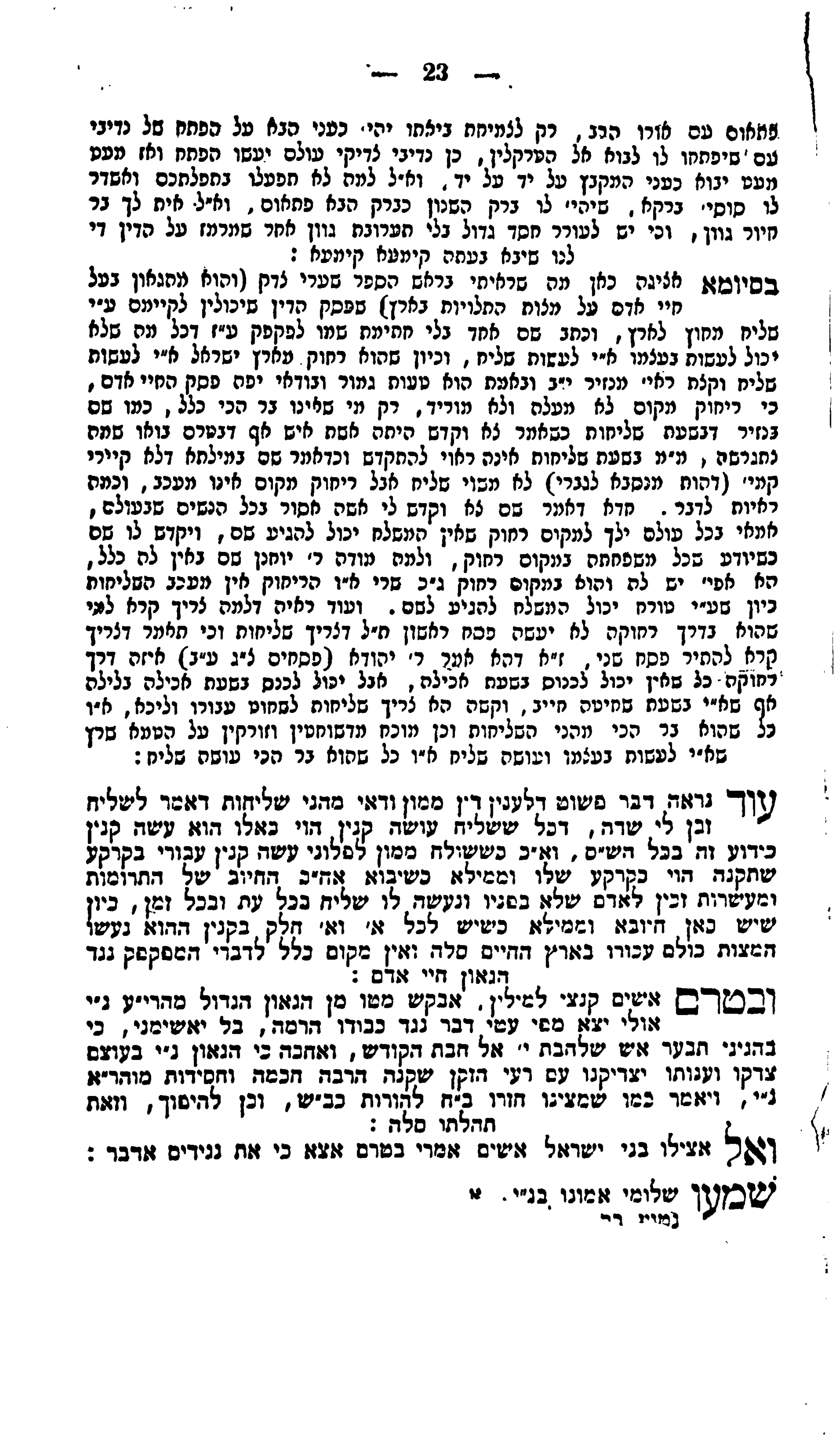
…suddenly with his great light; rather, as to the sprouting of his coming, it will be like a poor man who comes to the door of the nobles of the people, that they may open to him to come into the hall: so the nobles, the righteous of the world, will make the opening, and then little by little he will come, like the poor man who gathers little by little. And he said to him: Why do you not bring it about by your prayer, and I will send him a lightning horse, that he may have lightning [illegible] like the lightning that comes suddenly? And he said to him: Have you one of white colour? And can great lovingkindness be aroused without the admixture of another colour, which hints at judgment? It is enough for us that he come in its time, little by little.
In conclusion I shall set down here what I saw at the beginning of the book Sha'arei Tzedek (which is by the Gaon, the author of Hayyei Adam, on the commandments dependent on the Land), where he ruled that one can fulfil them through an agent from outside the Land. And someone wrote there, without signing his name, to cast doubt upon this: that whatever a man cannot do himself he cannot appoint an agent to do, and since he is far from the Land of Israel he cannot appoint an agent; and he took his proof from Nazir 12. But in truth this is a complete error, and the Hayyei Adam certainly ruled well. For distance of place neither raises nor lowers; it is only one who is not capable of the thing at all, as there in Nazir, where at the time of the agency, when he said "Go and betroth", she was a married woman: even though at the time of his arrival she may perhaps have been divorced, nevertheless at the time of the agency she is not fit to be betrothed; and as it says there, in a matter that does not stand within his power (when she was married to a stranger), an agent is of no avail. But distance of place does not hinder, and there are several proofs of the matter. That which it says there: "Go and betroth me a woman" — he is forbidden to all the women in the world. Why all the world? Will he go to a distant place which the sender cannot reach, and betroth for him there, when he knows all their families in the distant place? And why does Rabbi Yohanan concede there where she has none at all? Why, even if she has, and he is in a distant place, it would also be permitted! Rather it must be that distance does not hinder the agency, since with effort the sender can reach there. And a further proof: why is a verse needed that one who is on a distant journey shall not keep the first Passover? Let him derive it from the fact that it requires agency! And should you say that the verse is needed to permit the Second Passover, that is not so; for Rabbi Judah said (Pesahim 93b): What is "a distant journey"? Anyone who cannot enter at the time of eating; but if he can enter at the time of eating, at night, even though he cannot at the time of slaughtering, he is obliged. And this is difficult: surely agency is needed to slaughter for him, and there is none! Rather it must be that whoever is capable of the thing, agency avails for him. And so it is proved from the fact that one slaughters and sprinkles for one impure through a creeping thing, who cannot do it himself, and he appoints an agent: rather it must be that whoever is capable of the thing appoints an agent.
It further seems a simple matter that in regard to the law of property agency certainly avails, where he said to the agent, "Buy me a field"; for whatever acquisition the agent makes is as though he himself had made the acquisition, as is known throughout the Talmud. And if so, when he sends money to So-and-so, "Make an acquisition for me in land", the land that he buys is as his own land; and consequently, when afterwards the obligation of the heave-offerings and tithes arises, one may confer a benefit on a man in his absence, and one becomes his agent at every time and season, since there is an obligation here. And consequently, when each and every one has a share in that acquisition, all the commandments are performed for him in the land of the living, selah; and there is no room at all for the words of the doubter against the Gaon, the Hayyei Adam.
And before I set an end to words, I beg leave of the great Gaon, our teacher Rabbi Jacob Ettlinger, may his light shine: if perhaps a word has gone forth from the mouth of my pen against his exalted honour, let him not hold me guilty; for in my meditation a fire burns, a flame of Yahweh, for the love of the holy. And I hope that the Gaon, may his light shine, in the greatness of his righteousness and humility, will vindicate us, together with my aged friend, who has acquired much wisdom and piety, our teacher Rabbi Eliyahu, may his light shine; and that he will say, as we find, "The House of Hillel retracted, to teach according to the House of Shammai", and so the reverse; and this is his praise, selah.
And to the nobles of the children of Israel I will set forth my words before I take my leave, for it is with princes that I speak.
Hear, you peaceable and faithful of the children of Israel.