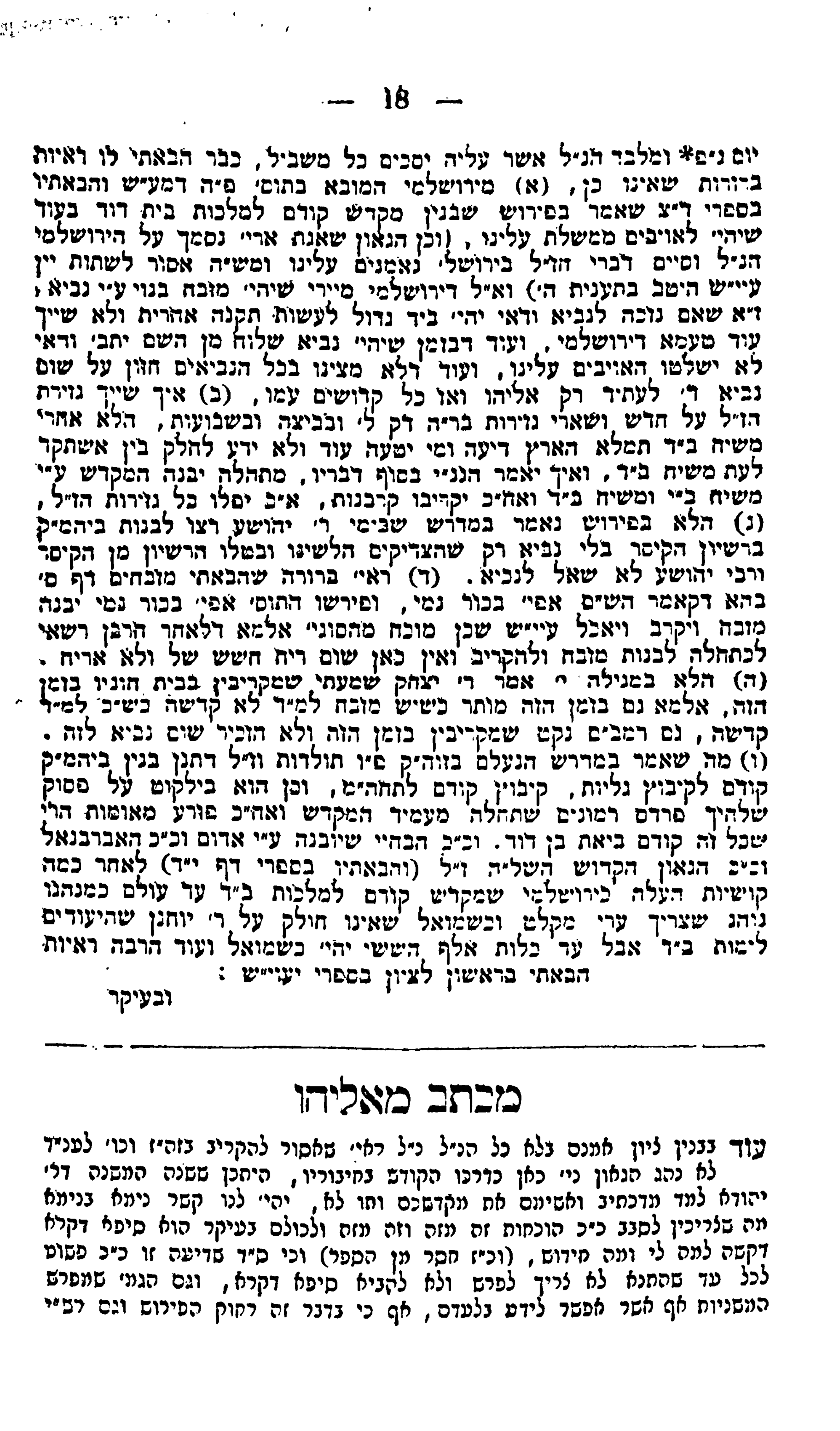
— 18 —
…day three times*. And besides what is mentioned above, with which every intelligent person will agree, I have already brought him clear proofs that it is not so. (1) From the Jerusalem Talmud cited in Tosafot, chapter 5 of Ma'aser Sheni, which I cited in my book Seeking Zion, which says explicitly that the building of the Sanctuary comes before the kingdom of the house of David, while the enemies will still have dominion over us (and so the Gaon, the Sha'agat Aryeh, relied on the Jerusalem Talmud mentioned above and concluded: the words of our Sages of blessed memory in the Jerusalem Talmud are trustworthy to us, and for this reason it is forbidden to drink wine; see there well, in Ta'anit 5). And one cannot say that the Jerusalem Talmud speaks of an altar built through a prophet; this is not so, for if we merit a prophet, it will certainly be in the power of a great one to make a different enactment, and the reason of the Jerusalem Talmud would no longer apply; and further, at a time when there is a prophet sent by Yahweh, blessed be He, the enemies will certainly not rule over us; and further, we do not find in all the prophets a vision of any prophet of Yahweh in the time to come except Elijah, and then "all the holy ones with him". (2) How could the decree of our Sages of blessed memory concerning the new grain, and the other decrees, in Rosh Hashanah folio 30 and in Betzah and in Shevuot, apply? For after Messiah son of David the earth will be full of knowledge, and who would still err and not know how to distinguish between last year and the time of Messiah son of David? And how can the prophet say at the end of his words: first the Sanctuary will be built through Messiah son of Joseph and Messiah son of David, and afterwards they will offer sacrifices? If so, all the decrees of our Sages of blessed memory would fall away. (3) Is it not said explicitly in the Midrash that in the days of Rabbi Joshua they wished to build the Temple with the Emperor's permission, without a prophet, only the righteous informed against them and the permission from the Emperor was annulled; and Rabbi Joshua did not inquire of a prophet. (4) The clear proof which I brought from Zevahim folio 60, in what the Talmud says, "even a firstling too", and Tosafot explained: even a firstling too, let him build an altar and offer it and eat it; see there, that so it is proven from the discussion. Hence after the destruction one is permitted from the outset to build an altar and to sacrifice, and there is here no scent of any concern of "and I will not smell". (5) Is it not so that in Megillah 10 Rabbi Isaac said, "I have heard that they offer sacrifices in the house of Onias at the present time"? Hence even at the present time it is permitted when there is an altar, according to the one who holds that it was not sanctified; all the more so according to the one who holds that it was sanctified. Maimonides too held that one may offer sacrifices at the present time, and did not mention any prophet for this. (6) What is said in the Midrash ha-Ne'lam in the holy Zohar, portion Toledot, in these words: "For we have learned: the building of the Temple precedes the ingathering of the exiles; the ingathering precedes the resurrection of the dead"; and so it is in the Yalkut on the verse "Thy shoots are an orchard of pomegranates", that first He establishes the Sanctuary and afterwards exacts payment from the nations. So all this is before the coming of the son of David. And so Bahya has it, that it will be built through Edom, and so wrote Abarbanel, and so wrote the holy Gaon, the Shelah, of blessed memory (and I cited him in my book, folio 14): after several difficulties he concluded from the Jerusalem Talmud that the Sanctuary comes before the kingdom of the son of David, until which the world follows its accustomed course, so that cities of refuge are needed; and concerning Samuel, that he does not dispute Rabbi Yohanan, that the promises are for the days of the son of David, but until the sixth thousand is completed it will be as Samuel says. And many more proofs I brought in First to Zion, in my book; see there.
A Letter from Elijah
Further, in The Building of Zion: "Indeed, without all that is mentioned above, there is to my mind a proof that it is forbidden to sacrifice at the present time" etc. In my humble opinion the Gaon, may his light shine, did not proceed here according to his holy manner in his writings. Is it possible that the Mishnah taught that Rabbi Judah learned it from what is written, "and I will make desolate your sanctuaries", and no more? It would be difficult for us [illegible] [illegible] that there is need [illegible] of so many demonstrations, this from that and that from this, while for all of them the main thing is the end of the verse, which is difficult: what need is there of it, and what is new in it? (And all this is missing from the book.) And shall we suppose that this view is so plain to everyone that the Tanna did not need to explain it nor to bring the end of the verse? And also the Talmud, which explains the Mishnahs even where it is possible to know without it; how much more in this matter, where the interpretation is far-fetched, and also [illegible]