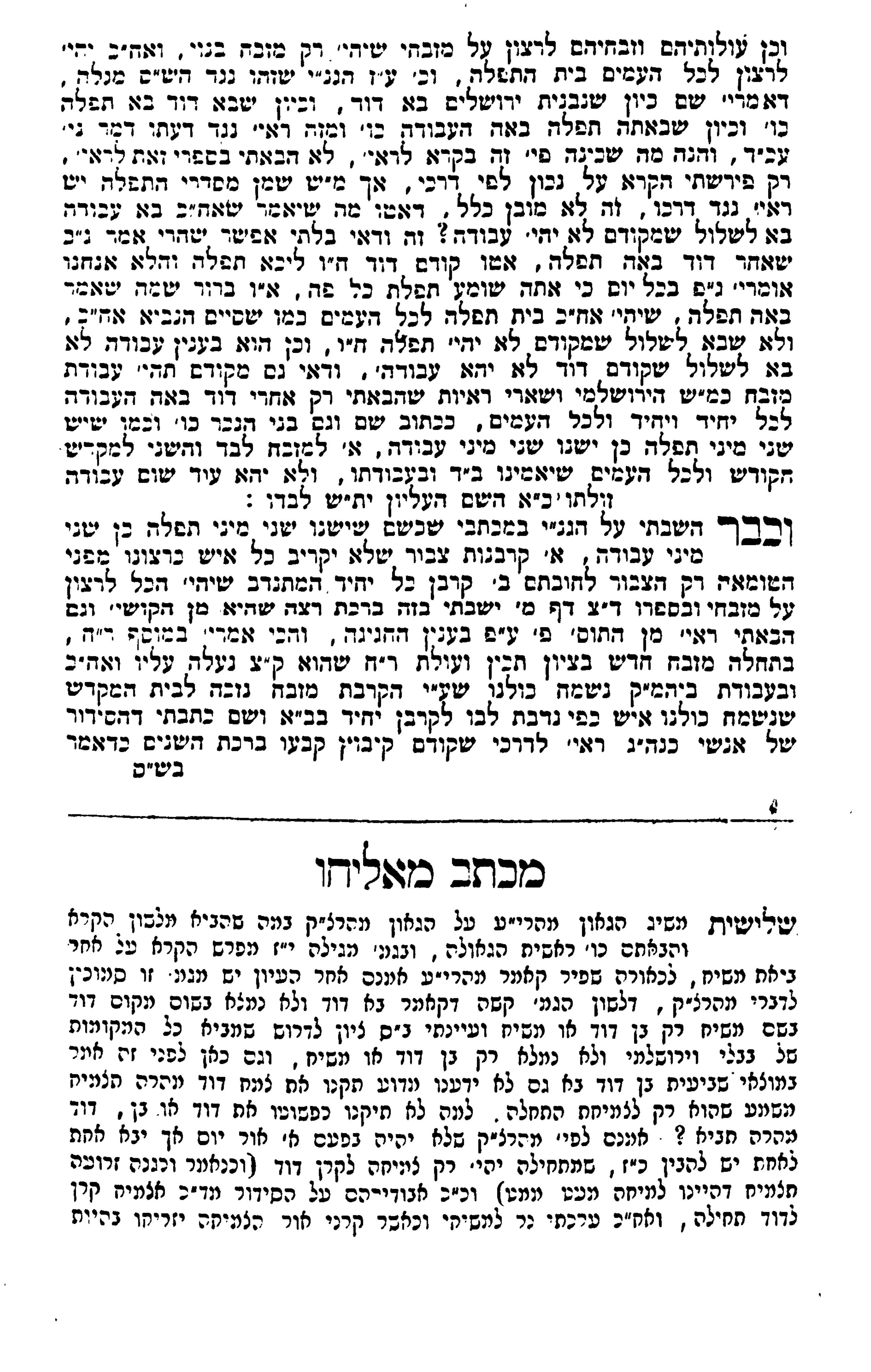
…and likewise, "their burnt-offerings and their sacrifices shall be for acceptance upon My altar", meaning that there will be only a built altar; and afterwards it will be for acceptance for all the peoples, the house of prayer. And on this the Gaon, may his light shine, wrote that this is against the Talmud in Megillah, where it is said: "Once Jerusalem is built, David comes; and once David has come, prayer comes, etc.; and once prayer has come, the Service comes, etc."; and from this there is a proof against his opinion, that he did it of his own accord. Now, as to his taking this explanation of the verse as a proof: I did not bring it in my book as a proof, but only explained the verse properly according to my way. But what he wrote, that from the ordainers of the prayers there is a proof against his way, is not understood at all. For would what it says, that afterwards the Service comes, come to exclude that beforehand there will be no Service? That is certainly impossible, for it says likewise that after David prayer comes; is it to be said that before David, God forbid, there is no prayer? And surely we say three times every day, "For Thou hearest the prayer of every mouth." Rather, it is certainly clear that what it says, "prayer comes", means that afterwards there will be a house of prayer for all the peoples, as the prophet concludes afterwards, and not that it comes to exclude that beforehand there will be no prayer, God forbid. And so it is in the matter of the Service: it does not come to exclude that before David there will be no Service; certainly beforehand too there will be the service of the altar, as the Jerusalem Talmud says, together with the other proofs I brought; only after David will the Service come for every single individual and for all the peoples, as it is written there, "Also the sons of the stranger etc." And just as there are two kinds of prayer, so there are two kinds of Service: one for the altar alone, and the second for the holy Sanctuary and for all the peoples, who will believe in Yahweh and in His service, and there will no longer be any worship besides Him, but Yahweh Most High, blessed be His name, alone.
And I have already replied to the Gaon, may his light shine, in my letter, that just as there are two kinds of prayer, so there are two kinds of Service: first, the public sacrifices, which not every man may offer as he wishes, because of impurity, but only the community for its obligation; second, the sacrifice of every individual who offers freely, so that all will be "for acceptance upon My altar". And in his book Seeking Zion, folio 40, I explained by this the blessing "Be pleased", which is among the difficulties; and I also brought a proof from Tosafot in the chapter "On the Eve of Passover" concerning the festival offering. And so we say in the Additional Service of the New Moon: first, "A new altar in Zion mayest Thou establish, and the burnt-offering of the New Moon", which is a public sacrifice, "we shall offer up upon it"; and afterwards, "and in the service of the Temple we shall all rejoice": that through offering upon the altar we shall merit the Temple, in which we shall all rejoice, each man according to the free-will of his heart, with the sacrifice of the individual, speedily and in our days, Amen. And there I wrote that the order of prayers of the Men of the Great Assembly is a proof for my way, for before the ingathering they fixed the Blessing of the Years, as it is said
A Letter from Elijah
Third, the Gaon, our teacher Rabbi Jacob Ettlinger, objects against the Gaon, our teacher Rabbi Tzvi Kalischer, in that he brought the wording of the verse "And I will bring them etc." for the beginning of the redemption, whereas the Talmud in Megillah 17 explains the verse as referring to after the coming of the Messiah. At first sight our teacher Rabbi Jacob Ettlinger speaks well; but on reflection there is support in this very passage of the Talmud for the words of our teacher Rabbi Tzvi Kalischer. For the wording of the Talmud is difficult, in that it says "David comes", and nowhere is David found as a name for the Messiah, but only "the son of David" or "the Messiah"; and I looked in the book Tziyyun Lidrosh, which brings all the passages of the Babylonian Talmud and the Jerusalem Talmud, and nothing is found but "the son of David" or "the Messiah". And here too, just before this, it says: "At the close of the seventh year the son of David comes." Nor do we know why they instituted "The Branch of David mayest Thou speedily cause to sprout", which implies that it is only for the sprouting of a beginning. Why did they not institute it plainly, "David", or "the son of David, mayest Thou speedily bring"? But according to our teacher Rabbi Tzvi Kalischer, that the light of day will not come all at once but will go forth little by little, all this can be understood: that at first there will be only a sprouting of the horn of David (as it is said, "and as a sown garden causes to sprout", that is, a sprouting little by little); and so Abudarham wrote on the prayer-book, from what is written, "I will make a horn sprout for David" first, and afterwards "I have set in order a lamp for My anointed". And when the rays of the light of the sprouting shine forth, when