— 12 —
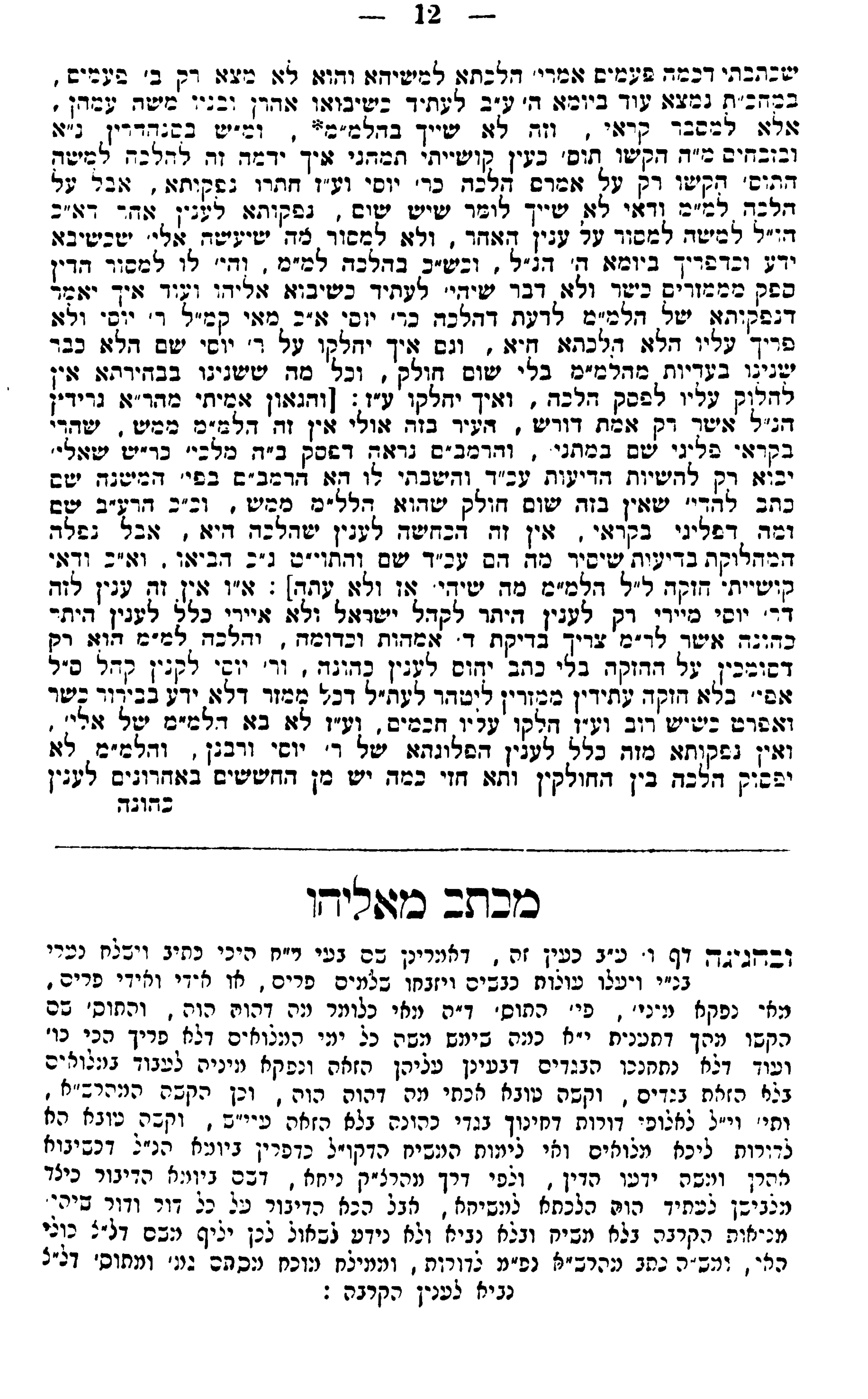
…what I wrote, that it is said several times "a halakhah for the Messiah", and he found it only twice: with all due respect to his honour, it is found also in Yoma 5b, "In the future, when Aaron and his sons come, Moses will be with them", but that is only for understanding the verses, and this does not apply to a law given to Moses at Sinai*. And as for what he wrote, that in Sanhedrin 51 and in Zevahim 45 Tosafot raised a difficulty like mine, I am astonished how he can liken this to a law given to Moses. Tosafot raised their difficulty only on their saying "the halakhah follows Rabbi Yose", and on this they searched out a practical consequence; but of a law given to Moses at Sinai it is certainly not fitting to say that there is any practical consequence for some other matter, for if so Moses ought to have handed it down concerning that other matter, and not have handed down what Elijah will do, since when he comes he will know, as the objection is raised in Yoma 5 mentioned above; and all the more so with a law given to Moses at Sinai. And he ought to have handed down the law that doubtful bastards are fit, and not a thing that will be in the future when Elijah comes. Moreover, how can he say that the practical consequence of the law given to Moses at Sinai is to know that the halakhah follows Rabbi Yose? If so, what does Rabbi Yose teach us, and why is no objection raised against him: but surely it is a halakhah? And further, how could they dispute Rabbi Yose there? Surely we have already learned in Eduyot, from a law given to Moses at Sinai, without anyone dissenting; and whatever we learned in Behirta may not be disputed in deciding the halakhah; so how could they dispute this? [And the true Gaon, our teacher Rabbi Eliyahu of Grätz mentioned above, who seeks only the truth, remarked on this that perhaps this is not a law given to Moses at Sinai in the strict sense, for they dispute over verses there in the Mishnah; and Maimonides, it seems, decided in the Laws of Kings according to Rabbi Shimon, that Elijah will come only to bring opinions into agreement; thus far his words. And I replied to him: surely Maimonides, in his Commentary on the Mishnah there, wrote explicitly that there is no dissent at all on this, that it is truly a law given to Moses at Sinai; and so wrote the Ra'av there: and as for their disputing over verses, that is no denial that it is a halakhah, but the dispute arose over opinions as to what the things are that he will remove; thus far his words there; and the Tosafot Yom Tov also cited it. And if so my difficulty certainly stands firm: why do I need a law given to Moses at Sinai for what will be then and not now?] Rather, it must be that the one matter has nothing to do with the other: Rabbi Yose speaks only of permission to enter the congregation of Israel, and does not speak at all of permission for the priesthood, for which according to Rabbi Meir an examination of four mothers and the like is required; and the law given to Moses at Sinai is only that one relies on presumption, without a written genealogy, in the matter of the priesthood; and Rabbi Yose holds, as regards the congregation, that even without presumption bastards are destined to be made pure in the time to come, for every bastard who is not known with certainty is fit, and especially where there is a majority; and on this the Sages disputed him. And the law given to Moses at Sinai concerning Elijah did not come for this, and there is no practical consequence from it at all for the dispute between Rabbi Yose and the Rabbis; and a law given to Moses at Sinai would not decide the halakhah between disputants. And come and see how many apprehensions there are among the later authorities concerning
A Letter from Elijah
And in Hagigah, folio 6b, there is something like this, for we say there: Rav Hisda asked, how is it written, "And he sent the young men of the children of Israel, and they offered burnt-offerings", sheep, "and sacrificed peace-offerings", bulls; or were both the one and the other bulls? What practical difference does it make? Tosafot explain, in the passage beginning "And what": that is to say, what was, was. And Tosafot there raised a difficulty from the passage in Ta'anit 11, "In what did Moses serve all the days of consecration?", where no such objection is raised, etc.; and further, that the garments had not been dedicated, for which we require sprinkling upon them, and the practical consequence is to serve in the consecration without the sprinkling of the garments. And this is very difficult [illegible] what was, was; and so the Maharsha raised the difficulty, and answered: "And one may say, to teach the generations that the dedication of the priestly garments is without sprinkling", see there. And this is very difficult: surely for the generations there is no consecration, and it would be for the days of the Messiah [illegible], as the objection is raised in Yoma mentioned above, that when Aaron and his sons come they will know the law. But according to the approach of Maharlak it is well: for there in Yoma the discussion of how he clothes them in the future is "a halakhah for the Messiah", whereas here the discussion concerns every single generation in which there will be [illegible] sacrifice without the Messiah and without a prophet, and we shall not know whom to ask; therefore he derives from them that all this is not needed; and for that reason the Maharsha wrote "a practical consequence for the generations". And it follows of itself [illegible] in regard to, and from Tosafot, that a prophet is not needed for the offering of sacrifice.