Mount Tzvi 50
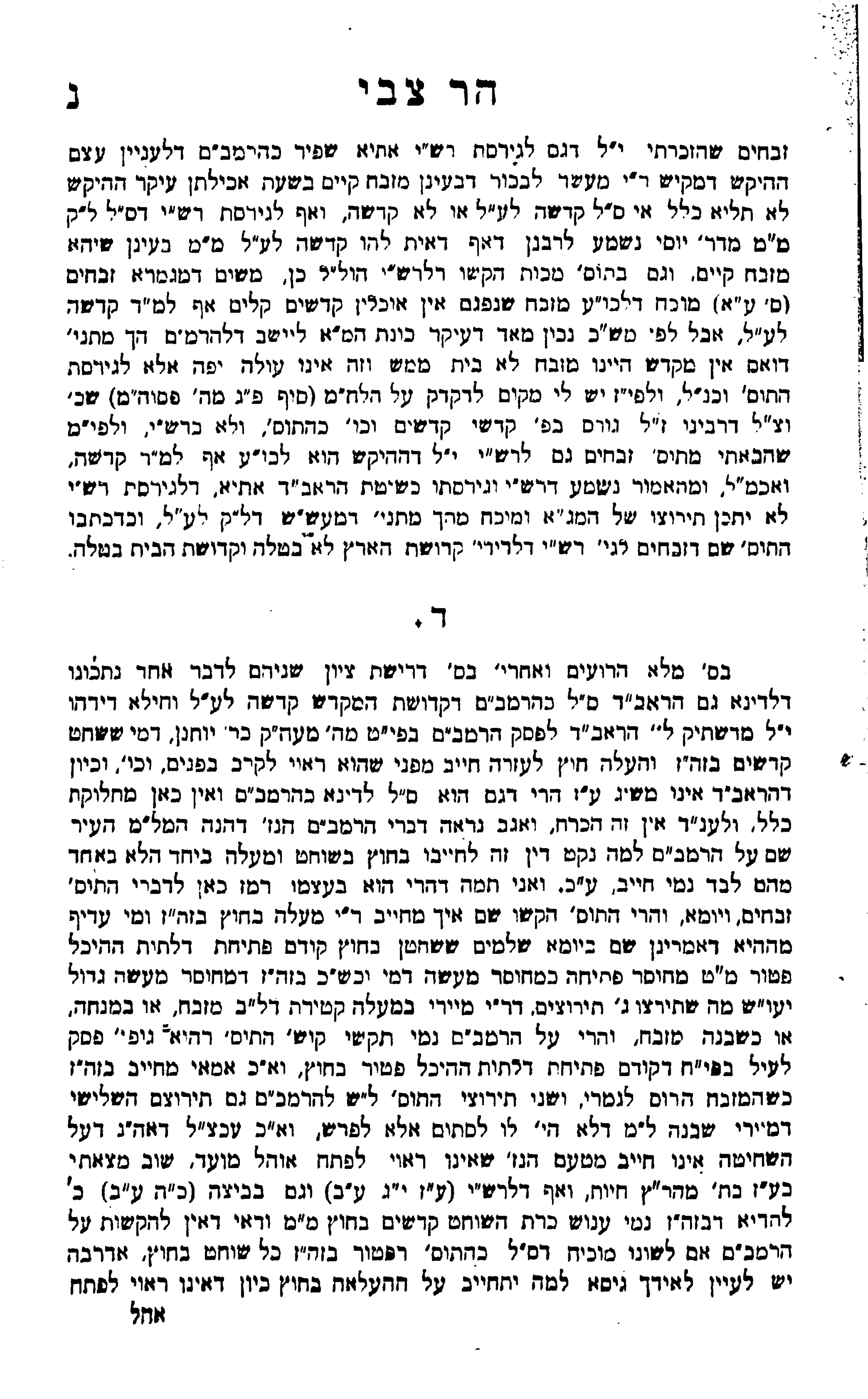
…on Zevahim, which I mentioned, one may say that even according to Rashi's reading it fits well with Maimonides; for as regards the analogy itself, by which Rabbi Yose likens the tithe to the firstling, that we require the altar to be standing at the time they are eaten, the essence of the analogy does not depend at all on whether he holds it was sanctified for the future or was not sanctified; and even according to Rashi's reading, which holds it was not sanctified, nevertheless from Rabbi Yose we may infer for the Rabbis that, although they hold it was sanctified for the future, nevertheless we require the altar to be standing. And Tosafot on Makkot too objected that according to Rashi it ought to have been so, since from the Talmud in Zevahim (60a) it is proven that according to all opinions, when the altar is damaged, lesser holy things are not eaten, even according to the one who says it was sanctified for the future. But according to what I have written it is very right: the main intention of the Magen Avraham is to settle that, for Maimonides, this Mishnah of "and if there is no Sanctuary" means the altar, not an actual House; and this works well only according to the reading of Tosafot, as above. And accordingly I have room to examine closely the Lehem Mishneh (end of chapter 3 of the Laws of Disqualified Consecrated Things), who wrote: "and one must say that our Master of blessed memory reads in the chapter Kodshei Kodashim, etc., like Tosafot and not like Rashi"; but according to what I have brought from Tosafot on Zevahim, even according to Rashi one may say that the analogy holds for all opinions, even for the one who says it was sanctified; and this is not the place to enlarge. And from what has been said we infer that Rashi and his reading go along with the view of Rabad; for according to Rashi's reading the answer of the Magen Avraham is not possible, and it is proven from this Mishnah on Second Tithe that it was not sanctified for the future; and as Tosafot wrote there on Zevahim, according to Rashi's reading, that in his view the sanctity of the Land was not annulled and the sanctity of the House was annulled.
In the book Melo ha-Ro'im, and after it in the book Seeking Zion, both intended one and the same thing: that in law Rabad too holds like Maimonides, that the sanctity of the Sanctuary was sanctified for the future. And their strength, one may say, comes from the fact that Rabad was silent toward Maimonides' ruling in chapter 19 of the Laws of the Sacrificial Procedure, following Rabbi Yohanan, that one who slaughtered holy things at the present time and offered them up outside the Court is liable, because it is fit to be offered inside, etc.; and since Rabad does not dispute this, it follows that he too holds in law like Maimonides, and there is no dispute here at all. But in my humble opinion this is not compelling. And incidentally let us look at the words of Maimonides mentioned above: for the Mishneh la-Melekh remarked there on Maimonides, why did he state this law, making him liable outside, of one who slaughters and offers up together? Surely for one of them alone he is also liable; end of quotation. And I wonder, for he himself alluded here to the words of Tosafot on Zevahim and on Yoma; and Tosafot objected there: how does Rabbi Yohanan make one who offers up outside at the present time liable? Is this any better than what we say there in Yoma, that peace-offerings which one slaughtered outside before the doors of the Sanctuary were opened — he is exempt; what is the reason? Lacking the opening is like lacking an act; and all the more so at the present time, when what is lacking is a great act. See there what they answered: three answers. That Rabbi Yohanan speaks of one who offers up incense, which does not need an altar; or of a meal-offering; or of when he built an altar. And surely Tosafot's objection will be difficult for Maimonides as well, for he himself ruled above in chapter 18 that before the opening of the doors of the Sanctuary one is exempt outside; and if so, why does he make one liable at the present time, when the altar is entirely destroyed? And two of Tosafot's answers do not apply to Maimonides; their third answer too, that it speaks of where he built one, does not help, for he should not have spoken without qualification but should have specified. And if so one must perforce say that indeed for the slaughtering he is not liable, for the reason mentioned, that it is not fit for the entrance of the Tent of Meeting. Afterwards I found this in Avodah Zarah, in the novellae of our teacher Rabbi Tzvi Chajes. And although Rashi (Avodah Zarah 13b), and also on Betzah (25b), wrote explicitly that at the present time too one who slaughters holy things outside is punished with excision, nevertheless certainly one cannot raise an objection against Maimonides, if his wording proves that he holds like Tosafot, that at the present time anyone who slaughters outside is exempt. On the contrary, one must examine the other side: why should he be liable for the offering up outside, since it is not fit for the entrance of