Additions to the Essay on Holy Things 42
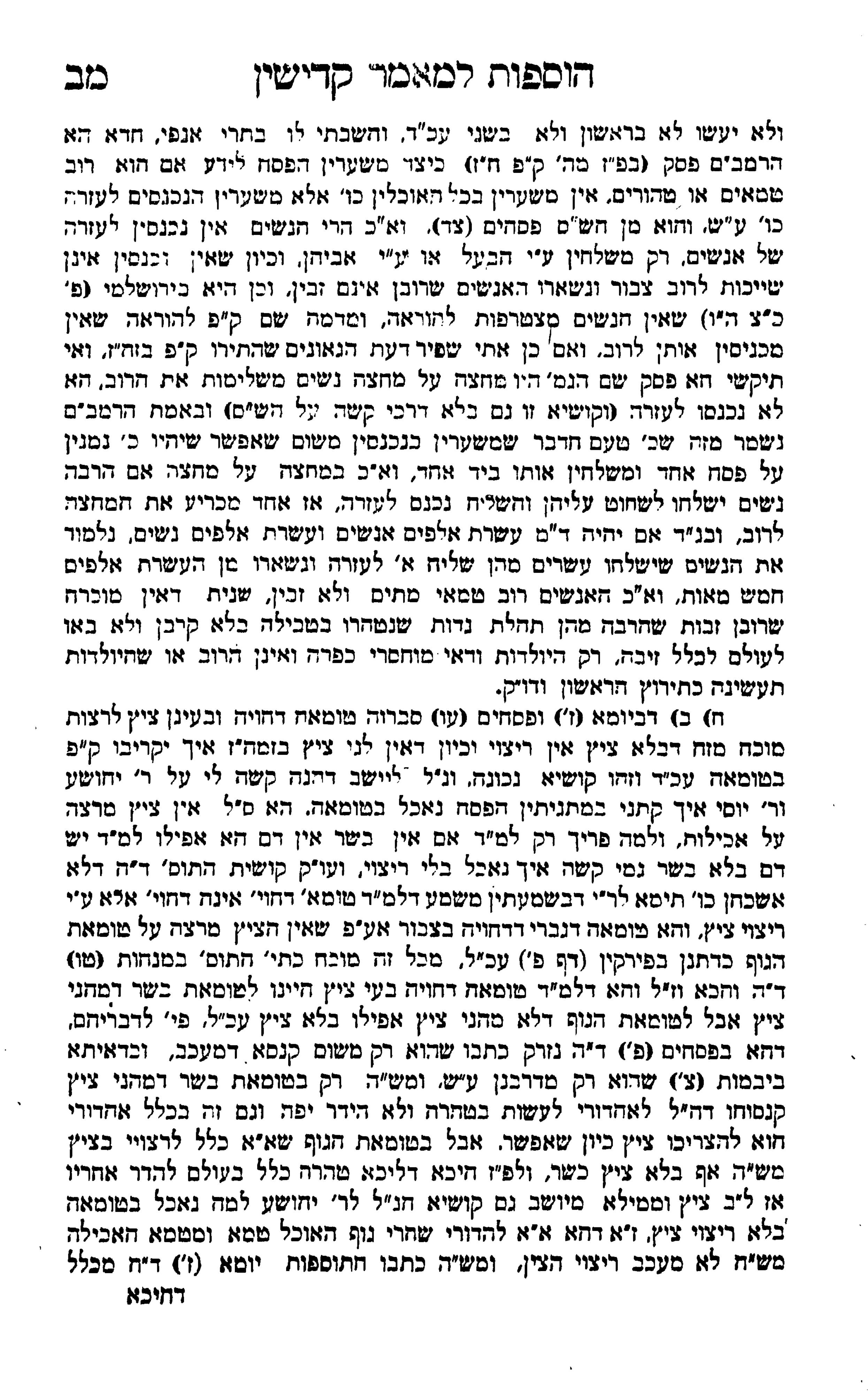
…they shall not perform it either at the first or at the second. End of his words. And I answered him in two ways. First: Maimonides ruled (chapter 7 of the Laws of the Passover Offering, halakhah 7): "How is the Passover reckoned, to know whether it is a majority of impure or of pure? They do not reckon by all who eat, etc., but they reckon by those who enter the Court, etc."; see there. And this is from the Talmud, Pesahim (94). And if so, the women do not enter the Court of the men, but send by means of the husband or by means of their father; and since they do not enter, they do not belong to the majority of the community, and there remain the men, the majority of whom are not men with a flux. And so it is in the Jerusalem Talmud (chapter Kezad Tzolin, halakhah 6), that women do not combine for a ruling; and there it likens the Passover offering to a ruling, that they are not counted into the majority. And if so, the view of the Geonim who permitted the Passover offering in this time stands well. And should you object: the Talmud ruled there, "if they were half and half, the women complete the majority" — but they did not enter the Court! (and this question is difficult on the Talmud even without my way) — in truth Maimonides guarded against this, for he wrote the reason why they reckon by those who enter: because it is possible that twenty be counted on one Passover offering and send it by the hand of another; and if so, at half and half, if many women send to have it slaughtered for them, and the agent enters the Court, then one tips the half into a majority. And in our case, if there be, for example, ten thousand men and ten thousand women, we shall teach the women that twenty of them send one agent to the Court, and there remain of the ten thousand five hundred; and if so the men are the majority, impure through the dead and not with a flux. Second: it is not compelled that most of them are with a flux, for many of them are at first menstruants, who were purified by immersion without a sacrifice and never came to the state of flux; only the women after childbirth certainly lack atonement, and they are not the majority; or the women after childbirth will do as in the first answer. Consider it carefully.
-
- "For in Yoma (7) and Pesahim (76) they supposed that impurity is set aside, and we require the frontlet to make acceptable; it is proved from this that without the frontlet there is no acceptance; and since we have no frontlet in this time, how will they offer the Passover offering in impurity?" End of his words. And this is a correct question. And it seems to me to resolve it thus: for behold, it is difficult for me concerning Rabbi Joshua and Rabbi Yose, how does the Mishnah teach "the Passover is eaten in impurity", when they hold that the frontlet does not make acceptable for eatings? And why does he object only according to the one who says "if there is no flesh there is no blood"? Even according to the one who says there is blood without flesh it is also difficult: how is it eaten without acceptance? And a further difficulty is the question of Tosafot, in the comment beginning "For we have not found, etc.": "It is a wonder to the Ri, for in our passage it is implied that according to the one who says impurity is set aside, it is set aside only through the acceptance of the frontlet; and yet the impurity of persons is set aside in the community, although the frontlet does not make acceptable for impurity of the body, as we learned in our chapter (folio 80)." End of his words. From all this the answer of Tosafot in Menahot (15), in the comment beginning "And here", is proved, in these words: "And that which, according to the one who says impurity is set aside, requires the frontlet, is for impurity of the flesh, where the frontlet is effective; but for impurity of the body, where the frontlet is not effective, even without the frontlet." End of his words. The explanation of their words: for in Pesahim (80), in the comment beginning "Was sprinkled", they wrote that it disqualifies only on account of a penalty, and as is stated in Yevamot (90), that it is only by the Rabbis; see there. And therefore only in impurity of the flesh, where the frontlet is effective, did they penalise him, for he ought to have sought to do it in purity and did not seek well; and this too is included in seeking, to require the frontlet of him, since it is possible. But in impurity of the body, where it is not at all possible to make acceptable through the frontlet, therefore even without the frontlet it is fit. And according to this, where there is no purity at all in the world to seek after, then the frontlet is not required. And of itself the question mentioned above on Rabbi Joshua is also resolved, why it is eaten in impurity without the acceptance of the frontlet: that is no difficulty, for it is impossible to seek, since the body of the eater is impure and makes the eating impure; therefore the acceptance of the frontlet does not hold it back. And therefore Tosafot wrote in Yoma (7), in the comment beginning "By implication"