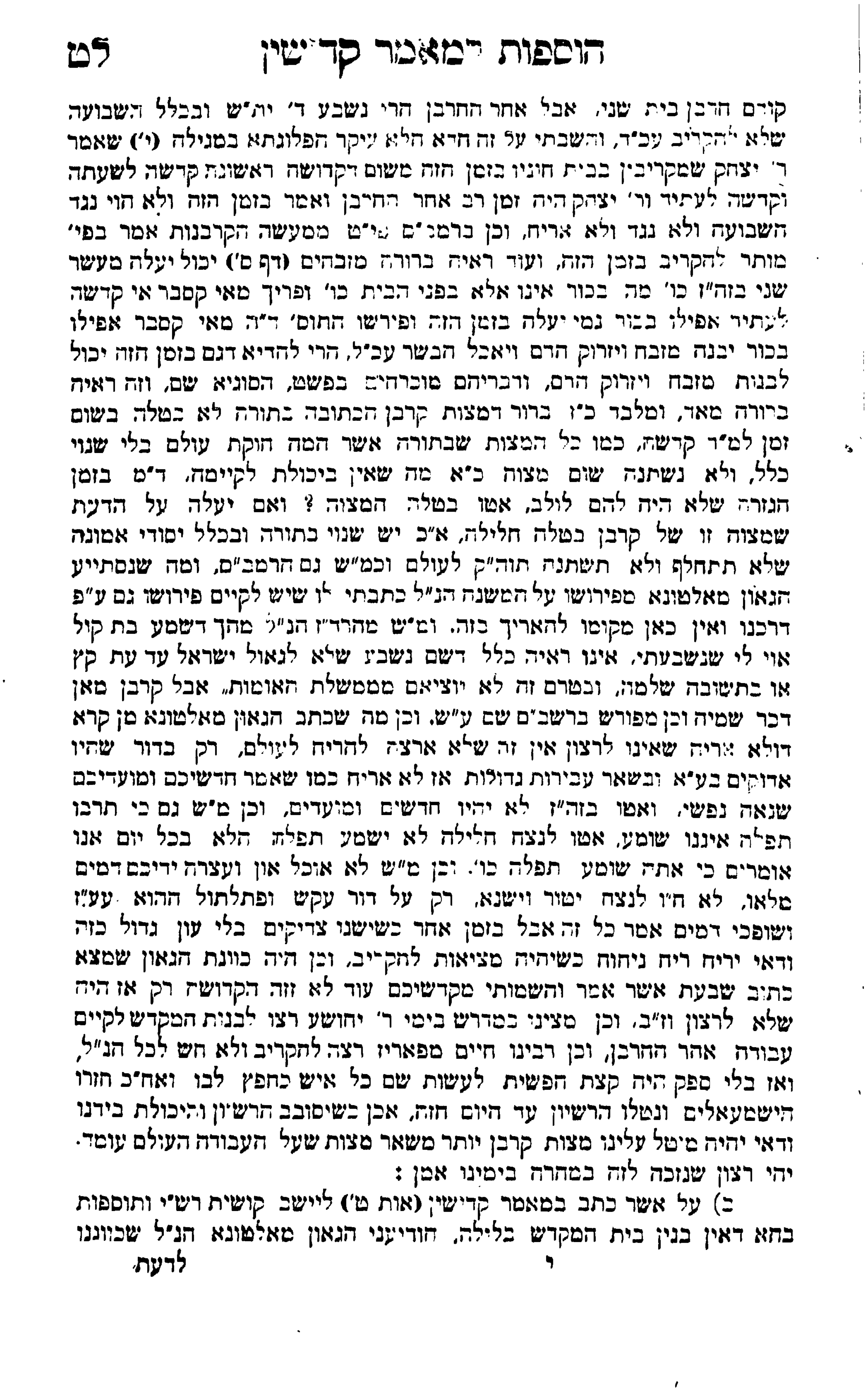
Additions to the Essay on Holy Things 39
…before the destruction of the Second Temple; but after the destruction, behold, Yahweh, blessed be His name, swore, and included in the oath was not to offer. End of his words. And I answered on this: firstly, is not the main dispute in Megillah (10), where Rabbi Yitzhak said that one offers at the house of Onias in this time, because the first sanctity sanctified for its time and sanctified for the future? And Rabbi Yitzhak lived a long time after the destruction and said "in this time", and it was neither against the oath nor against "and I will not smell". And likewise Maimonides, in chapter 19 of the Laws of the Procedure of the Sacrifices, said explicitly that it is permitted to offer in this time. And a further clear proof from Zevahim (folio 60): "One might think second tithe should be brought up in this time, etc.; just as the firstling is only in the presence of the House, etc."; and it objects: "What does he hold? If it sanctified for the future, then even the firstling too should be brought up in this time"; and Tosafot explained, at the heading "What does he hold": "Even the firstling: let him build an altar and sprinkle the blood and eat the flesh." End of their words. Behold, explicitly, that even in this time one may build an altar and sprinkle the blood; and their words are compelled by the plain sense of the passage there; and this is a very clear proof. And apart from all this, it is clear that the commandment of sacrifice written in the Torah has not been annulled at any time, according to the one who says that it sanctified, like all the commandments in the Torah, which are an everlasting statute without any change at all; and no commandment has changed, except in what it is not in our power to fulfil; for example, in the time of the decree, when they had no palm-branch, was the commandment then annulled? And if it should enter the mind that this commandment of sacrifice was annulled, Heaven forbid, then there is a change in the Torah; and it is among the principles of the faith that the holy Torah will not be exchanged and will not be changed for ever, as Maimonides also wrote. And as for the support that the Gaon of Altona drew from his interpretation of the Mishnah mentioned above, I wrote to him that his interpretation can stand also according to our way, and this is not the place to enlarge on it. And what our teacher Rabbi David Ziskind, mentioned above, wrote from that passage, "he heard a heavenly voice: Woe is me that I have sworn", is no proof at all; for there He swore not to redeem Israel until the time of the End or through complete repentance, and before this He will not bring them out from the dominion of the nations; but sacrifice, who mentioned it? And so it is explicit in Rashbam there; see there. And likewise what the Gaon of Altona wrote from the verse "and I will not smell", that it is not acceptable: this does not mean that I will not wish to smell for ever, but only in a generation that clung to idolatry and to other great transgressions, then I will not smell; as it says, Your new moons and your appointed feasts my soul hates; and shall there then be no new moons and appointed feasts in this time? And likewise what is written, Even when you make many prayers, I do not hear: shall He then, Heaven forbid, never hear prayer? Do we not say every day, For thou hearest prayer, etc.? And likewise what is written, I cannot bear iniquity and the solemn assembly; your hands are full of blood: not, Heaven forbid, that He will bear a grudge and hate for ever; but of that crooked and perverse generation, worshippers of idols and shedders of blood, He said all this; but at another time, when there are righteous men without so great a sin, He will surely smell the pleasing odour when it becomes possible to offer. And such too was the intent of the Gaon whose writing he found: that at the time when He said, And I will make your sanctuaries desolate, the sanctity had not yet departed, only then it was not acceptable; and this is clear. And so we find in the Midrash that in the days of Rabbi Joshua they wished to build the Sanctuary, to maintain the Service after the destruction; and so our master Rabbi Hayyim of Paris wished to offer and paid no heed to all the above; and then, without doubt, there was some freedom for every man to do there as his heart desired; and afterwards the Ishmaelites returned and took away the licence, to this day. But when the licence and the means come about in our hands, the commandment of sacrifice will surely be incumbent upon us more than the other commandments, for upon the Service the world stands. May it be His will that we merit this speedily in our days. Amen.
- Concerning what was written in the Essay on Holy Things (section 9), to resolve the difficulty of Rashi and Tosafot regarding the rule that the Temple is not built at night, the Gaon of Altona mentioned above informed me that we had arrived