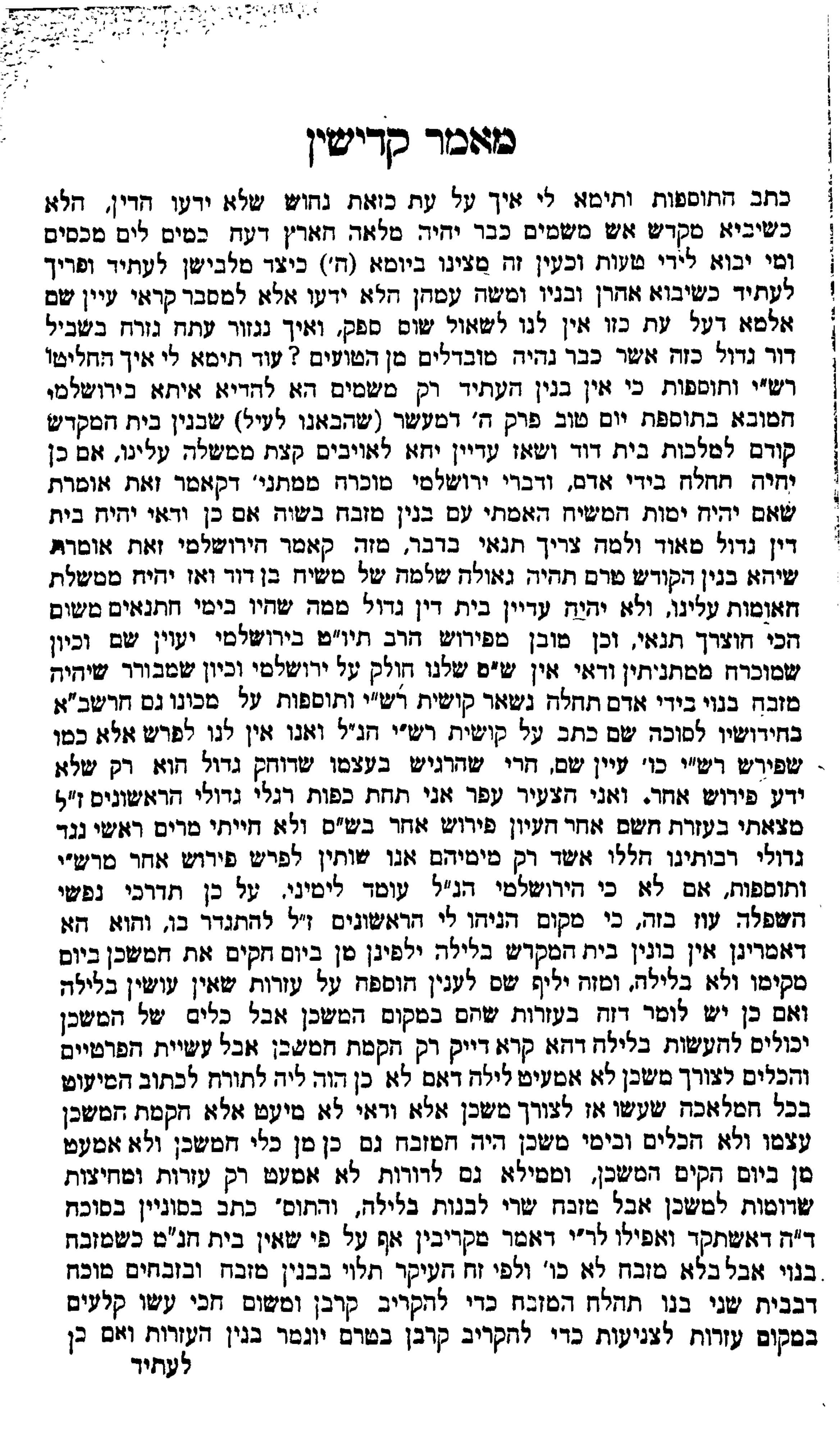
Essay on Holy Things
…wrote the Tosafot. And I wonder: how, concerning such a time as that, should we fear that they will not know the law? Surely, when a Sanctuary of fire is brought from heaven, the earth will already be full of knowledge as the waters cover the sea, and who will come to error? And similar to this we find in Yoma (5): "How did he clothe them? — In the time to come"; and it objects: "In the time to come, when Aaron and his sons come, and Moses with them, will they not know? Rather, it is to understand the verses"; see there. Hence concerning such a time we have no need to raise any doubt; and how shall we now decree a decree for the sake of so great a generation, in which we shall already be separated from those who err? I wonder further: how did Rashi and Tosafot determine that the future building will be only from heaven, when it is stated explicitly in the Jerusalem Talmud, cited in the Tosafot Yom Tov, chapter 5 of Ma'aser (which we cited above), that the building of the Temple comes before the kingdom of the House of David, and that then the enemies will still have some dominion over us? If so, it will at first be by human hands. And the words of the Jerusalem Talmud are compelled by the Mishnah, for it says "This teaches": for if the days of the true Messiah were to come together with the building of the altar, then surely there would be a very great court, and why would a condition be needed in the matter? From this the Jerusalem Talmud says, "This teaches that the building of the holy place will come before there is the complete redemption of Messiah son of David", and then the nations will have dominion over us, and there will not yet be a court greater than there was in the days of the Tannaim; therefore a condition was needed. And so it is understood from the commentary of the Rabbi, the Tosafot Yom Tov, on the Jerusalem Talmud; see there. And since it is compelled by the Mishnah, surely our Talmud does not disagree with the Jerusalem Talmud; and since it is established that the altar will at first be built by human hands, the difficulty of Rashi and Tosafot remains in its place. The Rashba too, in his novellae on Sukkah there, wrote on the difficulty of Rashi mentioned above: "And we have nothing to explain but as Rashi explained, etc."; see there. Thus he himself sensed that it is a great strain, only that he knew no other explanation. And I, the least, dust that I am beneath the soles of the feet of the great early authorities of blessed memory, have found, with Yahweh's help, after study, another explanation of the Talmud; and I would not have raised my head against these great ones among our Rabbis, from whose waters alone we drink, to give an explanation other than that of Rashi and Tosafot, were it not that the Jerusalem Talmud mentioned above stands at my right hand. Therefore, my lowly soul, march on in strength in this, for the early authorities of blessed memory have left me room to distinguish myself in it. And it is this: what we say, that the Temple is not built at night, we learn from "On the day that the Tabernacle was set up": by day one sets it up, and not at night; and from this it is derived there, concerning an addition to the Courts, that it is not made at night. If so, one may say that this applies to the Courts, which stand in the place of the Tabernacle; but the vessels of the Tabernacle may be made at night, for the verse is precise only about the setting up of the Tabernacle; but as for the making of the separate parts and of the vessels for the needs of the Tabernacle, night was not excluded; for otherwise the Torah ought to have written the exclusion for all the work that they did then for the needs of the Tabernacle. Rather, it surely excluded only the setting up of the Tabernacle itself, and not the vessels. And in the days of the Tabernacle the altar too was among the vessels of the Tabernacle, and was not excluded by "On the day that the Tabernacle was set up"; and consequently, for later generations too, only the Courts and partitions, which resemble the Tabernacle, are excluded, but the altar may be built at night. And the Tosafot wrote in our passage in Sukkah, in the comment beginning "That last year": "And even according to Rabbi Joshua, who says one may offer sacrifices even though there is no House, that applies when the altar is built, but without an altar, not, etc." And according to this the main thing depends on the building of the altar. And in Zevahim it is proved that in the Second Temple they built the altar first, in order to offer sacrifice, and therefore they made hangings in place of the Courts, for privacy, in order to offer sacrifice before the building of the Courts was completed. And if so