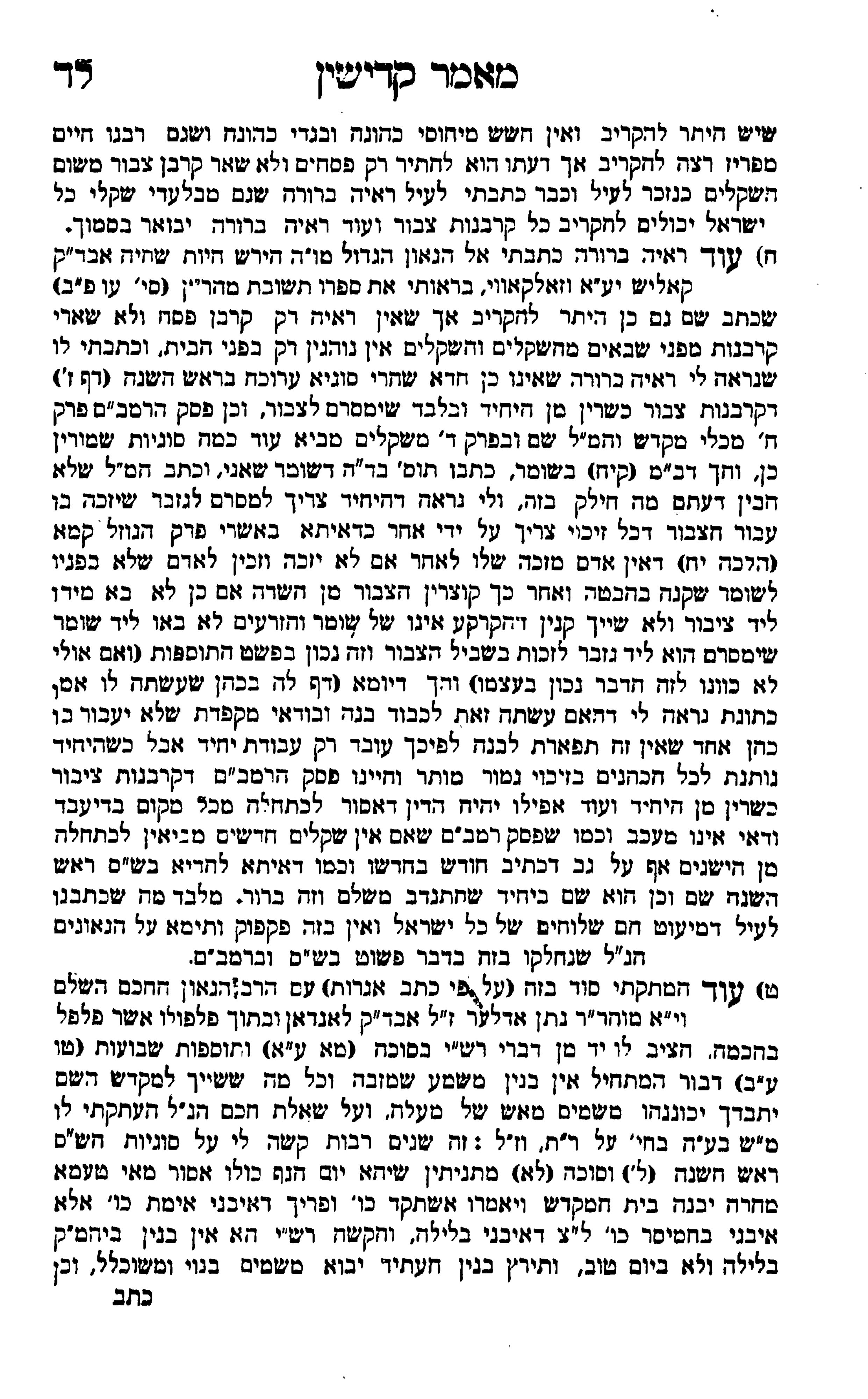
Essay on Holy Things 34
…that there is permission to offer sacrifices, and that there is no concern over priests of attested lineage and the priestly garments; and that Rabbi Hayyim of Paris also wished to offer sacrifices, but his opinion is to permit only the Passover offerings and not the other community sacrifices, because of the shekels, as mentioned above. And I have already written above a clear proof that even without the shekels of all Israel they can offer all the community sacrifices; and a further clear proof will be set out shortly.
-
Further, I wrote a clear proof to the great Gaon, our teacher Rabbi Hirsch Chajes, who was head of the rabbinical court of the holy community of Kalisch, may God protect it, Amen, and of Zolkiew, on seeing his book, the Responsa of Maharatz (section 76, chapter 2), where he too wrote a permission to offer sacrifices, but that there is proof only for the Passover offering and not for the other sacrifices, because they come from the shekels, and the shekels apply only while the Temple stands. And I wrote to him that it seems to me there is clear proof that it is not so. First, for there is an explicit passage in Rosh Hashanah (folio 7) that community sacrifices are valid when they come from an individual, provided that he hands them over to the community; and so Maimonides ruled, Laws of the Temple Vessels, chapter 8, and the Mishneh la-Melekh there, and in Laws of the Shekels, chapter 4, he brings several more passages that teach so. And as for that passage in Bava Metzia (118) concerning a watchman, Tosafot wrote in the comment beginning "A watchman is different", and the Mishneh la-Melekh wrote that he did not understand their view, what distinction they drew in this. And it seems to me that the individual must hand them over to the treasurer, that he may acquire it on behalf of the community, for every conferring of title must be done through another, as is stated in the Asheri, chapter Ha-Gozel Kamma (halakhah 18), that a man does not confer what is his upon another unless it is acquired for him; and one may confer a benefit on a man in his absence. As to the watchman, who acquired by looking, and afterwards the community reaps from the field: if so, it did not come from his hand into the hand of the community, and acquisition does not apply, for the ground is not the watchman's and the crops did not come into the watchman's hand, that he should hand them over into the hand of the treasurer to acquire on behalf of the community. And this is correct in the plain sense of the Tosafot (and if perhaps they did not intend this, the thing is correct in itself). And that passage in Yoma (folio 35, concerning a priest whose mother made him a tunic: it seems to me that the mother made it for the honour of her son, and is surely particular that no other priest should serve in it, for that is no glory for her son; therefore he serves in it only in an individual's service. But when the individual gives it to all the priests by a complete conferring of title, it is permitted; and this is the ruling of Maimonides, that community sacrifices are valid when they come from an individual. And further, even if the law were that it is forbidden at the outset, nevertheless after the fact it certainly does not invalidate; just as Maimonides ruled that if there are no new shekels one brings even at the outset from the old, although it is written "month by its month"; and as is stated explicitly in the Talmud, Rosh Hashanah there; and so it is there concerning an individual who donated from his own. And this is clear. Besides what we wrote above, that a minority are the agents of all Israel; and in this there is no doubt. And I wonder at the Gaonim mentioned above, who disagreed about this in a matter that is plain in the Talmud and in Maimonides.
-
Further, I took sweet counsel on this (by way of letters) with the Rabbi, the Gaon, the wise and perfect and God-fearing, our teacher Rabbi Nathan Adler of blessed memory, head of the rabbinical court of the holy community of London. And in the course of the argument which he argued with wisdom, he took his stand on the words of Rashi in Sukkah (41a) and of Tosafot on Shevuot (15b), in the comment beginning "There is no building", which imply that the altar and everything that belongs to the Sanctuary Yahweh, blessed be He, will establish from heaven, out of fire from above. And in answer to the question of the sage mentioned above I copied out for him what I wrote, with Yahweh's help, in my novellae on Rabbenu Tam, and these are its words: For many years the passages of the Talmud in Rosh Hashanah (30) and Sukkah (31) have troubled me. The Mishnah: that the whole day of the waving shall be forbidden. What is the reason? "Speedily the Temple will be built, and they will say: Last year, etc." And it objects: "If it was built, when? etc. Rather, it was built on the fifteenth, etc." "It is needed only where it was built at night." And Rashi asked: But the Temple is not built at night, nor on a festival! And he answered: the future building will come from heaven, built and perfected. And so