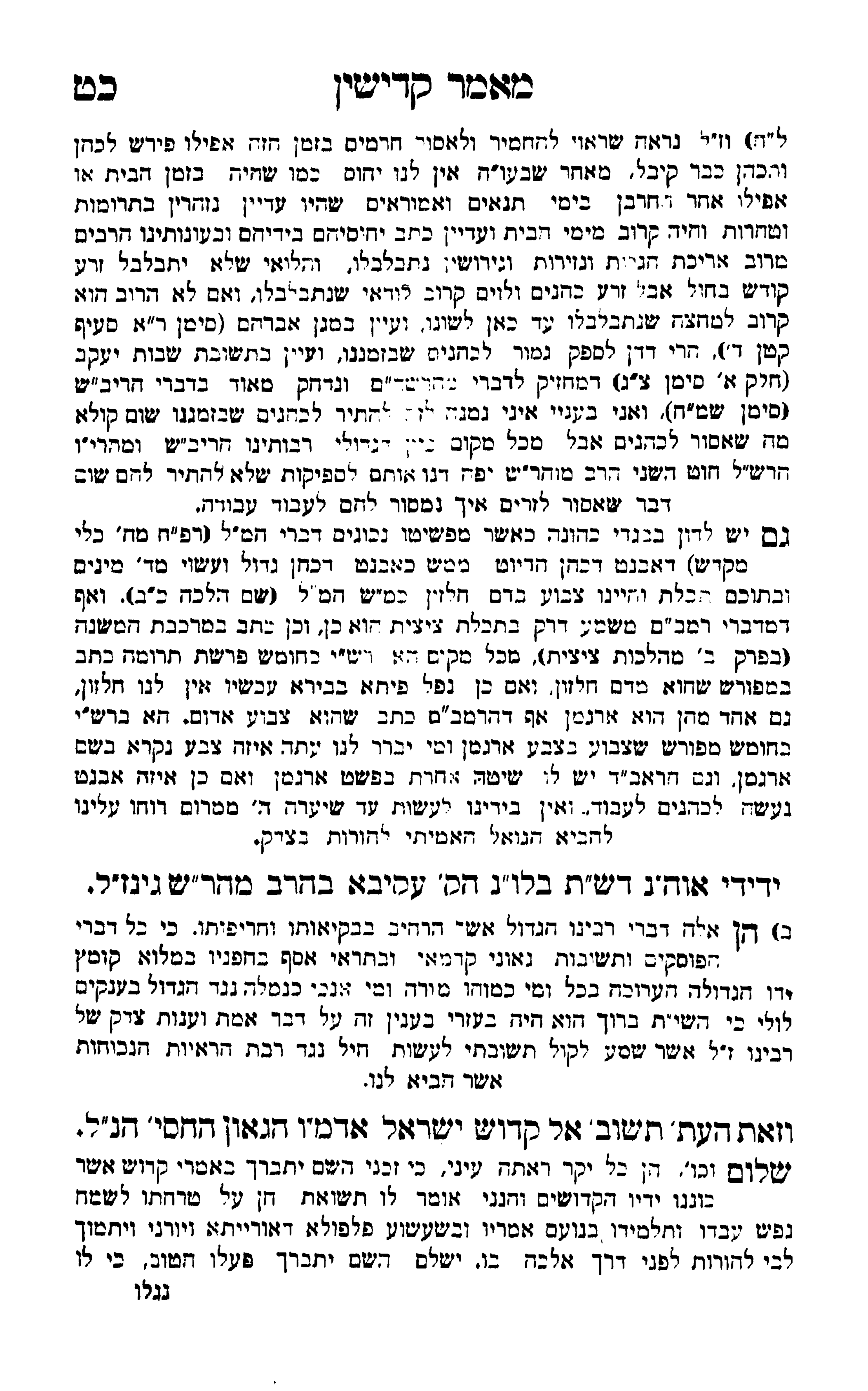
Essay on Holy Things 29
…35), and these are his words: "It appears that it is proper to be strict and to forbid devoted things at this time, even if he designated them for a priest and the priest has already received them, since, because of our many sins, we have no lineage such as there was in the time of the Temple, or even after the destruction, in the days of the Tannaim and Amoraim, when they were still careful about heave-offerings and purities, and it was near to the days of the Temple, and their written records of lineage were still in their hands; and because of our many sins, through the great length of the Exile and the decrees and expulsions, they have become confused. Would that holy seed has not become mixed with the profane! But the seed of priests and Levites has almost certainly become confused, and if not the majority, it is close to half that have become confused." End of quotation. And see Magen Avraham (section 201, subsection 4); thus he judges the priests of our time as a complete doubt. And see the Responsa Shevut Ya'akov (Part 1, section 93), who upholds the words of Maharshdam and strains greatly over the words of Rivash (section 348). And I, in my poverty, do not join in this, to permit to the priests of our time any leniency in what is forbidden to priests; but nevertheless, since the greatest of our Rabbis, Rivash and Mahariv, Rashal, Hut ha-Shani, the Rabbi our teacher Rabbi Shmuel Yafeh, judged them as doubtful, so as not to permit them anything that is forbidden to non-priests, how shall we hand over to them the performance of the Service?
Further, there is a question to consider concerning the priestly garments: for, taken in their plain sense, the words of the Mishneh le-Melekh are correct (beginning of chapter 8 of the Laws of the Vessels of the Sanctuary), that the girdle of an ordinary priest is exactly like the girdle of the High Priest, and is made of four kinds, and among them tekhelet (the blue), that is, dyed with the blood of the chilazon (the shellfish of the blue dye), as the Mishneh le-Melekh wrote there (there, halakhah 22). And although from the words of Maimonides the implication is that this is so only for the tekhelet of the fringes, and so too wrote the Mirkevet ha-Mishneh (on chapter 2 of the Laws of Fringes), nevertheless Rashi on the Pentateuch, in the portion Terumah, wrote explicitly that it is from the blood of the chilazon; and if so, the bread has fallen into the well: now we have no chilazon. Also, one of them is purple; although Maimonides wrote that it is dyed red, yet in Rashi on the Pentateuch it is explicit that it is dyed with a purple dye; and who will make clear to us now which dye is called by the name of purple? And Rabad too has another view on the plain meaning of purple; and if so, what girdle shall we make for the priests to serve in? And it is not in our power to do so until Yahweh pours out His spirit upon us from on high, to bring the true redeemer to teach in righteousness.
Your friend, who loves you as his own soul, who seeks the peace of your Torah with heart and soul, the writer, Akiva son of the Rabbi Maharash Ginzil.
- Behold, these are the words of our great master, who showed his boldness in his erudition and his acumen; for all the words of the decisors and the responsa of the Gaonim, earlier and later, he gathered in his fists, with the full handful of his great hand, ordered in all things; and who is a teacher like him? And who am I, like an ant against the greatest of the giants, were it not that Yahweh, blessed be He, blessed be He, was my help in this matter, for the sake of the truth and the meek righteousness of our master of blessed memory, who listened to the voice of my reply, to do valiantly against the multitude of correct proofs which he brought us.
And this is the copy of the reply to the holy one of Israel, my lord, my master and teacher, the pious Gaon mentioned above.
Peace etc. Behold, my eye has seen every precious thing, for Yahweh, blessed be He, has granted me holy sayings which his holy hands established; and I say to him, "Grace, grace!" for his trouble to gladden the soul of his servant and disciple with the pleasantness of his sayings and with the delight of Torah debate; and he has taught me and upheld my heart, to show before me the way in which I should walk. May Yahweh, blessed be He, repay his good work, for to him