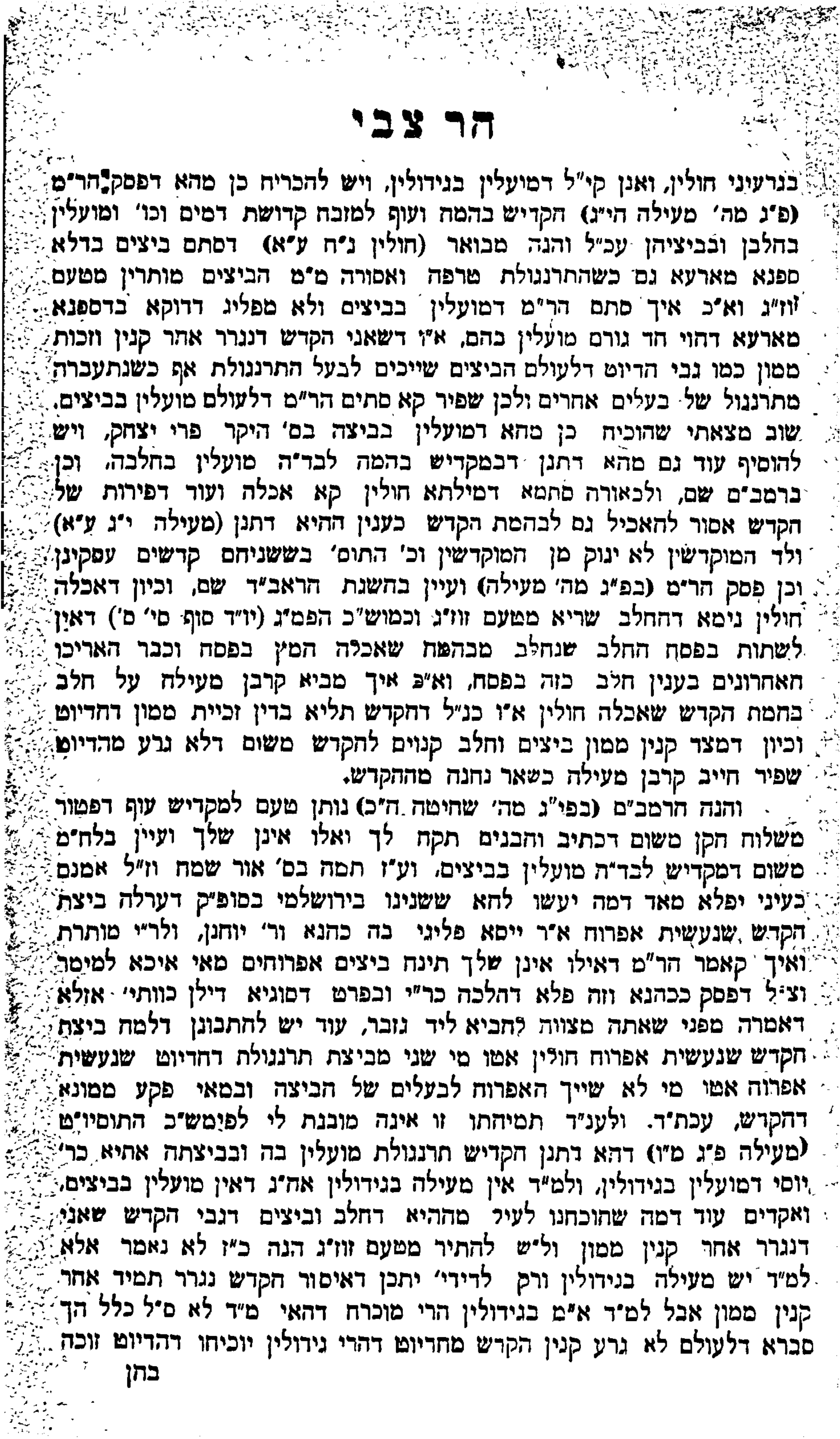
Mount Tzvi
…with profane seed-grains; and we hold that the law of sacrilege applies to growths. And one may establish this from what Maimonides ruled (chapter 3 of the Laws of Sacrilege, halakhah 13): "If he consecrated a beast or a fowl for the altar with monetary sanctity etc., the law of sacrilege applies to their milk and to their eggs"; thus far his words. Now it is explained (Hullin 58a) that ordinary eggs, where the hen did not conceive from the dust, even when the hen is terefah and forbidden, are nevertheless permitted on the ground of "both this and that cause"; and if so, how did Maimonides state without qualification that the law of sacrilege applies to eggs, and not distinguish that only where she conceived from the dust, where there is a single cause, does the law of sacrilege apply to them? It must therefore be that consecrated property is different, for it follows after the ownership and right of property, as with an ordinary person, where the eggs always belong to the owner of the hen even when she was impregnated by a cock belonging to other owners; and therefore Maimonides rightly stated without qualification that the law of sacrilege always applies to eggs. Afterwards I found that this was demonstrated, from the fact that the law of sacrilege applies to an egg, in the precious book Peri Yitzhak; and one may add further also from what we learnt in the Mishnah, that when one consecrates a beast for the upkeep of the Temple the law of sacrilege applies to its milk, and so in Maimonides there; and seemingly, in the ordinary course of things, it eats profane fodder; and further, the produce of consecrated property may not be fed even to a consecrated beast, as in the matter of what we learnt in the Mishnah (Me'ilah 13a): "The young of consecrated animals shall not suck from consecrated animals", and Tosafot wrote that we are dealing with a case where both are holy, and so Maimonides ruled (in chapter 3 of the Laws of Sacrilege), and see the stricture of Rabad there; and since it eats profane fodder, let us say that the milk is permitted on the ground of "both this and that cause", as the Peri Megadim wrote (Yoreh De'ah, end of section 60) that one should not drink on Passover milk milked from a beast that ate leaven on Passover, and the later authorities have already written at length on the matter of such milk on Passover; and if so, how does one bring a sacrifice for sacrilege for the milk of a consecrated beast that ate profane fodder? It must be, as above, that consecrated property depends on the law of an ordinary person's acquisition of property; and since, in respect of ownership of property, the eggs and the milk are owned by the Temple treasury, because it is no worse off than an ordinary person, he is rightly liable to a sacrifice for sacrilege like anyone else who benefits from consecrated property.
Now Maimonides (in chapter 13 of the Laws of Slaughter, halakhah 20) gives the reason why one who consecrates a bird is exempt from sending away the mother from the nest: because it is written, "and the young thou shalt take for thyself", and these are not yours; and see the Lehem Mishneh, that it is because when one consecrates for the upkeep of the Temple the law of sacrilege applies to the eggs. And at this the book Or Same'ah wondered, and these are his words: "However, in my eyes it is very astonishing: what will they do with what we learnt in the Jerusalem Talmud, at the end of the first chapter of Orlah: 'A consecrated egg that became a chick — Rabbi Yissa said: Kahana and Rabbi Yohanan disagree about it, and according to Rabbi Yohanan it is permitted'? And how does Maimonides say 'these are not yours'? Granted for eggs; what is there to say about chicks? And one must say that he ruled like Kahana, and this is astonishing, for the halakhah follows Rabbi Yohanan, and especially since our Talmudic discussion goes according to him, for it says 'because you are commanded to bring it to the hand of the treasurer'. Further one must consider: why is a consecrated egg that became a chick profane? Is it any different from the egg of an ordinary person's hen that became a chick? Does the chick not belong to the owners of the egg? And by what is the property of the Temple treasury cancelled?" Thus far the substance of his words. And in my humble opinion this astonishment of his is not understood by me, according to what the Tosafot Yom Tov wrote (Me'ilah, chapter 3, mishnah 6), that what we learnt, "If he consecrated a hen, the law of sacrilege applies to it and to its egg", follows Rabbi Yosi, who holds that the law of sacrilege applies to growths; and according to the one who says there is no sacrilege with growths, indeed the law of sacrilege does not apply to eggs. And let me further preface that what we proved above from the case of the milk and the eggs, that consecrated property is different because it follows after the ownership of property, and it is not fitting to permit on the ground of "both this and that cause" — all this is said only according to the one who says there is sacrilege with growths, and only according to him is it possible that the prohibition of consecrated property always follows after the ownership of property; but according to the one who says there is no sacrilege with growths, it is proved that this authority does not hold at all this reasoning that the ownership of the Temple treasury is never worse off than an ordinary person's, for the growths prove it, that the ordinary person acquires