Mount Tzvi
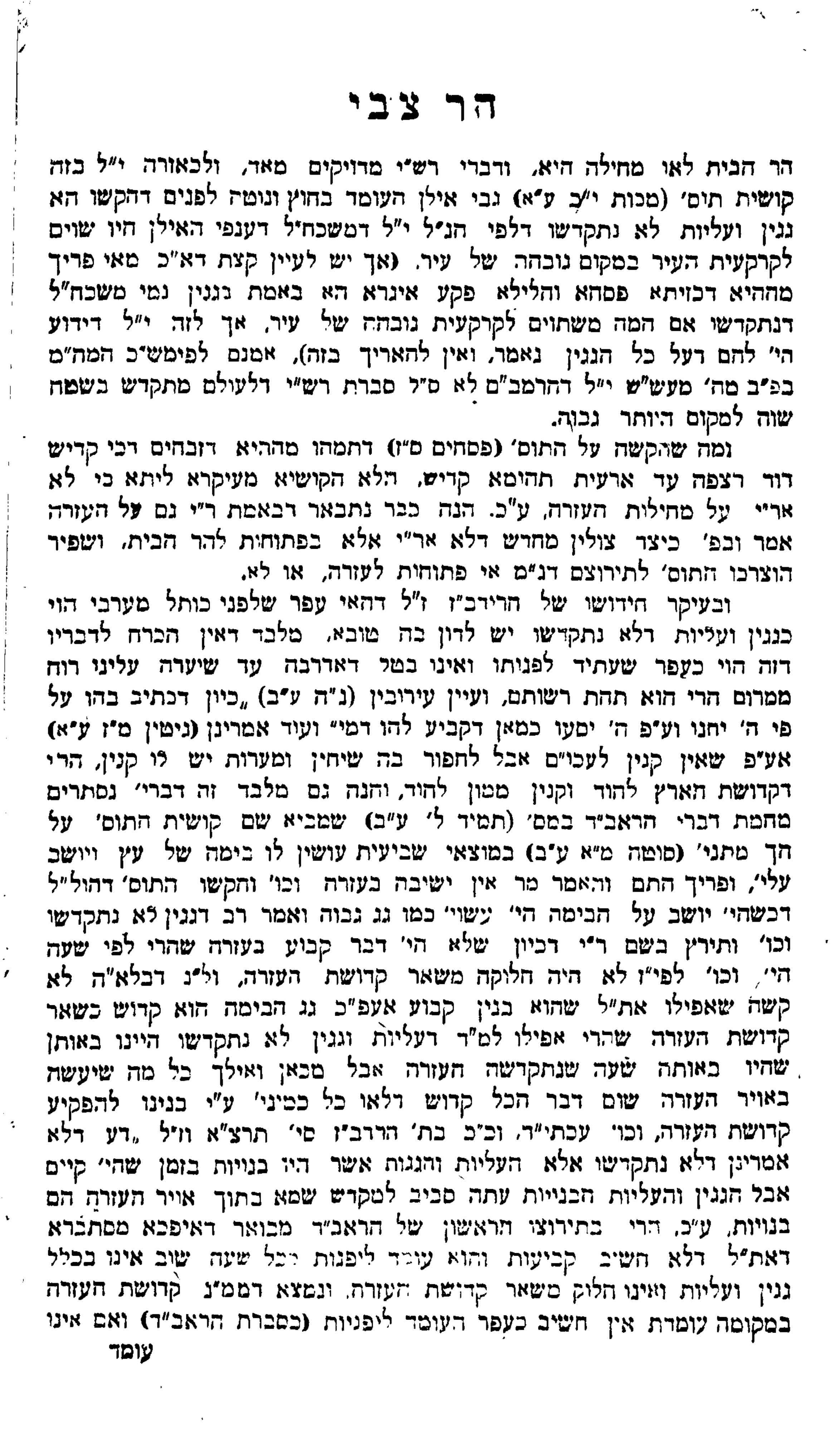
…the Temple Mount it is not a tunnel; and the words of Rashi are very precise. And at first sight one may resolve by this the difficulty of Tosafot (Makkot 12a) concerning a tree standing outside and leaning inward, where they asked: but surely roofs and upper chambers were not sanctified? For according to what was said above, one may say that it can be found where the branches of the tree were level with the ground of the city at the place of the city's height. (But one must examine somewhat: if so, what is the objection from that saying, "An olive's bulk of the Passover offering, and the Hallel bursts the roofs"? For in truth it can be found with roofs too that they were sanctified, if they are level with the ground at the city's height. But to this one may say that it was known to them that it was said of all the roofs; and there is no need to lengthen on this.) However, according to what the Maharam wrote on chapter 2 of the Laws of Second Tithe, one may say that Maimonides does not hold Rashi's reasoning, that it is always sanctified on a surface level with the highest place.
And as for his difficulty against Tosafot (Pesahim 67), who wondered at that passage of Zevahim, "When David sanctified the pavement, down to the depths of the abyss it was sanctified": surely the difficulty does not exist from the outset, for Rabbi Yohanan did not speak of the tunnels of the Court. Thus far. Now it has already been explained that in truth Rabbi Yohanan spoke of the Court too, and in the chapter Keitzad Tzolin he makes the new point that Rabbi Yohanan said it only of those opening into the Temple Mount; and Tosafot rightly needed their answer, that it makes a difference in practice whether they open into the Court or not.
And as to the chief novelty of the Ridbaz of blessed memory, that this earth before the Western Wall is like roofs and upper chambers which were not sanctified, there is much to discuss in it. Apart from there being no compelling ground for his words, that this counts as earth that is due to be cleared away and is not nullified — on the contrary, until a spirit be poured upon us from on high it is under their dominion; and see Eruvin (55b): "Since it is written of them, At the word of Yahweh they would encamp, and at the word of Yahweh they would journey, it is as though they were fixed"; and further we say (Gittin 47a): although an idolater has no ownership, yet to dig in it ditches and caves he has ownership; thus the sanctity of the Land is one thing and the ownership of property is another. And indeed, even apart from this, his words are refuted by the words of Rabad on the tractate (Tamid 30b), where he cites the difficulty of Tosafot on this Mishnah (Sotah 41b), "At the close of the seventh year they make for him a wooden platform and he sits upon it"; and the Talmud there objects, "But did not the master say, there is no sitting in the Court, etc."; and Tosafot asked that it should have said that when he sat upon the platform it was made like a high roof, and Rav said that roofs were not sanctified, etc.; and they answered in the name of Ri that since it was not a fixed thing in the Court, for it was only for the time being, etc. According to this it was not distinct from the rest of the sanctity of the Court. And it seems to me that even without this it is no difficulty, for even if you say that it is a fixed building, nevertheless the roof of the platform is holy like the rest of the sanctity of the Court; for even according to the one who says that upper chambers and roofs were not sanctified, that means those which existed at the time when the Court was sanctified; but from then on, whatever thing is made in the airspace of the Court, all is holy, for it is not in his power by his building to cancel the sanctity of the Court, etc. Thus far the substance of his words. And so wrote the Radbaz in his Responsa, section 691, and these are his words: "Know that we say that they were not sanctified only of the upper chambers and roofs which were built at the time when it stood; but the roofs and the upper chambers now built around the Sanctuary, perhaps they are built within the airspace of the Court." Thus far. Thus in the first answer of Rabad it is explained that the reverse is the reasonable view: that if you say it does not count as fixed and it stands to be cleared away at any hour, then it is no longer in the category of roofs and upper chambers and is not distinct from the rest of the sanctity of the Court. And it follows that, whichever way you take it, the sanctity of the Court stands in its place: if it counts as earth standing to be cleared away (according to the reasoning of Rabad), and if it is not