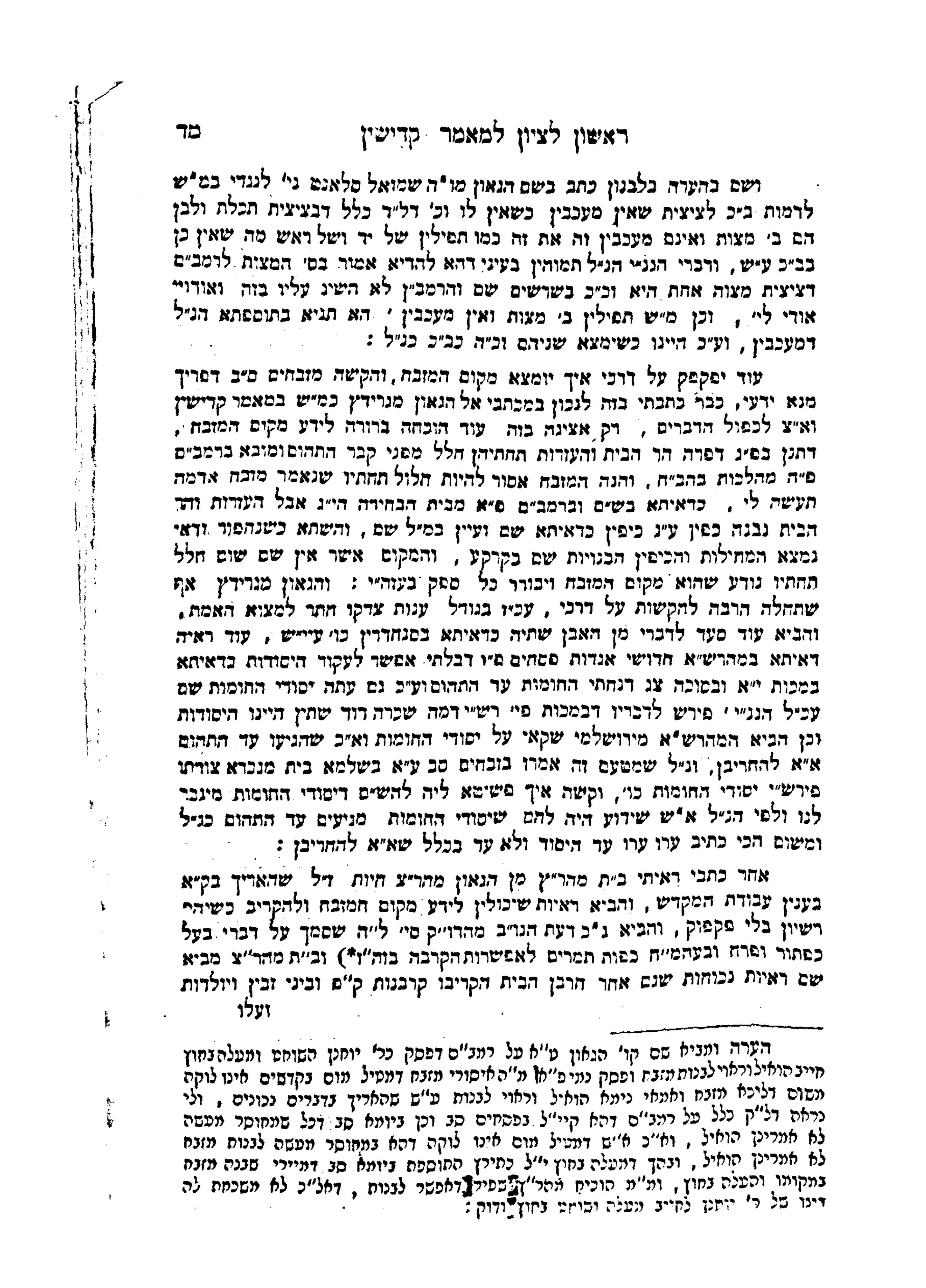
First to Zion — to the Essay on Holy Things 44
And there, in a note in HaLevanon, he wrote in the name of the Gaon our teacher Rabbi Samuel Salant, may his light shine, against me, concerning what I wrote in likening the priestly garments to the fringes, which do not hinder when one does not have them; and he wrote that it is not comparable at all, for in the fringes the tekhelet (the blue) and the white are two commandments and do not hinder each other, like the tefillin of the hand and of the head, which is not so in the priestly garments; see there. But the words of the Gaon, may his light shine, mentioned above are astonishing in my eyes; for it is stated explicitly in Maimonides' Book of the Commandments that the fringes are one commandment, and so he wrote in the Principles there, and Nahmanides did not object against him in this, but indeed conceded it to him. And likewise what he wrote, that tefillin are two commandments and do not hinder: but it is taught in the Tosefta mentioned above that they do hinder; and perforce that means when he can find both; and so it is in the priestly garments, as above.
Further, he raises a doubt about my way, how the place of the altar will be found, and raised the difficulty from Zevahim 62, where the Talmud asks, "Whence did they know?" I have already written on this properly in my letter to the Gaon of Grätz, as I wrote in the Essay on Holy Things, and there is no need to repeat the words; only I shall set forth here one more clear proof for knowing the place of the altar. For we learnt in chapter 3 of Parah: the Temple Mount and the Courts had a hollow beneath them because of the grave of the deep; and it is brought in Maimonides, chapter 5 of the Laws of the Chosen House. Now the altar may not be hollow beneath it, as it is said, "An altar of earth shalt thou make unto me", as is found in the Talmud and in Maimonides, chapter 1 of the Chosen House, halakhah 13; but the Courts and the Temple Mount were built arches upon arches, as is found there; and see the Mishneh la-Melekh there. And now, when we dig, we shall certainly find the passages and the arches built there in the ground, and the place beneath which there is no hollow at all will be known to be the place of the altar, and every doubt will be cleared up, with the help of Yahweh, blessed be He. And the Gaon of Grätz, although at first he raised many difficulties against my way, nevertheless, in the greatness of his righteous humility, strove to find the truth, and brought further support for my words from the Foundation Stone, as is found in Sanhedrin, etc.; see there. A further proof: for it is found in the Maharsha, Novellae on the Aggadot, Pesahim chapter 6, that it is impossible to uproot the foundations, as is found in Makkot 11 and in Sukkah 93, that the walls went down to the deep; and therefore even now the foundations of the walls are there. Thus far the words of the Gaon, may his light shine. He explained his words: that in Makkot Rashi explained that the pits which David dug are the foundations; and likewise the Maharsha brought from the Jerusalem Talmud that it refers to the foundations of the walls; and if so, since they reached down to the deep, it is impossible to destroy them. And it seems to me that for this reason they said in Zevahim 62a, "Granted the House, its form is recognisable", and Rashi explained: the foundations of the walls, etc. And it is difficult: how was it so plain to the Talmud that the foundations of the walls are recognisable to us? But according to what is said above it goes well, that it was known to them that the foundations of the walls reach down to the deep, as above; and for that reason it is written, "Lay it bare, lay it bare, even to the foundation", and "even to" does not include the foundation, for it is impossible to destroy them.
After I had written this, I saw in the Responsa of Maharatz, by the Gaon our teacher Rabbi Tzvi Chajes of blessed memory, that he dealt at length in the Final Tract with the matter of the Service of the Sanctuary, and brought proofs that one can know the place of the altar and offer sacrifice, when there is permission, without hesitation; and he also brought the opinion of the Noda bi-Yehudah, first edition, section 35, who relied on the words of the author of Kaftor va-Ferah and the author of the book Kappot Temarim for the possibility of sacrificing at the present time.*) And the Responsa of Maharatz brings there sound proofs that even after the destruction of the Temple they offered sacrifices, the Passover offering and the bird-pairs of men with an issue and of women after childbirth
*) Note. And he brings there the difficulty of the Gaon Rabbi Akiva Eger against Maimonides, who ruled like Rabbi Yohanan that one who slaughters and offers up outside is liable, since it is fit to build an altar; and he also ruled, in chapter 1 of the Laws of Things Forbidden for the Altar, that one who inflicts a blemish on holy things is not flogged, because there is no altar; but why? Let us say, since it is fit to build! See there, where he enlarged with sound words. And to me it seems that there is no difficulty at all against Maimonides, for we hold, in Pesahim 62 and likewise in Yoma 62, that wherever an act is lacking we do not say "since"; and if so it goes well that one who inflicts a blemish is not flogged, for where the act of building an altar is lacking we do not say "since". And in the case of one who offers up outside, one may say as in the answer of Tosafot in Yoma 62, that it speaks of where he built an altar in its place and offered up outside. And nevertheless Maharatz proved well that it is possible to build, for otherwise the law of Rabbi Yohanan, to hold liable one who offers up and slaughters outside, would never be found; and examine it carefully.