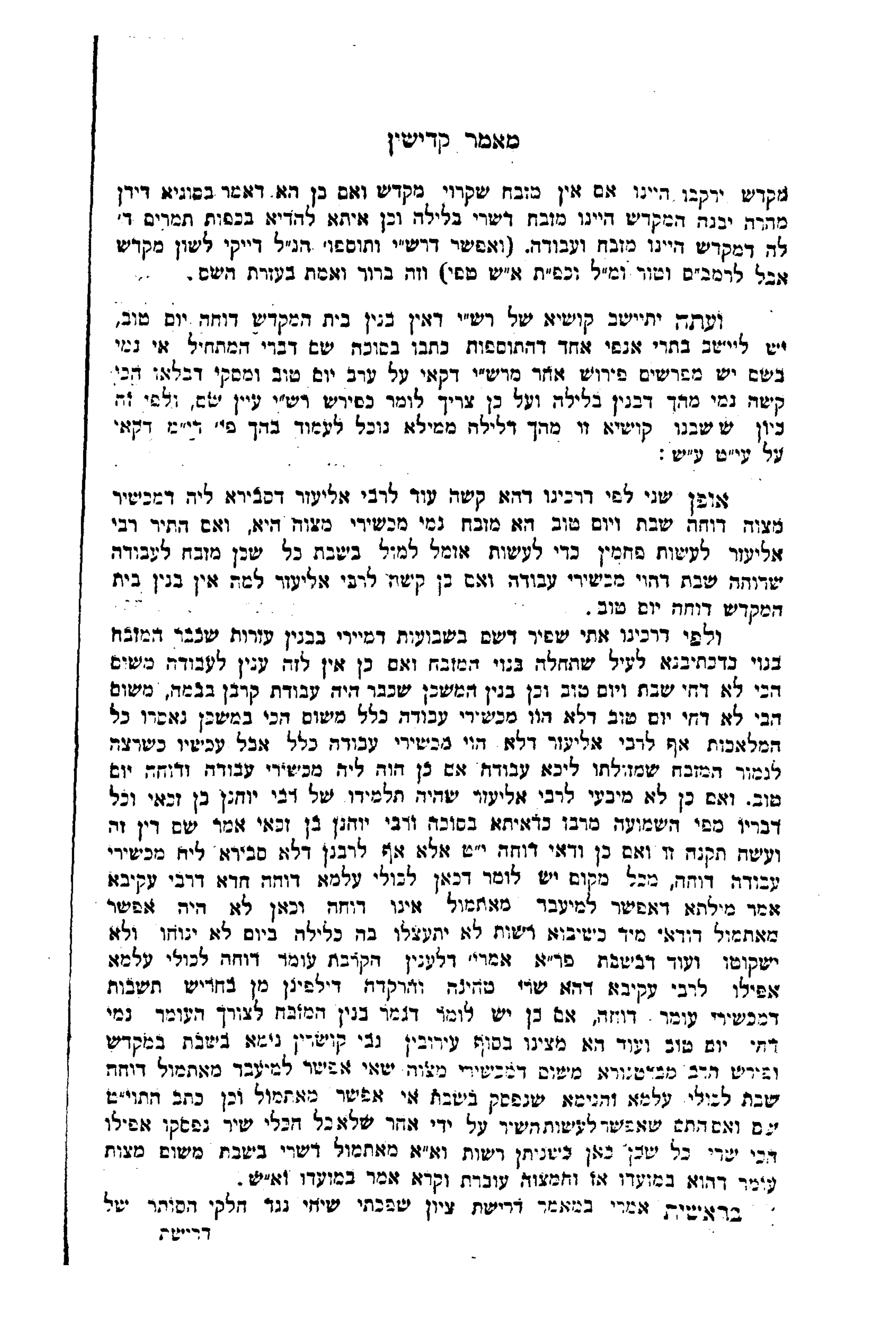
Essay on Holy Things
…Sanctuary, they shall rot", means if there is no altar, which is called a Sanctuary. And if so, that which is said in our discussion, "The Sanctuary may speedily be built", means an altar, which is permitted at night. And so it is found explicitly in the Kappot Temarim, folio 35, that "Sanctuary" means the altar and the Service. (And it is possible that Rashi and Tosafot mentioned above are precise about the word "Sanctuary"; but according to Maimonides and the Tur and the Mishneh la-Melekh and the Kappot Temarim it goes better.) And this is clear and true, with Yahweh's help.
And now, to settle the difficulty of Rashi, that the building of the Temple does not override a festival, one may settle it in two ways. One: that Tosafot wrote in Sukkah there, passage beginning "Alternatively", in the name of some who explain, an explanation other than Rashi's, that it refers to the eve of the festival; and they conclude that even without this there is a difficulty also from that of building at night, and therefore one must say as Rashi explained; see there. And according to this, since we have settled this difficulty from that of night, we can of itself stand by that explanation of those who explain that it refers to the eve of the festival; see there.
A second way, according to our way: for there is a further difficulty for Rabbi Eliezer, who holds that the preparations for a commandment override the Sabbath and the festival; but the altar too is a preparation for a commandment. And if Rabbi Eliezer permitted making charcoal in order to make a knife to circumcise on the Sabbath, how much more an altar for the Service, which overrides the Sabbath, for it is a preparation for the Service. And if so, there is a difficulty for Rabbi Eliezer: why does the building of the Temple not override a festival?
And according to our way it goes well. For there in Shevuot it speaks of the building of the Courts when the altar is already built, as we wrote above, that the altar is built first; and if so, this has no bearing on the Service; therefore it does not override the Sabbath and the festival. And likewise the building of the Tabernacle, when there was already the Service of sacrifice on a high place; therefore it did not override a festival, for they were not preparations for the Service at all; therefore in the Tabernacle all the labours were forbidden even according to Rabbi Eliezer, since they were not preparations for the Service at all. But now, when one wishes to complete the altar, without which there is no Service, it is then a preparation for the Service and overrides a festival. And if so, it goes without saying for Rabbi Eliezer, who was the disciple of Rabbi Yohanan ben Zakkai, and all of whose words were from tradition received from his master, as is found in Sukkah; and Rabbi Yohanan ben Zakkai stated that law there and made that ordinance; and if so it certainly overrides a festival. But even according to the Rabbis, who do not hold that preparations for the Service override, nevertheless one may say that here it overrides according to all. First, that Rabbi Akiva said: a thing that could have been done the day before does not override; and here it could not have been done the day before, for certainly as soon as permission comes they will not be slothful in it; night as day they will not rest and not be quiet. And further, in the chapter "Rabbi Eliezer" of Shabbat we say that concerning the offering of the Omer it overrides according to all, even according to Rabbi Akiva, for grinding and sifting are permitted, as we derive from "In ploughing thou shalt rest", that the preparations of the Omer override; if so, one may say that the completion of the building of the altar for the needs of the Omer also overrides a festival. And further, we find at the end of Eruvin, concerning tying a string on the Sabbath in the Sanctuary, and the Rabbi of Bertinoro explained: because preparations for a commandment that could not have been done the day before override the Sabbath according to all, and a string that snapped on the Sabbath could not have been tied the day before; and so the Tosafot Yom Tov wrote there. And if there, where it is possible to make the music by means of another, for not all the musical instruments snapped, it is nevertheless permitted, how much more here, when permission has been given and it was not possible the day before, that it is permitted on the Sabbath on account of the commandment of the Omer, which is in its appointed time then, and the commandment would pass; and the verse says "in its appointed time"; and it goes well.
At the beginning of my words in the essay Seeking Zion I poured out my speech against the opposing parties of