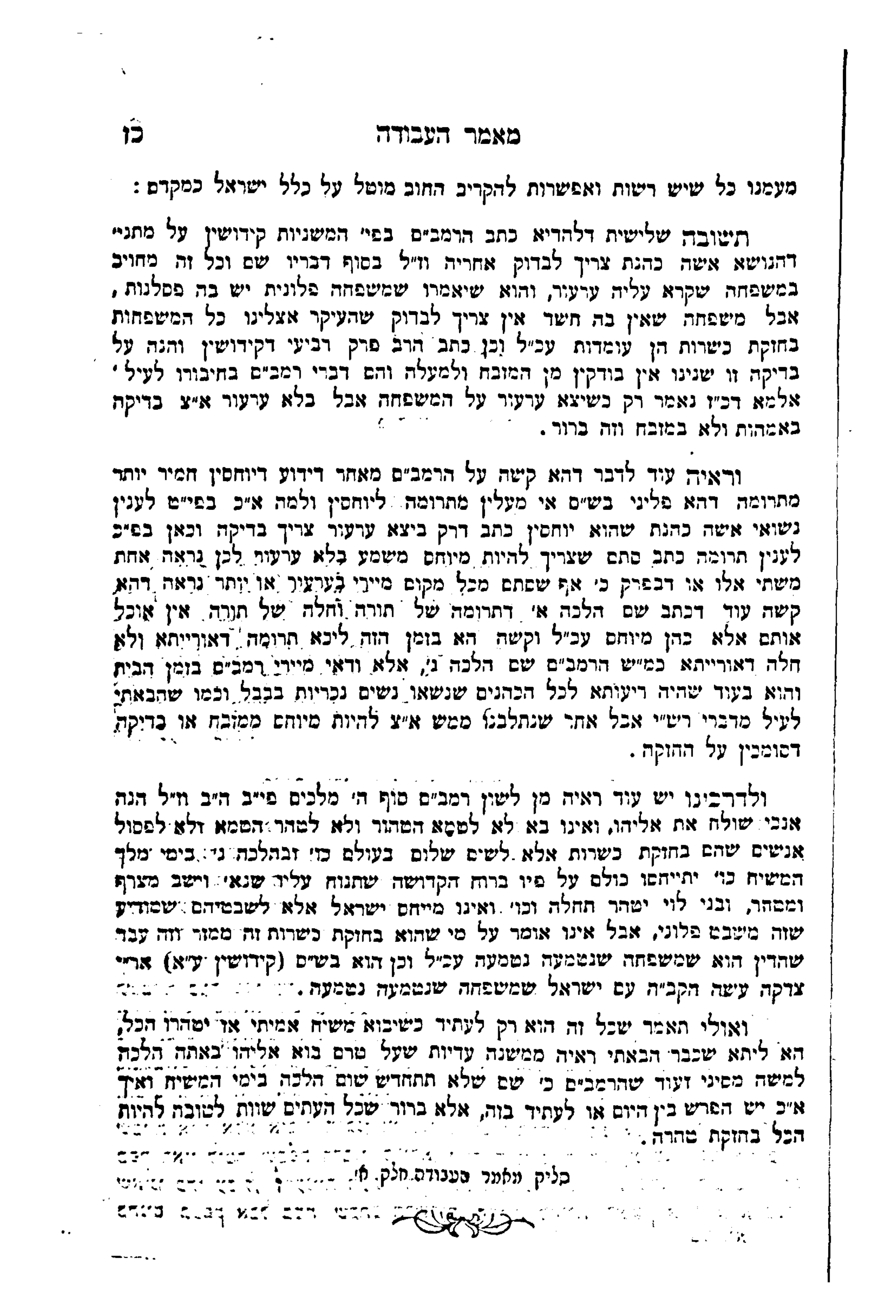
Essay on the Service 27
…from us; so long as there is permission and possibility to offer, the duty lies upon the whole of Israel as of old.
A third reply: Maimonides wrote explicitly in his Commentary on the Mishnah, Kiddushin, on the Mishnah that one who marries a woman of priestly family must examine after her, and these are his words at the end of his remarks there: "And all this is required for a family against which a challenge has been raised, that is, that people say that a certain family has disqualification in it; but a family in which there is no suspicion needs no examination, for the principle with us is that all families stand in the presumption of fitness", end of his words. And so the Rabbi wrote in the fourth chapter of Kiddushin. And behold, concerning this examination we have learned, "one does not examine from the altar upward", and these are the words of Maimonides in his Code mentioned above; hence all this is said only when a challenge has arisen against the family, but without a challenge no examination is required, neither of the mothers nor of the altar, and this is clear.
And a further proof of the matter: for there is a difficulty with Maimonides, since it is known that lineage is more stringent than heave-offering, for they dispute in the Talmud whether one may raise from heave-offering to lineage; why then, in chapter 19, regarding the marriage of a woman of priestly family, which is a matter of lineage, did he write that only where a challenge has arisen is examination required, while here in chapter 20, regarding heave-offering, he wrote without qualification that he must be of attested lineage, implying even without a challenge? Therefore one of these two seems right: either that in chapter 20, although he wrote without qualification, he nevertheless speaks of a case of challenge; or, what seems more likely, since there is a further difficulty, that he wrote there in halakhah 1 that heave-offering of the Torah and dough-offering of the Torah are eaten only by a priest of attested lineage, end of his words; and it is difficult, for at the present time there is no heave-offering of Torah law and no dough-offering of Torah law, as Maimonides wrote there in halakhah 3: rather, Maimonides certainly speaks of the time of the Temple, while there was still a flaw in all the priests, who had married foreign wives in Babylon, as I brought above from the words of Rashi; but after they were truly refined, there is no need to be of attested lineage from the altar, or of examination, for one relies on the presumption.
And for our way there is yet another proof from the wording of Maimonides at the end of the Laws of Kings, chapter 12, halakhah 2, and these are his words: "Behold, I send Elijah", and he comes neither to declare the pure impure nor to declare the impure pure, nor to disqualify men who are in the presumption of fitness, but to make peace in the world etc. And in halakhah 3: In the days of King Messiah etc. they will all be traced in their lineage by his word, through the holy spirit that will rest upon him, as it is said, "And he shall sit as a refiner and purifier, and he shall purify the sons of Levi first" etc.; and he traces the lineage of Israel only according to their tribes, making known that this one is of such-and-such a tribe, but he does not say of one who is in the presumption of fitness, "This one is a bastard" and "This one is a slave", for the law is that a family that has been assimilated is assimilated, end of his words. And so it is in the Talmud (Kiddushin 71): Rabbi Yitzhak said, The Holy One, blessed be He, did a kindness with Israel, that a family that has been assimilated is assimilated.
And perhaps you will say that all this is only for the future, when the true Messiah comes, and then all will be purified. That is not so, for I have already brought proof from the Mishnah of Eduyot that a law given to Moses at Sinai came concerning the time before Elijah's coming; and moreover Maimonides wrote there that no halakhah will be newly made in the days of the Messiah, and how then is there a difference in this between today and the future? Rather, it is clear that all times are equal, for good, in that all are in the presumption of purity.
Here ends the Essay on the Service, Part 1.