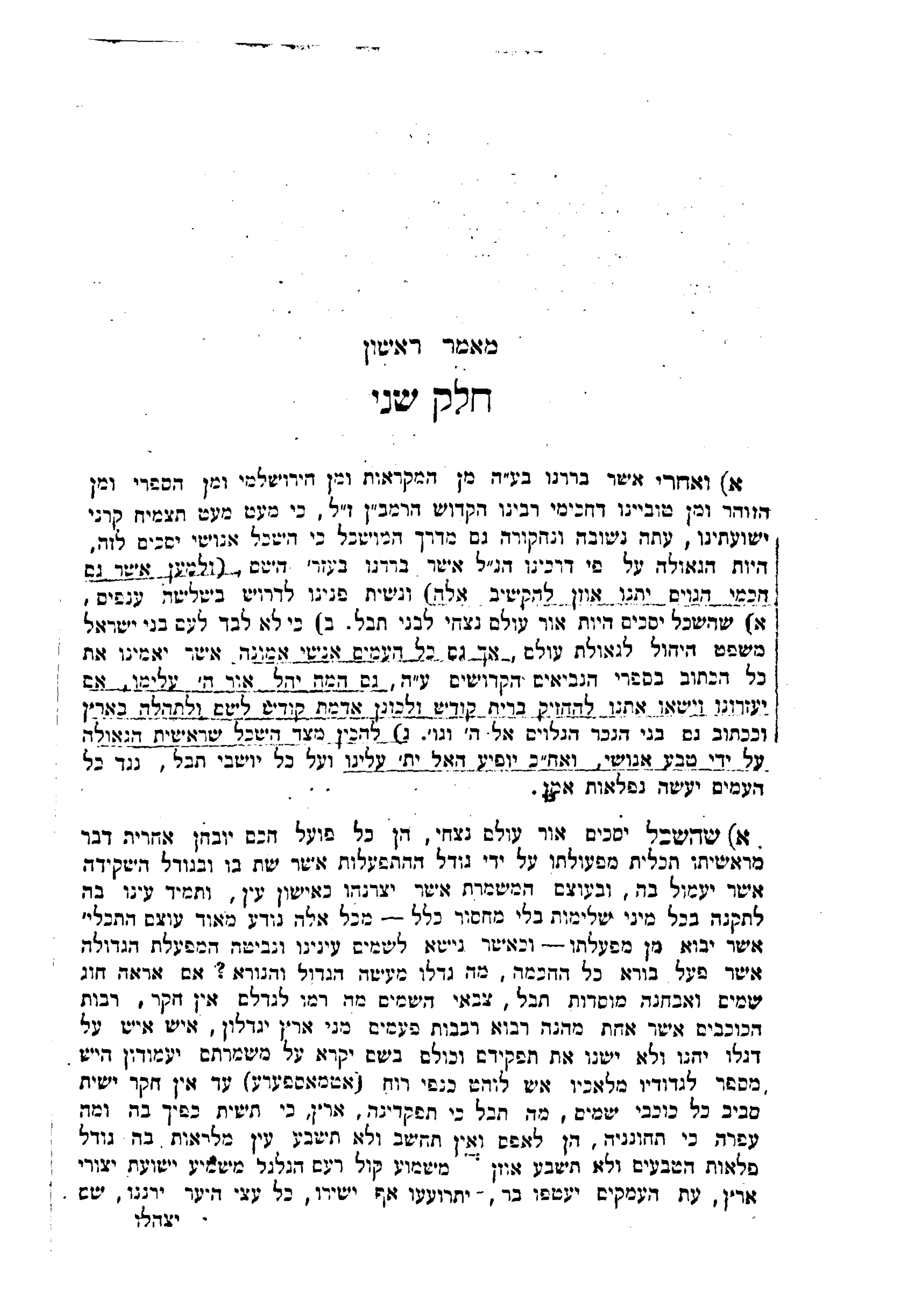
First Essay
Part Two
-
And now that we have established, with Yahweh's help, from the Scriptures and from the Jerusalem Talmud and from the Sifre and from the Zohar and from the choicest of the sages, our holy master Nahmanides of blessed memory, that little by little the horn of our salvation will sprout, let us now turn again and inquire also by the way of reason, that human reason will agree to this, that the redemption is to be according to our way mentioned above, which we have established with Yahweh's help (and so that the wise men of the nations too may give ear to hearken to these things); and we shall set our faces to expound it in three branches: 1) That reason will agree that there is to be an everlasting, eternal light for the children of the world. 2) That not only for the people of the children of Israel is there the right of hope for an everlasting redemption, but also all the peoples, men of faith who believe all that is written in the books of the holy prophets, peace be upon them, upon them too the light of Yahweh will shine, if they help us and bear the burden with us to uphold the holy covenant and to establish the holy soil for a name and for a praise in the earth; and as it is written, Also the sons of the stranger who join themselves to Yahweh, etc. 3) To establish from the side of reason that the beginning of the redemption is to be through human nature, and afterwards God, blessed be He, will appear over us and over all the inhabitants of the world; before all the peoples He will do wonders, Amen.
-
That reason will agree to an everlasting, eternal light: behold, in every wise maker the end of a thing is discerned from its beginning, the purpose of his work, by the greatness of the effort he has put into it, and by the greatness of the diligence with which he labours at it, and by the intensity of the watch with which he guards it as the apple of the eye, his eye ever upon it to perfect it in every kind of completeness without any lack at all — from all these the greatness of the purpose that will come of his work is well known — and when we lift up our eyes to heaven and look upon the great work which the Creator of all wisdom has wrought, how great are the works of the Great and Terrible One? If I look upon the circle of the heavens and examine the foundations of the world: the hosts of heaven, how lofty they are, their greatness is beyond searching; the multitudes of the stars, of which a single one is ten thousand myriads of times greater than the earth; each encamps by his own standard, and they do not change their appointed task, and He calls them all by name, and they stand at their posts. Is there any number to His troops? His messengers a flaming fire; the wings of the wind (atmosphere) without measure He sets round about all the stars of heaven. What is the world, that Thou shouldst visit it, the earth, that Thou shouldst lay Thy hands upon it, and what is its dust, that Thou shouldst favour it? Behold, it is reckoned as nothing and naught; and the eye is not satisfied with seeing in it the greatness of the wonders of nature, nor the ear satisfied with hearing the voice of the thunder of the sphere proclaiming the salvation of the creatures of the earth, when the valleys are covered with corn — they shout for joy, yes, they sing; all the trees of the forest sing for joy; there