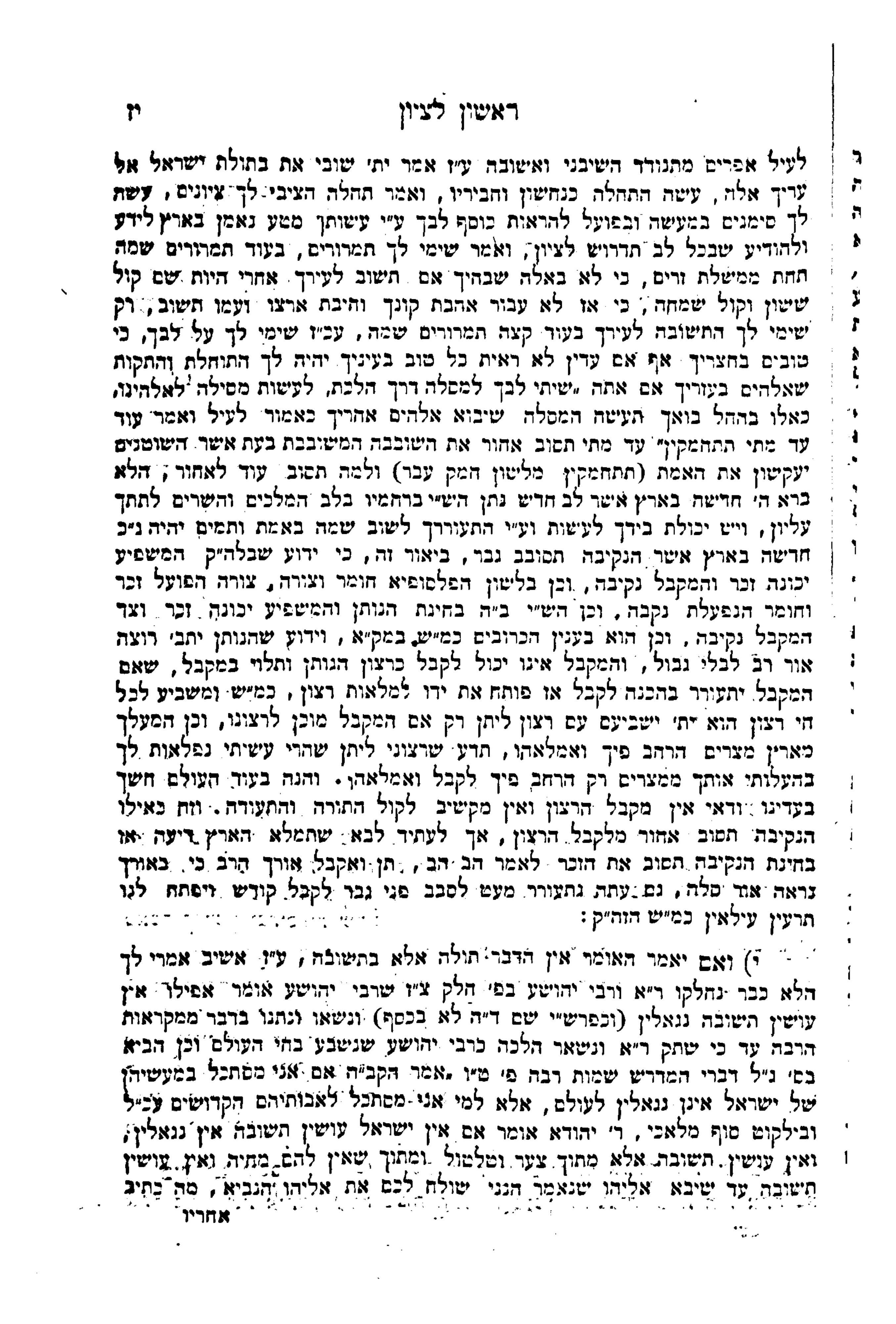
First to Zion 17
…above, "Ephraim bemoaning himself: Turn thou me, and I shall be turned"; to this He, blessed be He, said, "Return, O virgin of Israel, to these thy cities": make a beginning, like Nahshon and his companions. And He said first, "Set thee up waymarks": make for yourself signs, in deed and in action, to show the longing of your heart by planting a faithful planting in the Land, to know and to make known that with all your heart you seek Zion. And He said, "Set thee up bitter marks": while there is still bitterness there under the rule of strangers; for it is not in these that your praise lies, if you return to your city after there is the voice of joy and the voice of gladness there, for then you would not be returning for the love of your Maker and for affection for His Land and His people; rather, set yourself to return to your city while its edge is still bitterness there. On this account set it upon your heart that there are good things in your courts; even if you have not yet seen any good with your eyes, you shall have the expectation and the hope that God is your help, if you "set thy heart toward the highway, the way by which thou wentest," to make a highway for our God, as though, in beginning to come, you make the highway, so that God will come after you, as said above. And He said further, "How long wilt thou turn away": how long will you turn back, O backsliding one, turned aside, at a time when the adversaries twist the truth ("turn away" is from the expression "had turned away and was gone"), and why will you turn back still further? Has not Yahweh created a new thing in the land, in that Yahweh, blessed be He, in His mercy has put a new heart into the heart of the kings and the princes, to set you on high, and it is in your power to act? And through your awakening to return there in truth and sincerity, there will also be a new thing in the land, that the female shall compass a man. The explanation of this: it is known that in the holy tongue the one who bestows is called male and the one who receives female; and so in the language of philosophy, matter and form: form, the agent, is male, and matter, that which is acted upon, is female; and so with Yahweh, blessed be He, blessed be He: the aspect of the Giver and Bestower is called male, and the side of the receiver female; and so it is in the matter of the cherubim, as I have written elsewhere. And it is known that the Giver, blessed be He, desires abundant light without limit, and the receiver cannot receive as the Giver desires, and it depends on the receiver: for if the receiver awakens in readiness to receive, then He opens His hand to fill with goodwill, as it is written, "and satisfies every living thing with goodwill": He, blessed be He, satisfies them with a goodwill to give, only if the receiver is ready for His goodwill. And so, "who brought thee up out of the land of Egypt: open thy mouth wide, and I will fill it": know that it is My will to give, for I did wonders for you in bringing you up out of Egypt; only open your mouth wide to receive, and I will fill it. And behold, while the world is dark for us, there is surely none to receive the goodwill and none who hearkens to the voice of the Torah and the testimony; and this is as though the female turns back from receiving the goodwill. But in the time to come, when the earth shall be full of knowledge, then the aspect of the female will compass the male, saying, "Give, give": give, and I will receive Thy abundant light, for in Thy light we shall see light, Selah. Even now let us awaken a little to turn toward the face of the man, to receive holiness, and He will open for us the supernal gates, as the holy Zohar wrote.
- And if one should say that the matter depends only on repentance, to this I shall make you my reply: did not Rabbi Eliezer and Rabbi Joshua already dispute it in chapter Helek, 97, where Rabbi Joshua says that even if they do not repent they are redeemed (and as Rashi explained there, at the words "not with money")? And they debated the matter from many verses, until Rabbi Eliezer fell silent, and the halakhah remained according to Rabbi Joshua, who swore by Him that lives for ever. And so the book mentioned above brought the words of the Midrash, Exodus Rabbah, chapter 15: "The Holy One, blessed be He, said: If I look at the deeds of Israel, they will never be redeemed; but to whom do I look? To their holy fathers." Thus far its words. And in the Yalkut, at the end of Malachi: Rabbi Judah says, If Israel do not repent, they are not redeemed; and they do not repent except out of suffering and wandering, and out of having no livelihood; and they do not repent until Elijah comes, as it is said, "Behold, I send you Elijah the prophet." What is written