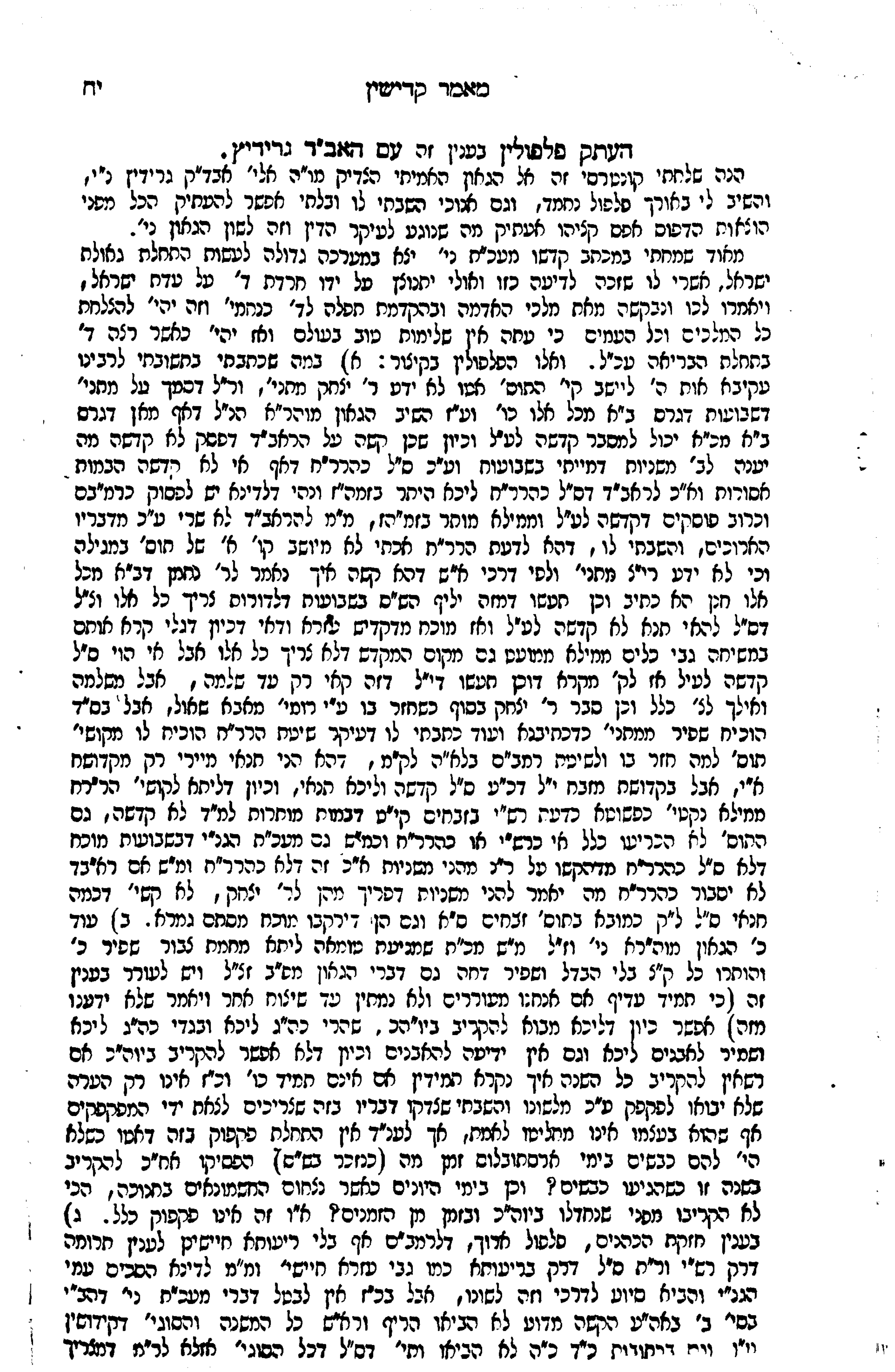
18 Essay on Holy Things
Copy of the dialectical exchanges on this matter with the head of the rabbinical court of Grätz.
Now I sent this tract of mine to the true Gaon, the righteous, our teacher Rabbi Eliyahu, head of the rabbinical court of the holy community of Grätz, may his light shine, and he answered me at length with a delightful dialectic, and I too answered him; and it is impossible to copy everything because of the costs of printing, but only a part of it shall I copy, what touches the essence of the law; and these are the words of the Gaon, may his light shine.
I rejoiced greatly at the holy letter of your honour, may his light shine, who has gone forth into a great battle-array to bring about the beginning of the redemption of Israel. Happy is he who is privileged to such a view, and perhaps through him the reverent zeal for Yahweh will be established upon the congregation of Israel, and they will say: Come, let us petition the kings of the earth, with prayer to Yahweh beforehand, as Nehemiah did; and this will be to make it manifest to all the kings and all the peoples, for now there is no perfection of good in the world, and it will not be as Yahweh willed at the beginning of creation. Thus far his words. And these are the dialectical exchanges, in brief: 1) On what I wrote in my reply to our master Rabbi Akiva, section 5, to settle the difficulty of Tosafot, "Did Rav Yitzhak then not know the Mishnah?", and it seems to me that he relied on the Mishnah of Shevuot, which reads "with one of all these" etc. And to this the Gaon, our teacher Rabbi Eliyahu mentioned above, replied that even one who reads "with one of all these" can hold that it was sanctified for the time to come; and since that is so, there is a difficulty against Rabad, who ruled that it was not sanctified: what will he answer to the two Mishnayot that are cited in Shevuot? Perforce he holds like Rabbi Hayyim, that even if it was not sanctified the high places are forbidden; and if so, according to Rabad, who holds like Rabbi Hayyim, there is no permission in the present time; and granted that in practice one must rule like Maimonides and the majority of the decisors, that it was sanctified for the time to come, and consequently it is permitted in the present time, nevertheless according to Rabad it is not permitted. Thus far from his lengthy words. And I answered him: for according to the view of Rabbi Hayyim the first difficulty of Tosafot in Megillah is still not settled: did Rav Yitzhak then not know the Mishnah? But according to my approach it is well; for there is a difficulty: how can we say, according to Rav Nahman, that "with one of all these" is what we learned, when it is written "and so shall you do", from which the Talmud in Shevuot derives that for the generations all these are required? And it seems to me that this Tanna holds that it was not sanctified for the time to come, and it is not proved from Ezra's having consecrated it; and he rejects it: since Scripture revealed "them" with anointing in the case of the vessels, it consequently excludes also the place of the Sanctuary, that not all these are required. But if he held that it was sanctified for the time to come, then there is no difficulty from the verse "and so shall you do", for one can say that this applies only until Solomon, but from Solomon onward it is not required at all; and so Rav Yitzhak held at the end, when he retracted on account of the contradiction from Abba Shaul; but at the first supposition he proved it well from the Mishnah, as I have written. And further I wrote to him that the main basis of Rabbi Hayyim's position he proved from the difficulty of Tosafot, why he retracted; and according to the position of Maimonides there is no difficulty at all even without this, for these Tannaim speak only of the sanctity of the Land of Israel, but as to the sanctity of the altar one can say that all hold that it was sanctified, and those Tannaim do not enter into it; and since the difficulty of Rabbi Hayyim falls away, we consequently take it in its plain sense, according to the view of Rashi in Zevahim 119, that the high places are permitted according to the one who says it was not sanctified. Also Tosafot did not decide at all whether like Rashi or like Rabbi Hayyim; and as your honour, the Gaon, may his light shine, also wrote, in Shevuot it is evident that it does not hold like Rabbi Hayyim, since they raised objections against Rav Nahman from these Mishnayot; if so, this is not like Rabbi Hayyim. And as for what he wrote, that if Rabad will not hold like Rabbi Hayyim, what will he say to these Mishnayot from which it objects against Rav Yitzhak: this is no difficulty, for several Tannaim hold that it was not sanctified, as is evident in Tosafot, Zevahim 61; and also what we have inferred is evident from the anonymous Talmud. 2) Further the Gaon, our teacher Rabbi Eliyahu, may his light shine, wrote, and these are his words: What your honour wrote, that the impediment of impurity does not exist on account of the community, he wrote well, and all the lesser holy things were permitted without distinction; and he rightly rejected also the words of the Gaon Moses Sofer, of blessed memory. And one may raise a point on this matter (for it is always better if we raise it, and do not wait until another comes and says that we did not know of it): perhaps, since there is no way to offer on the Day of Atonement, for there is no High Priest, and there are no garments of the High Priest, and there is no shamir for the stones, and also there is no knowledge of the stones; and since it is impossible to offer on the Day of Atonement, whether they are permitted to offer all the year: how are they called daily offerings if they are not offered continually? etc. And all this is only a note, lest they come to cast doubt. Thus far from his words. And I answered that his words are right in this, that one must satisfy those who cast doubt, even though he himself does not decide it to be true; but in my humble opinion there is not even the beginning of a doubt in this. For when they had no lambs for some time in the days of Aristobulus (as is mentioned in the Talmud), did they afterwards stop offering in that year when lambs arrived? And likewise in the days of the Greeks, when the Hasmoneans fought, at Hanukkah, did they then not offer because they had ceased on the Day of Atonement and at one time or another? God forbid! This is no doubt at all. 3) On the matter of the presumption of the priests, a long dialectic: that according to Maimonides we are concerned even without a flaw with regard to heave-offering, for only Rashi and Rabbenu Tam hold that only where there is a flaw, as in the case of Ezra, are we concerned; nevertheless in practice the Gaon, may his light shine, agreed with me and brought support for my approach; and also his words: But for all that your honour's words, may his light shine, are not to be set aside, for the Bet Yosef in section 2 of Even ha-Ezer asked why the Rif and the Rosh did not bring the whole Mishnah and the discussion of Kiddushin 76 and 18; of Ketubot 24, 25 they did not bring it; and he answered that they hold that the whole discussion follows Rabbenu Tam, who requires