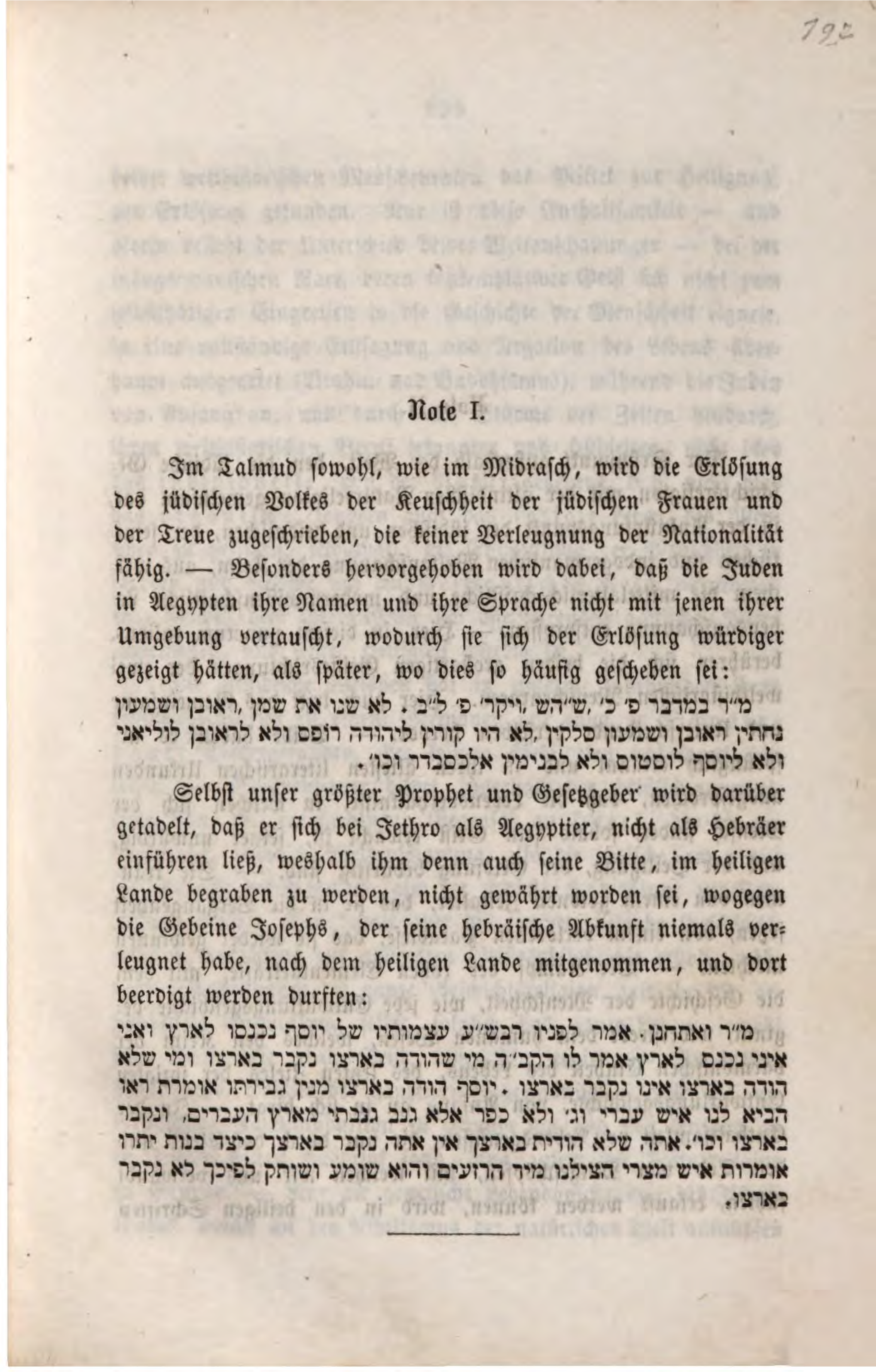
Note I.
Both in the Talmud and in the Midrash, the redemption of the Jewish people is ascribed to the chastity of the Jewish women and to that fidelity which was incapable of any denial of nationality. — It is especially emphasised in this connection that the Jews in Egypt did not exchange their names and their language for those of their surroundings, whereby they had shown themselves more worthy of redemption than in later times, when this so frequently happened:
מ"ר במדבר פ' כ', ש"הש, ויקר' פ' ל"ב . לא שנו את שמן, ראובן ושמעון נחתין ראובן ושמעון סלקין, לא היו קורין ליהודה רופס ולא לראובן לוליאני ולא ליוסף לוסטוס ולא לבנימין אלכסנדר וכו'.
[Translated from the Hebrew: "Midrash Rabbah, Numbers, section 20; Song of Songs; Leviticus, section 32. They did not change their names: Reuben and Simeon went down, Reuben and Simeon came up; they did not call Judah Rufus, nor Reuben Lulianus, nor Joseph Justus, nor Benjamin Alexander, &c."]
Even our greatest prophet and lawgiver is blamed for having suffered himself to be introduced to Jethro as an Egyptian, not as a Hebrew, for which reason, too, his prayer to be buried in the Holy Land was not granted him; whereas the bones of Joseph, who had never denied his Hebrew descent, were permitted to be carried along to the Holy Land and buried there:
מ"ר ואתחנן. אמר לפניו רבש"ע עצמותיו של יוסף נכנסו לארץ ואני איני נכנס לארץ אמר לו הקב"ה מי שהודה בארצו נקבר בארצו ומי שלא הודה בארצו אינו נקבר בארצו . יוסף הודה בארצו מנין גבירתו אומרת ראו הביא לנו איש עברי וג' ולא כפר אלא גנב גנבתי מארץ העברים, ונקבר בארצו וכו'. אתה שלא הודית בארצך אין אתה נקבר בארצך כיצד בנות יתרו אומרות איש מצרי הצילנו מיד הרועים והוא שומע ושותק לפיכך לא נקבר בארצו.
[Translated from the Hebrew: "Midrash Rabbah, Va-ethchanan. He said before Him: Lord of the Universe, the bones of Joseph entered into the land, and I enter not into the land? The Holy One, blessed be He, said unto him: He who acknowledged his land is buried in his land, and he who acknowledged not his land is not buried in his land. Joseph acknowledged his land. Whence is this known? His mistress saith, 'See, he hath brought in an Hebrew unto us,' &c., and he denied it not, but said, 'For indeed I was stolen away out of the land of the Hebrews'; and he was buried in his land, &c. Thou, who didst not acknowledge thy land, shalt not be buried in thy land. How so? The daughters of Jethro say, 'An Egyptian delivered us out of the hand of the shepherds,' and he heard and held his peace; therefore he was not buried in his land."]