The Maccabaean
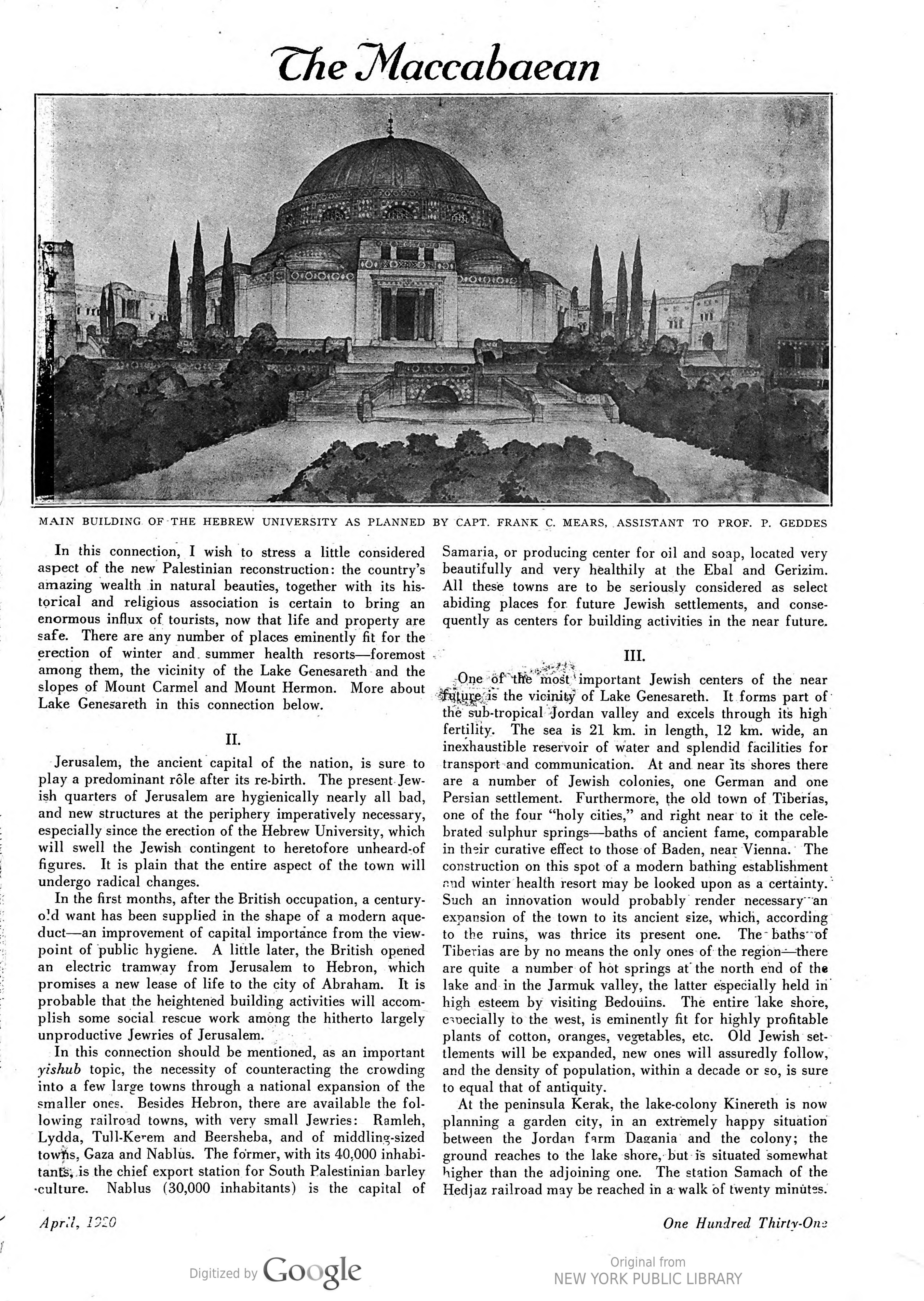
MAIN BUILDING OF THE HEBREW UNIVERSITY AS PLANNED BY CAPT. FRANK C. MEARS, ASSISTANT TO PROF. P. GEDDES
In this connection, I wish to stress a little considered aspect of the new Palestinian reconstruction: the country's amazing wealth in natural beauties, together with its historical and religious association is certain to bring an enormous influx of tourists, now that life and property are safe. There are any number of places eminently fit for the erection of winter and summer health resorts—foremost among them, the vicinity of the Lake Genesareth and the slopes of Mount Carmel and Mount Hermon. More about Lake Genesareth in this connection below.
II.
Jerusalem, the ancient capital of the nation, is sure to play a predominant rôle after its rebirth. The present Jewish quarters of Jerusalem are hygienically nearly all bad, and new structures at the periphery imperatively necessary, especially since the erection of the Hebrew University, which will swell the Jewish contingent to heretofore unheard-of figures. It is plain that the entire aspect of the town will undergo radical changes.
In the first months, after the British occupation, a century-o'd want has been supplied in the shape of a modern aqueduct —an improvement of capital importance from the viewpoint of public hygiene. A little later, the British opened an electric tramway from Jerusalem to Hebron, which promises a new lease of life to the city of Abraham. It is probable that the heightened building activities will accomplish some social rescue work among the hitherto largely unproductive Jewries of Jerusalem.
In this connection should be mentioned, as an important yishub topic, the necessity of counteracting the crowding into a few large towns through a national expansion of the smaller ones. Besides Hebron, there are available the following railroad towns, with very small Jewries: Ramleh, Lydda, Tull-Kerem and Beersheba, and of middling-sized towns, Gaza and Nablus. The former, with its 40,000 inhabitants, is the chief export station for South Palestinian barley culture. Nablus (30,000 inhabitants) is the capital of
Samaria, or producing center for oil and soap, located very beautifully and very healthily at the Ebal and Gerizim. All these towns are to be seriously considered as select abiding places for future Jewish settlements, and consequently as centers for building activities in the near future.
III.
One of the most important Jewish centers of the near future is the vicinity of Lake Genesareth. It forms part of the sub-tropical Jordan valley and excels through its high fertility. The sea is 21 km. in length, 12 km. wide, an inexhaustible reservoir of water and splendid facilities for transport and communication. At and near its shores there are a number of Jewish colonies, one German and one Persian settlement. Furthermore, the old town of Tiberias, one of the four "holy cities," and right near to it the celebrated sulphur springs—baths of ancient fame, comparable in their curative effect to those of Baden, near Vienna. The construction on this spot of a modern bathing establishment and winter health resort may be looked upon as a certainty. Such an innovation would probably render necessary an expansion of the town to its ancient size, which, according to the ruins, was thrice its present one. The baths of Tiberias are by no means the only ones of the region—there are quite a number of hot springs at the north end of the lake and in the Jarmuk valley, the latter especially held in high esteem by visiting Bedouins. The entire lake shore, especially to the west, is eminently fit for highly profitable plants of cotton, oranges, vegetables, etc. Old Jewish settlements will be expanded, new ones will assuredly follow, and the density of population, within a decade or so, is sure to equal that of antiquity.
At the peninsula Kerak, the lake-colony Kinereth is now planning a garden city, in an extremely happy situation between the Jordan farm Dagania and the colony; the ground reaches to the lake shore, but is situated somewhat higher than the adjoining one. The station Samach of the Hedjaz railroad may be reached in a walk of twenty minutes.