The Maccabaean
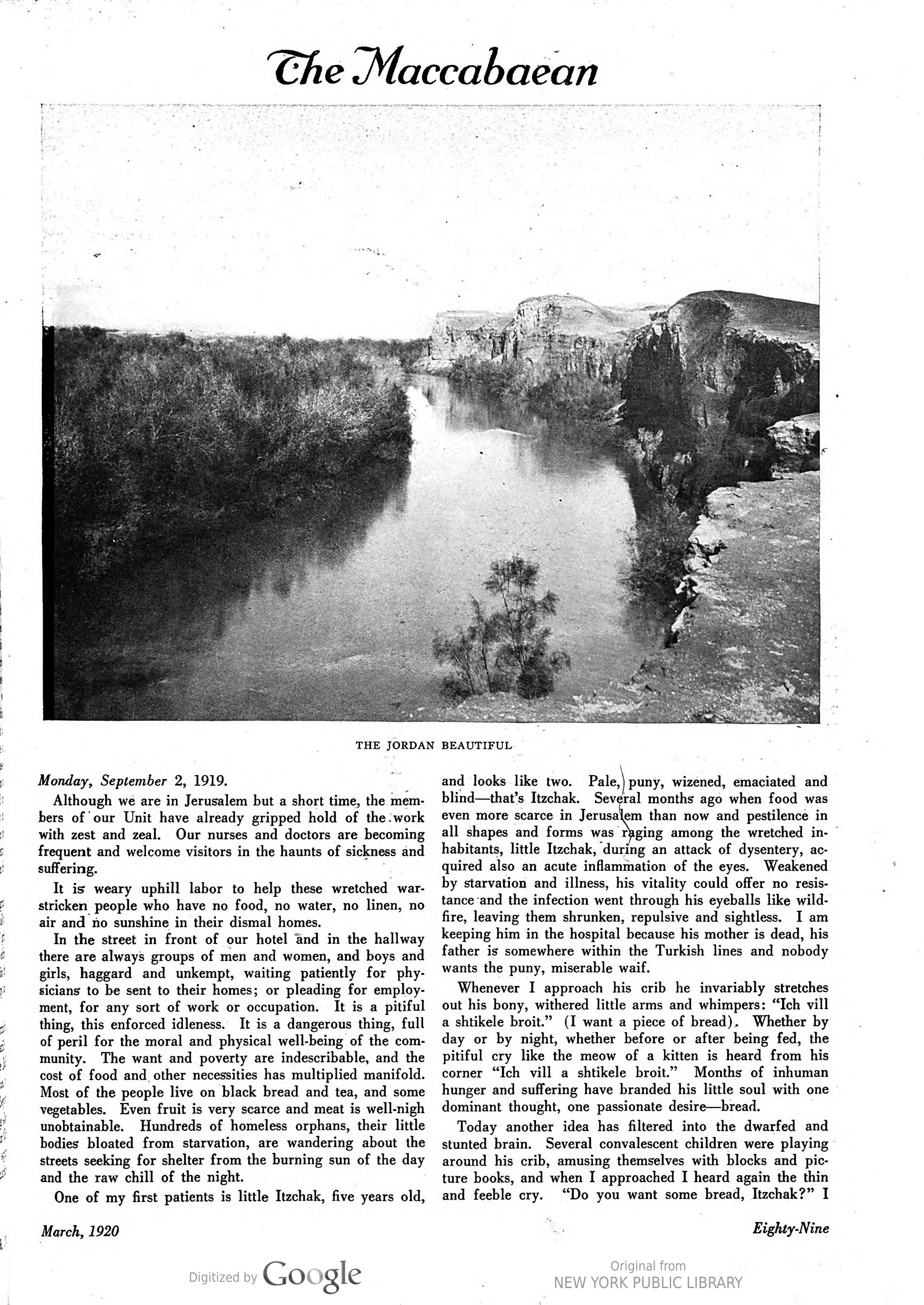
THE JORDAN BEAUTIFUL
Monday, September 2, 1919.
Although we are in Jerusalem but a short time, the members of our Unit have already gripped hold of the work with zest and zeal. Our nurses and doctors are becoming frequent and welcome visitors in the haunts of sickness and suffering.
It is weary uphill labor to help these wretched warstricken people who have no food, no water, no linen, no air and no sunshine in their dismal homes.
In the street in front of our hotel and in the hallway there are always groups of men and women, and boys and girls, haggard and unkempt, waiting patiently for physicians to be sent to their homes; or pleading for employment, for any sort of work or occupation. It is a pitiful thing, this enforced idleness. It is a dangerous thing, full of peril for the moral and physical well-being of the community. The want and poverty are indescribable, and the cost of food and other necessities has multiplied manifold. Most of the people live on black bread and tea, and some vegetables. Even fruit is very scarce and meat is well-night unobtainable. Hundreds of homeless orphans, their little bodies bloated from starvation, are wandering about the streets seeking for shelter from the burning sun of the day and the raw chill of the night.
One of my first patients is little Itzchak, five years old,
and looks like two. Pale, puny, wizened, emaciated and blind—that's Itzchak. Several months ago when food was even more scarce in Jerusalem than now and pestilence in all shapes and forms was raging among the wretched inhabitants, little Itzchak, during an attack of dysentery, acquired also an acute inflammation of the eyes. Weakened by starvation and illness, his vitality could offer no resistance and the infection went through his eyeballs like wild-fire, leaving them shrunken, repulsive and sightless. I am keeping him in the hospital because his mother is dead, his father is somewhere within the Turkish lines and nobody wants the puny, miserable waif.
Whenever I approach his crib he invariably stretches out his bony, withered little arms and whimpers: “Ich vill a shtikele broit.” (I want a piece of bread). Whether by day or by night, whether before or after being fed, the pitiful cry like the meow of a kitten is heard from his corner “Ich vill a shtikele broit.” Months of inhuman hunger and suffering have branded his little soul with one dominant thought, one passionate desire—bread.
Today another idea has filtered into the dwarfed and stunted brain. Several convalescent children were playing around his crib, amusing themselves with blocks and picture books, and when I approached I heard again the thin and feeble cry. "Do you want some bread, Itzchak?" I