The Maccabaean
offering new occupations and employments and creating vast new openings. The re-establishment of the Jewish nationality would mean all this not only to the Jews but to the whole civilized world. Why should this movement not be helped?
PARALLEL ESTABLISHED BETWEEN JEWS AND OTHER STRIVING NATIONS
Greeks, Poles, Italians, and more recently Roumanians, Serbs, Bulgarians and Armenians, have they not each and all of them found ardent sympathy and efficient help in their endeavors to regain their nationality? And yet none of them had as much right to our interest as the Jews, none of them had passed through so many humiliating persecutions, so much cruel injustice from the whole world, principally at the hands of Christendom.
Reasons For Helping THE JEWISH NATIONALISTIC ENDEAVORS
And where will one find a nationality more real, more living, more absolute, more powerful, more wonderful? Professor Carl Vogt said: "Of all classes of men and among all nations the Jews accommodate themselves most quickly to changes in all external conditions of existence."
The scholarly Dr. Neubauer certifies that anthropologists generally recognize that the Jewish race has been preserved from admixture. Dr. Andrée calls it the only pure race in Europe.1
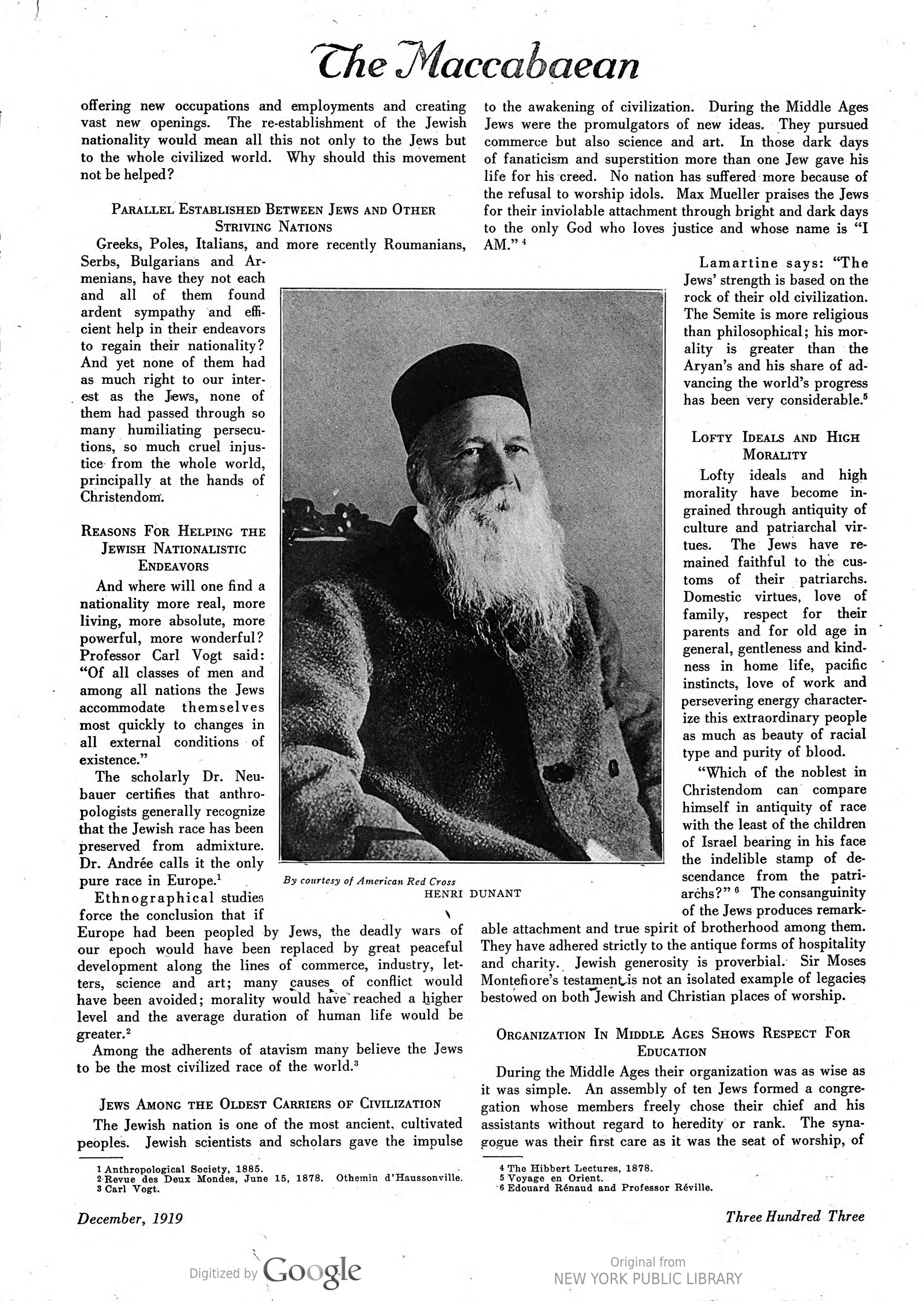
Ethnographical studies HENRI force the conclusion that if Europe had been peopled by Jews, the deadly wars of our epoch would have been replaced by great peaceful development along the lines of commerce, industry, letters, science and art; many causes of conflict would have been avoided; morality would have reached a higher level and the average duration of human life would be greater.2
Among the adherents of atavism many believe the Jews to be the most civilized race of the world.3
JEWS AMONG THE OLDEST CARRIERS OF CIVILIZATION
The Jewish nation is one of the most ancient, cultivated peoples. Jewish scientists and scholars gave the impulse
1 Anthropological Society, 1885.
2 Revue des Deux Mondes, June 15, 1878. Othemin d'Haussonville.
3 Carl Vogt.
to the awakening of civilization. During the Middle Ages Jews were the promulgators of new ideas. They pursued commerce but also science and art. In those dark days of fanaticism and superstition more than one Jew gave his life for his creed. No nation has suffered more because of the refusal to worship idols. Max Mueller praises the Jews for their inviolable attachment through bright and dark days to the only God who loves justice and whose name is "I AM."4
Lamartine says: "The Jews' strength is based on the rock of their old civilization. The Semite is more religious than philosophical; his morality is greater than the Aryan's and his share of advancing the world's progress has been very considerable.5
LOFTY IDEALS AND HIGH MORALITY
Lofty ideals and high morality have become ingrained through antiquity of culture and patriarchal virtues. The Jews have remained faithful to the customs of their patriarchs. Domestic virtues, love of family, respect for their parents and for old age in general, gentleness and kindness in home life, pacific instincts, love of work and persevering energy characterize this extraordinary people as much as beauty of racial type and purity of blood.
"Which of the noblest in Christendom can compare himself in antiquity of race with the least of the children of Israel bearing in his face the indelible stamp of descendance from the patriarchs?" 6 The consanguinity of the Jews produces remark-
able attachment and true spirit of brotherhood among them. They have adhered strictly to the antique forms of hospitality and charity. Jewish generosity is proverbial. Sir Moses Montefiore’s testament is not an isolated example of legacies bestowed on both Jewish and Christian places of worship.
Organization In Middle Ages Shows Respect For Education
During the Middle Ages their organization was as wise as it was simple. An assembly of ten Jews formed a congregation whose members freely chose their chief and his assistants without regard to heredity or rank. The synagogue was their first care as it was the seat of worship, of
4 The Hibbert Lectures, 1878.
5 Voyage en Orient.
6 Edouard Rénaud and Professor Réville.