The Maccabaean
men, names of men who changed their minds. Once in a while someone would succeed in extracting a statement from an officer. Then he would be told that if he waived his claim to repatriation two things would happen. He would have to remain in the service no one knows how long after the repatriable ones had left. If he is locally released but does not find employment and decides to return, the government would not provide the passage. Thus, instead of "encouraging and assisting men to find occupation on the land for which they had fought" the would-be settlers were to be penalized. Most of the men were in no mood under prevailing conditions, to put up with the army longer than possible. The likelihood of being stranded and becoming a public charge loomed ominously before the ultra-practical American Jew.
The situation is slightly altered at the time of this writing. Today the position is that “Any American Jew serving in the Jewish battalions may with the approval of the military authorities be locally demobilized in Palestine, as a special case on the understanding that he forfeits all claims to repatriation at government approval.” This ruling may have come about as a result of Captain Ormsby-Gore’s pertinent parliamentary questions in the House of Commons (August 19). But more likely as one of the fruits of Justice Brandeis’ successful intervention in England on his return from Palestine. For almost simultaneously came the even more bracing news of the cable from the Foreign Office to the local Administration directing their attention to the Declaration and directing them to look upon the Jewish National Homeland in Palestine as a fait accompli. But the position was altered too late. It became so after the great majority had already applied to be repatriated. It came after several drafts of the repatriable ones were on the hich seas.
The attitude of the American Zionists toward these returning soldiers should be the same of any grateful people towards those of its sons who had done their bit. Let us remember that these are our own particular ex-service men. They have done their duty. They went, prepared to shed their blood in Palestine. If they were not equally prepared to live in the land for which they were willing to die it is not entirely their fault. It is as much the fault of our leaders who too readily agreed to all grand plans for the ultimate settlement of these men. It is the fault of the Zionist body that they believed it could be seen through without their voting and raising the wherewithal to see it through. It is the fault of that vociferous organization in America—The Red Mogen David—which wasted itself in shrieking its appeals and advertising its intentions. It is true that some of the difficulties which confronted our men were, for the moment, irreducible. Money alone could not improve the political conditions or alter the social fabric of the old Yishub or endow officials inclined to be unfriendly with wisdom and understanding. But as far as the bulk of our soldiers were concerned the problem was how to get work. Money was needed by the Zionist Commission to tell these men that work would be found or created for them. That money was not forthcoming.
Matthew Arnold credits a German professor with having thus summed up the English people "so much genius, so little method." In his probable Anglophobia that clever professor overlooked another people to which that epithet could be aptly applied. And by a peculiar combination of circumstances characteristic of British bungling—which succeeds in the end—was wedded to equally characteristic Jewish lack of foresight. This has driven roughly a thousand young and sturdy Jews back to American shores.
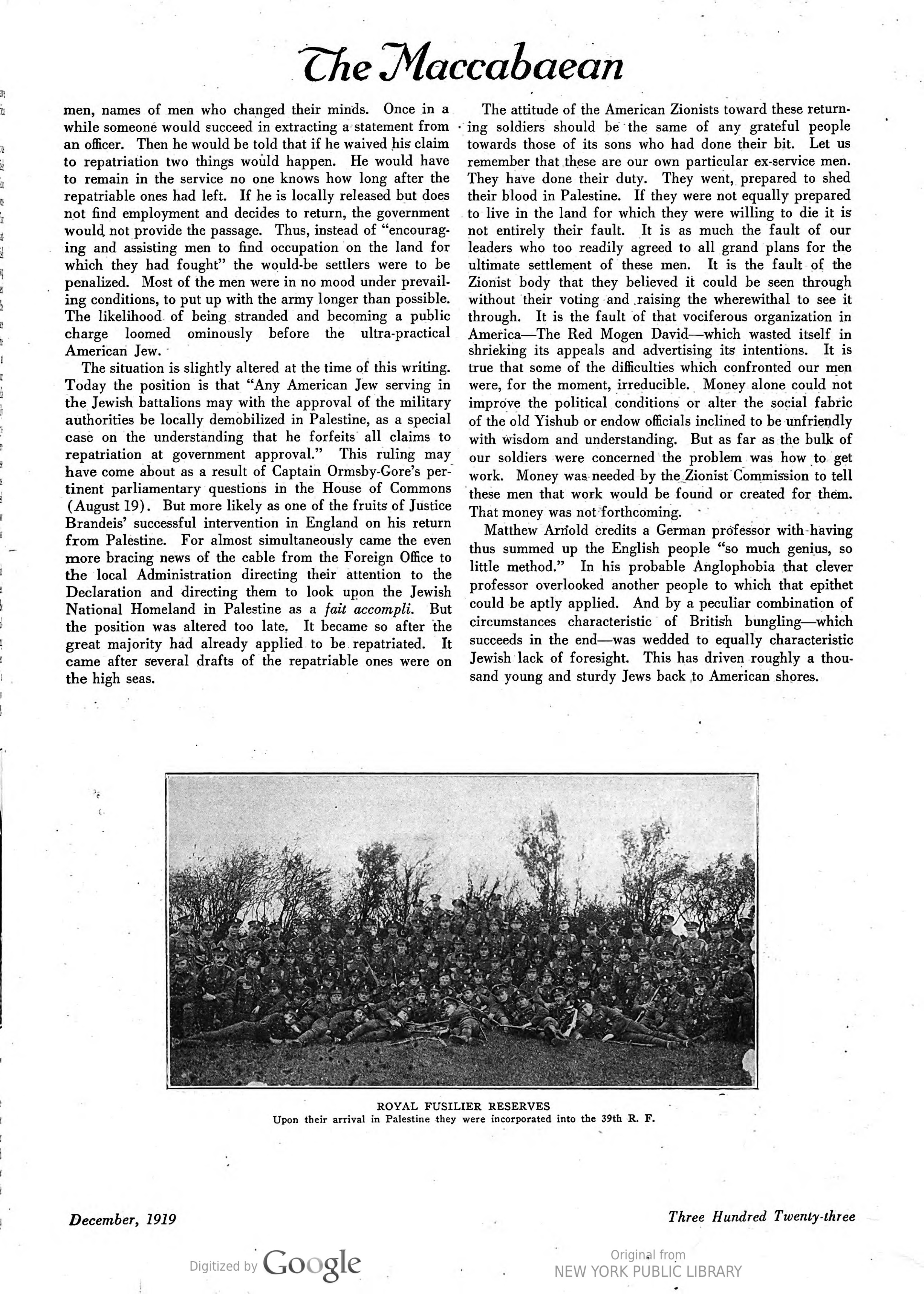
ROYAL FUSILIER RESERVESUpon their arrival in Palestine they were incorporated into the 39th R. F.