The Maccabaean
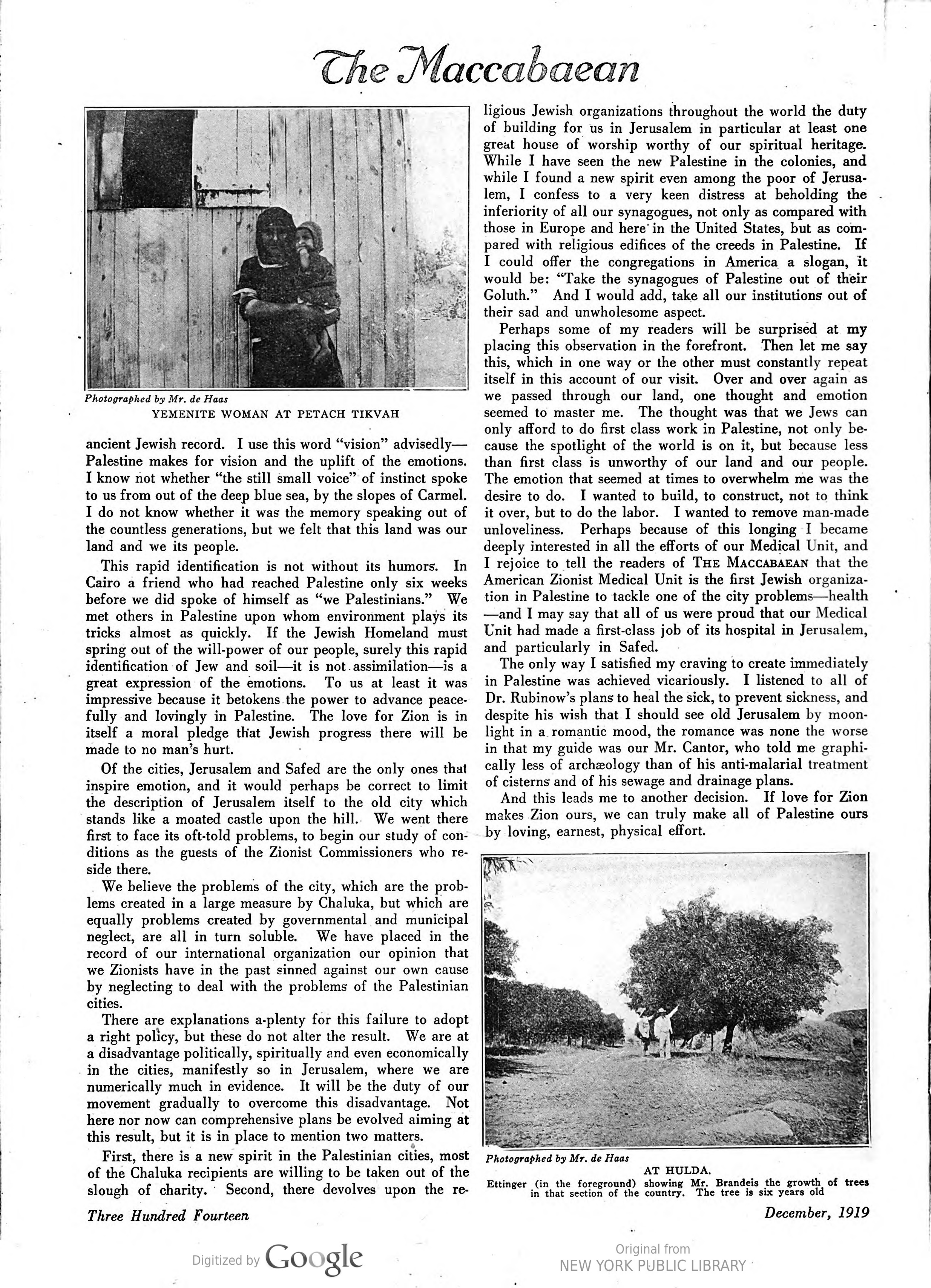
Photographed by Mr. de Haas
YEMENITE WOMAN AT PETACH TUKVAHH
ancient Jewish record. I use this word “vision” advisedly—Palestine makes for vision and the uplift of the emotions. I know not whether “the still small voice” of instinct spoke to us from out of the deep blue sea, by the slopes of Carmel. I do not know whether it was the memory speaking out of the countless generations, but we felt that this land was our land and we its people.
This rapid identification is not without its humors. In Cairo a friend who had reached Palestine only six weeks before we did spoke of himself as “we Palestinians.” We met others in Palestine upon whom environment plays its tricks almost as quickly. If the Jewish Homeland must spring out of the will-power of our people, surely this rapid identification of Jew and soil—it is not assimilation—is a great expression of the emotions. To us at least it was impressive because it betokens the power to advance peacefully and lovingly in Palestine. The love for Zion is in itself a moral pledge that Jewish progress there will be made to no man’s hurt.
Of the cities, Jerusalem and Safed are the only ones that inspire emotion, and it would perhaps be correct to limit the description of Jerusalem itself to the old city which stands like a moated castle upon the hill. We went there first to face its oft-told problems, to begin our study of conditions as the guests of the Zionist Commissioners who reside there.
We believe the problems of the city, which are the problems created in a large measure by Chaluka, but which are equally problems created by governmental and municipal neglect, are all in turn soluble. We have placed in the record of our international organization our opinion that we Zionists have in the past sinned against our own cause by neglecting to deal with the problems of the Palestinian cities.
There are explanations a-plenty for this failure to adopt a right policy, but these do not alter the result. We are at a disadvantage politically, spiritually and even economically in the cities, manifestly so in Jerusalem, where we are numerically much in evidence. It will be the duty of our movement gradually to overcome this disadvantage. Not here nor now can comprehensive plans be evolved aiming at this result, but it is in place to mention two matters.
First, there is a new spirit in the Palestinian cities, most of the Chaluka recipients are willing to be taken out of the slough of charity. Second, there devolves upon the re-
Three Hundred Fourteen
ligious Jewish organizations throughout the world the duty of building for us in Jerusalem in particular at least one great house of worship worthy of our spiritual heritage. While I have seen the new Palestine in the colonies, and while I found a new spirit even among the poor of Jerusalem, I confess to a very keen distress at beholding the inferiority of all our synagogues, not only as compared with those in Europe and here in the United States, but as compared with religious edifices of the creeds in Palestine. If I could offer the congregations in America a slogan, it would be: "Take the synagogues of Palestine out of their Goluth." And I would add, take all our institutions out of their sad and unwholesome aspect.
Perhaps some of my readers will be surprised at my placing this observation in the forefront. Then let me say this, which in one way or the other must constantly repeat itself in this account of our visit. Over and over again as we passed through our land, one thought and emotion seemed to master me. The thought was that we Jews can only afford to do first class work in Palestine, not only because the spotlight of the world is on it, but because less than first class is unworthy of our land and our people. The emotion that seemed at times to overwhelm me was the desire to do. I wanted to build, to construct, not to think it over, but to do the labor. I wanted to remove man-made unloveliness. Perhaps because of this longing I became deeply interested in all the efforts of our Medical Unit, and I rejoice to tell the readers of THE MACCABAEAN that the American Zionist Medical Unit is the first Jewish organization in Palestine to tackle one of the city problems—health—and I may say that all of us were proud that our Medical Unit had made a first-class job of its hospital in Jerusalem, and particularly in Safed.
The only way I satisfied my craving to create immediately in Palestine was achieved vicariously. I listened to all of Dr. Rubinow's plans to heal the sick, to prevent sickness, and despite his wish that I should see old Jerusalem by moonlight in a romantic mood, the romance was none the worse in that my guide was our Mr. Cantor, who told me graphically less of archæology than of his anti-malarial treatment of cisterns and of his sewage and drainage plans.
And this leads me to another decision. If love for Zion makes Zion ours, we can truly make all of Palestine ours by loving, earnest, physical effort.
Photographed by Mr. de Haas
AT HULDA.
Ettinger (in the foreground) showing Mr. Brandeis the growth of trees in that section of the country. The tree is six years old