The Maccabaean
city, a Thibetan prayer-wheel affixed on top of a community pious by proxy. The first aggressive moves of Austrian anti-Semitism in 1888 had a curious educational effect upon the Jewish school-youth of Vienna, and upon many thousands of our people beyond school-age besides. I must ask the reader to believe me in earnest and sticking to the literal truth, when I tell him that in 1888, I and my schoolmates and all the grown-up folks of my own faith I knew became first aware of the existence of a book called Shulehan Aruch through anti-Semitic newspaper accounts of its alleged wickedness. A volume representing for three centuries the norm and plumb-line of human life to millions of Jews was unknown even by name, to thousands of little boys "of the Mosaic faith"—intelligent and well-read boys, many of whom could have told you all about Erasmus and Reuchlin and Pfefferkorn but nothing about the Talmud except that it cut a big figure in the chronique scandaleuse of the early sixteenth century! Man or schoolboy, we were all Austro-Germans to the core, with a cosmopolitan range of lettered interests, and nothing human was foreign to us—except the history and literary treasures of our own race. There was method in this seeming madness of unconcern about the nearest things—the method of assimilationism.
The press supported by such a community was in its entire bearing and contents a true mirror of the educated Philistinism of its clientele. According to shrill anti-Semitic complaint, the daily press of Vienna was "verjudet." The denunciations of Schoenerer and his like heaped upon a "Judaized" press were really without foundation. True, the four biggest metropolitan dailies were partly owned and largely written by Jews. But there existed not a single daily in Vienna which prominently "featured" matters of specifically Jewish concern. In the Neue Freie Presse, reports of Jewish communal activities—a few lines at most—were printed in obscure corners of little-read inside pages. Its highest-paid and best-considered staff-contributors were Herzl and Nordau the former contributing prolifically, the latter at fitful intervals. From the Jewish schoolboys of the preceding paragraph to the future dioskurs of Zionism there seems to be a wide stretch. But in those days, Max Nordau and Theodor Herzl were the sublimated expression of that very
spirit of the Leopaldstaedter Gymnasium which discussed everything in the world of letters, from Hesiod to Laotse—except Judaica. Both Herzl and Nordau—particularly Nordau—functioned as interpreters of foreign soul-states and connoisseurs of remote literatures in the columns of the Neue Freie Presse and elsewhere. They wrote about the entire literary and artistic flora of Europe, from the cedar even unto the hyssop that springeth out of the wall—but I defy anyone to show me in all the multifarious writings of Herzl or Nordau antedating 1895 a single page of specifically Jewish interest. The name of one of his early books of travel, "From the Kreml to the Alhambra," might fitly
be chosen as the collective title of Nordau's pre-Zionist writings. He had traveled from Iceland to the Black Sea, with soul and eyes wide open. His writings previous to 1895 contain an immense and varied repertory of literary information. Yet there isn't the slightest evidence to be found in any of them that he knew of the existence of a modern literature of the Ostjuden. As the son and boyhood pupil of a Hungarian rabbi, he could not have been ignorant of its existence. He simply wasn't interested enough to give it even a passing mention in a twenty-five years' output of literary studies; in this he was flesh of the flesh and bone of the bone of assimilationist Jewish Vienna. To revert for a moment to the latter, I had better mention a circum-
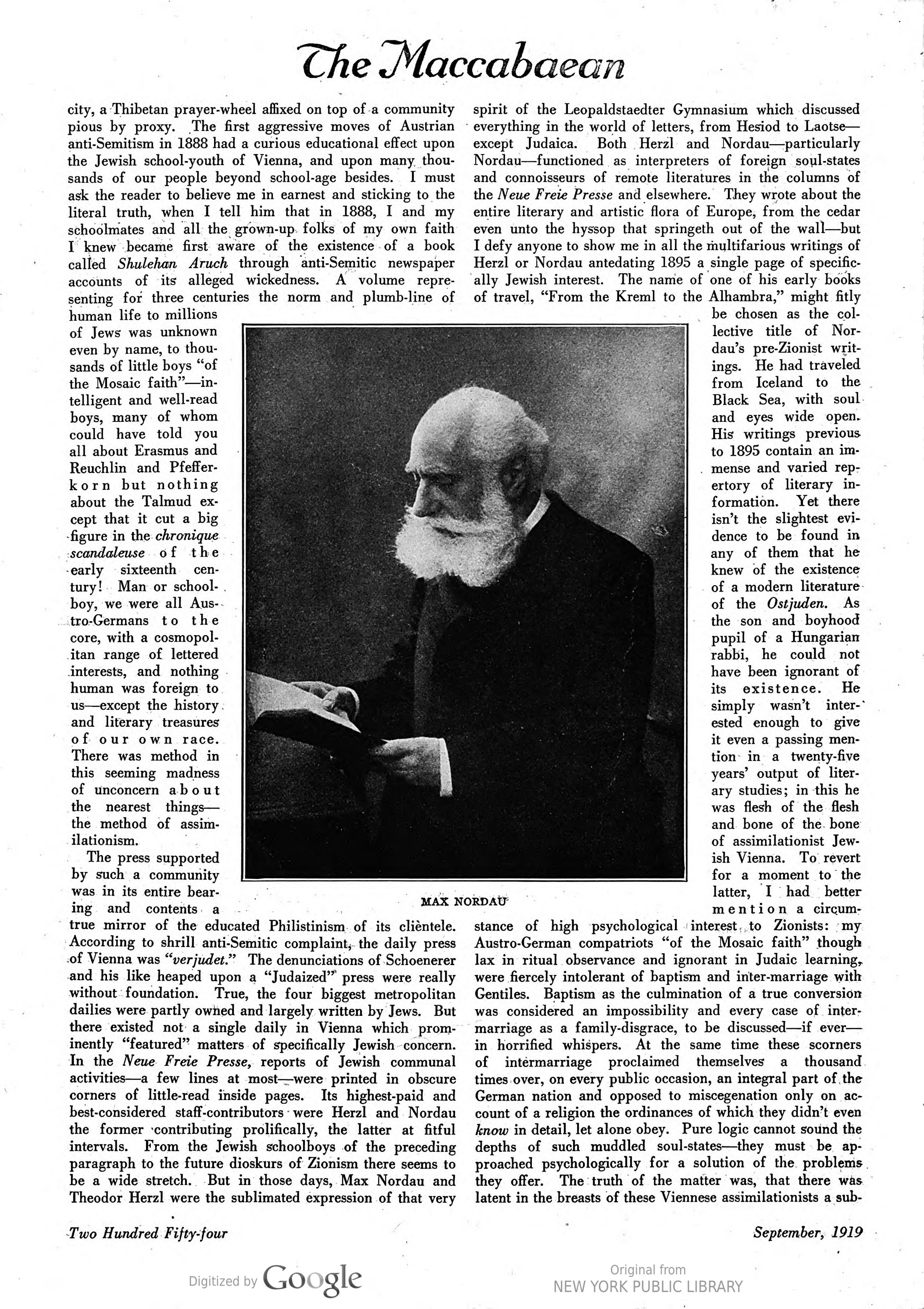
MAX NORDAU
stance of high psychological interest to Zionists: my Austro-German compatriots "of the Mosaic faith" though lax in ritual observance and ignorant in Judaic learning, were fiercely intolerant of baptism and intermarriage with Gentiles. Baptism as the culmination of a true conversion was considered an impossibility and every case of intermarriage as a family-disgrace, to be discussed—if ever—in horrified whispers. At the same time these scorners of intermarriage proclaimed themselves a thousand times over, on every public occasion, an integral part of the German nation and opposed to miscegenation only on account of a religion the ordinances of which they didn't even know in detail, let alone obey. Pure logic cannot sound the depths of such muddled soul-states—they must be approached psychologically for a solution of the problems they offer. The truth of the matter was, that there was latent in the breasts of these Viennese assimilationists a sub-