The Maccabaean
great things would come out of the Experiment Station, and they would have.
azıııı BEEIT YWUUIM I1CAVO. Aaronsohn made a trip up the Nile for the Office of Foreign Seed and Plant Introduction, and some of the palms which he secured at that time are now growing in the Salt River Valley. The most important one, the Sultany, came from Nubia, and is one of the most noted date varieties of Upper Egypt. This and the information which he secured with regard to the cultivation of the date palm on the sand dune region of Lower Egypt have contributed materially to the development of the date palm industrv in America.
But after all, perhaps that which will remain longest in the minds of those here in Washington who knew Aaronsohn will be his penetrating, analytical remarks with regard to the theories and conditions which were being discussed at the time of his visits here. On his first trip, I remember, after he had returned from the Pacific Coast, he remarked: "The men in Europe look for their romance in love affairs.
In America they find it in their work." Of Bolshevism he once explained to me his belief that it was a faith, not a theory, and that the effect on the individual was of the nature of a dissolving rather than a keying up process—it let things down, loosened them, instead of tightening them up. He was never a convert to the accepted theory of deforestation as explaining the drying up of the streams of central Asia, for he believed that slight shiftings of geological strata were one of the commonest causes for the drying up of springs and small waterways.
er Area u Fl“ ln > anna ren rn aan Sa da nr De et ae Aaronsohn was a positive and dynamic force :which: the world at this time can ill afford to lose. "Abstract science might never again have felt his push, and what he did in the field of politics will always overshadow what he accomplished in the field of science, in the popular mind; but, even so, the fact should be recorded that first and foremost he was a scientific man and made discoveries which entitle him to hieh honors in the field of agricultural science.
The Wild Wheat of Palestine
By O. F. COOK
Bionomist, United States Department of Agriculture
IN the world of botanical science Aaronsohn’s discovery of the wild wheat plant probably will be reckoned as his most striking contribution. The origin of wheat has been a subject of outstanding botanical interest, on account of the belief of many writers that the home of man, the beginning of agriculture or the cradleland of civilization would be located if it were possible to learn where wheat grew in its original wild state. Many efforts had been made by previous investigators to trace the origin proposed, and several different plants brought forward as representing the ancestrial type of wheat. In a matter thus controverted it was to be expected that every conceivable question would be raised that might throw doubt upon the authenticity or significance of so radical a discovery as a new wild species of wheat, in a country that had been traversed by many previous explorers.
Regarding the habits of the plant and its status as a genuine, cross-fertilized, wild species, additional information was secured during a
visit with Aaronsohn to the wild wheat distriets of Northern Palestine and Mount Hermon in the summer of 1910. As stated in Bulletin 274 of the Bureau of Plant
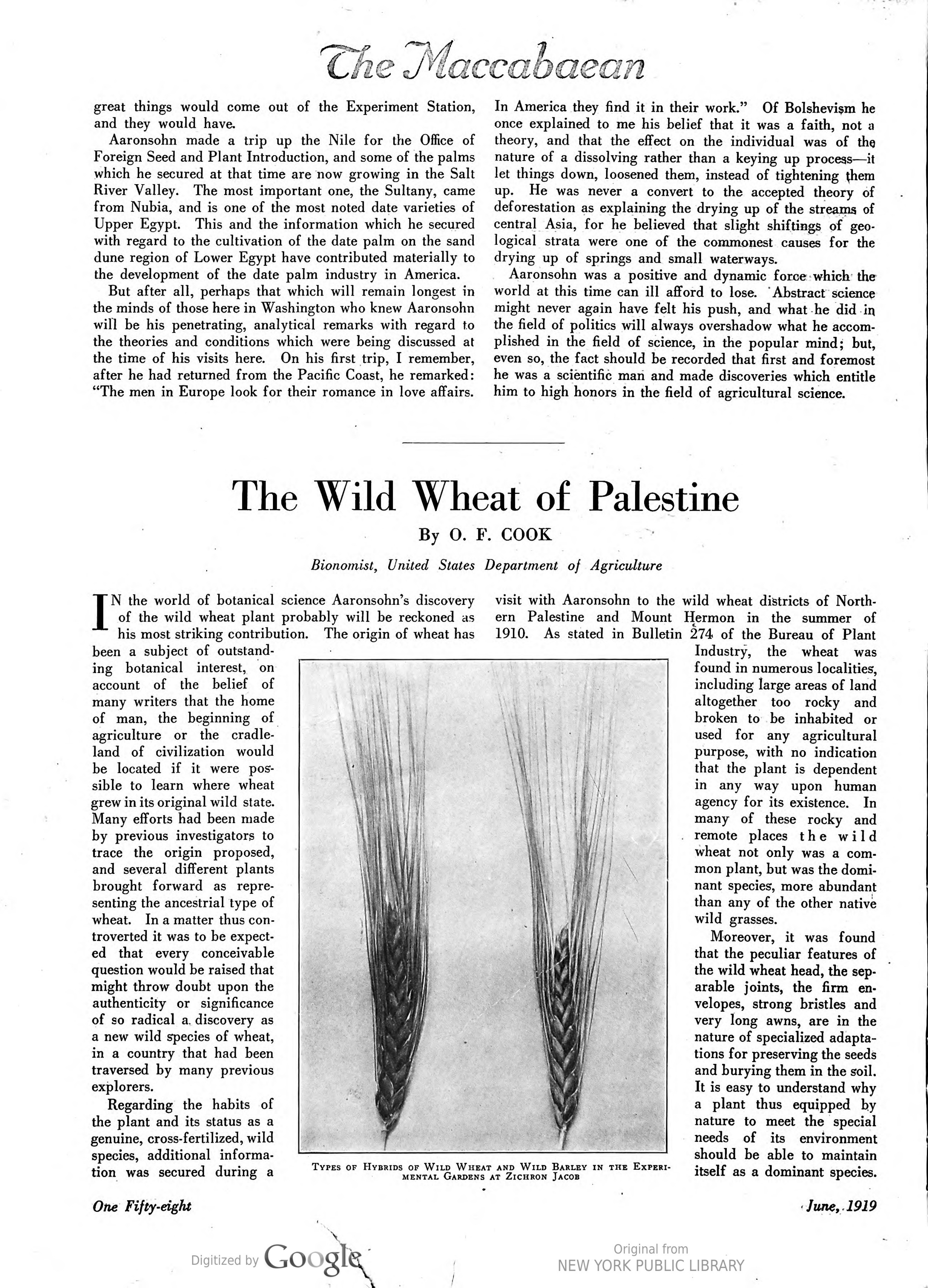
TYPES OF HYBRIDS OF WILD WHEAT AND WILD BARLEY IN THE EXPERIMENTAL GARDENS AT ZICHRON JACOB
Moreover, it was found that the peculiar features of the wild wheat head, the separable joints, the firm envelopes, strong bristles and very long awns, are in the nature of specialized adaptations for preserving the seeds and burying them in the soil. It is easy to understand why a plant thus equipped by nature to meet the special needs of its environment should be able to maintain itself as a dominant species.