Aaron Aaronsohn as an Agricultural Explorer
By DAVID FAIRCHILD
Agricultural Explorer, United States Department of Agriculture.
IN the fall of an aeroplane near Boulogne, the fog which hangs over that coast has shut from view forever a brilliant intellectual light. An intellect has gone out which was characterized by a fearless originality. This intellect, because it focussed for a period on plants, threw Aaron Aaronsohn and me into a relationship which has lasted for the past twelve years.
In August, 1906, Aaronsohn published an article on the wild wheat of Palestine. This article attracted little attention in Europe, and resulted in arousing no enthusiasm.
and enthusiastic over the agricultural possibilities of the land which he loved most—Palestine:
Within six months of his arrival in America, he acquired such a speaking knowledge of English that he addressed a Dry Farming Congress in Wyoming, a Foresters' Meeting, and a special meeting of Botanists in Washington.
His familiarity with the literature on the agriculture of California and the close parallel which his experiences in Palestine enabled him to draw between the flora of his own country and the flora of the Pacific slope were the things
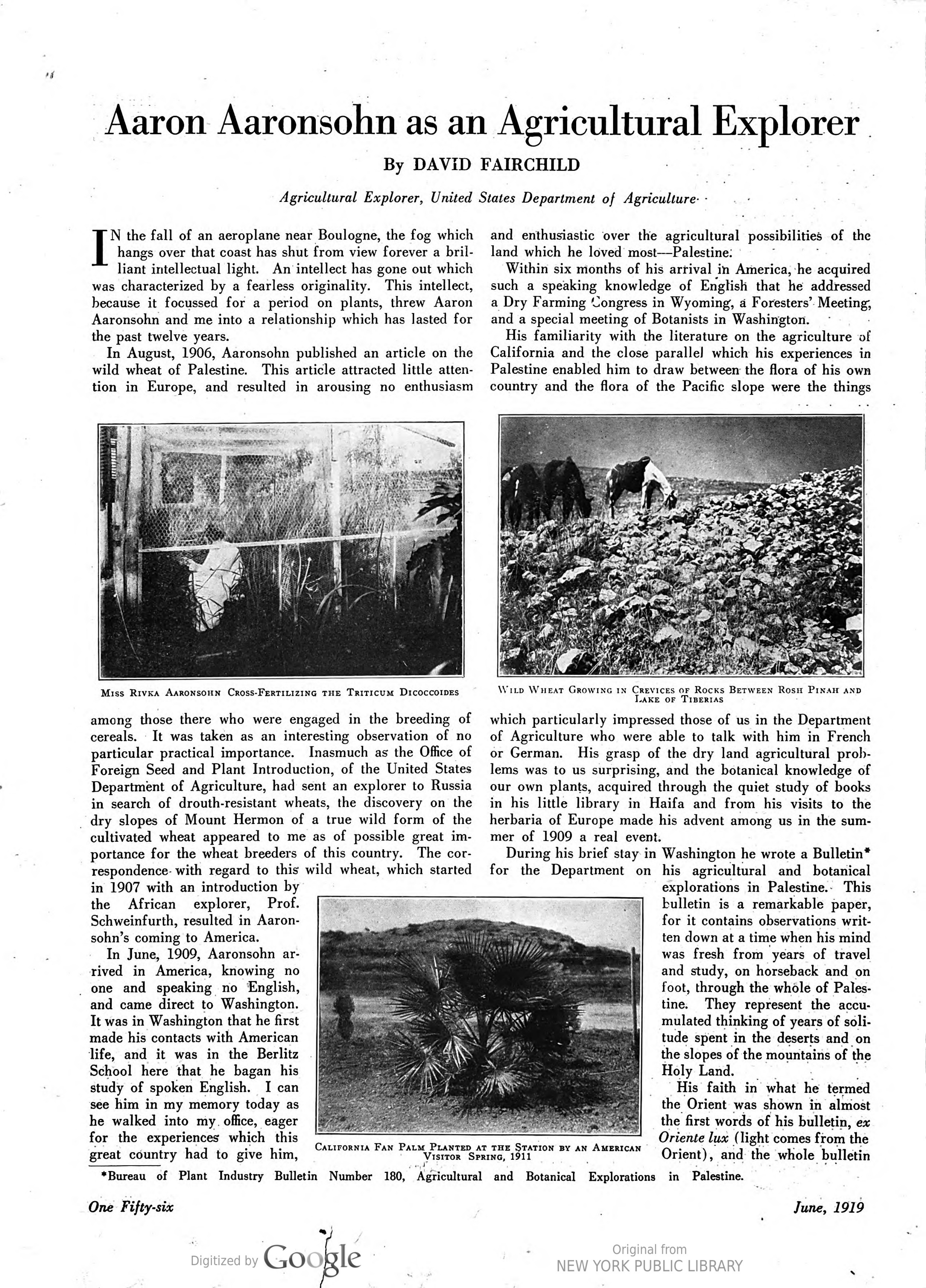
MISS RIVKA AARONSOHN CROSS-FERTILIZING THE TRITICUM DICOCCOIDES
WILD WHEAT GROWING IN CREVICES OF ROCKS BETWEEN ROSH PINAH AND LAKE OF TIBERIAS
among those there who were engaged in the breeding of cereals. It was taken as an interesting observation of no particular practical importance. Inasmuch as the Office of Foreign Seed and Plant Introduction, of the United States Department of Agriculture, had sent an explorer to Russia in search of drouth-resistant wheats, the discovery on the dry slopes of Mount Hermon of a true wild form of the cultivated wheat appeared to me as of possible great importance for the wheat breeders of this country. The correspondence with regard to this wild wheat, which started in 1907 with an introduction by the African explorer, Prof. Schweinfurth, resulted in Aaronsohn's coming to America.
In June, 1909, Aaronsohn arrived in America, knowing no one and speaking no English, and came direct to Washington. It was in Washington that he first made his contacts with American life, and it was in the Berlitz School here that he bagan his study of spoken English. I can see him in my memory today as he walked into my office, eager for the experiences which this great country had to give him,
which particularly impressed those of us in the Department of Agriculture who were able to talk with him in French or German. His grasp of the dry land agricultural problems was to us surprising, and the botanical knowledge of our own plants, acquired through the quiet study of books in his little library in Haifa and from his visits to the herbaria of Europe made his advent among us in the summer of 1909 a real event.
During his brief stay in Washington he wrote a Bulletin* for the Department on his agricultural and botanical explorations in Palestine. This bulletin is a remarkable paper, for it contains observations written down at a time when his mind was fresh from years of travel and study, on horseback and on foot, through the whole of Palestine. They represent the accumulated thinking of years of solitude spent in the deserts and on the slopes of the mountains of the Holy Land.
His faith in what he termed the Orient was shown in almost the first words of his bulletin, ex Oriente lux (light comes from the Orient), and the whole bulletin
CALIFORNIA FAN PALM PLANTED AT THE STATION BY AN AMERICAN VISITOR SPRING, 1911
*Bureau of Plant Industry Bulletin Number 180, Agricultural and Botanical Explorations in Palestine.