The Maccabaean
What Is Expected of American Zionism
By JACOB DE HAAS
Acting Chairman American Zionist Delegation to the Peace Conference
WITH prophetic insight as to what may be accomplished by the effort of a generation, Herzl in "OldNewland" assigned 1923 as the date by which Haifa is discovered as the known harbor of a prosperous politically advanced Palestine. The achievement will not be so complete as the great leader foreshadowed, but Haifa will be much in the mouth of men by 1923, if events take their natural course. Such at least is the conclusion of those who have not only been in Europe during the Peace Conference sessions, but have been able to maintain poise and equilibrium during some of the most stressful hours of world history. The end is not yet; the peace treaty has not yet been signed; moreover peace has not yet become part of normality of life; nor can the wisdom of the conclusions arrived at in Paris be seen in the true perspective of actual experiences. Seen at close range the settlement of world problems is a guess at futurity, and if the next generation finds it all wrong, posterity must remember that contemporaneous opinion was justified of its shortsightedness. For never before in human history have all the interwoven threads of time and space been gathered in a few hands so that the threads may be unravelled; and complete unravelment was impossible. And among the strands, tangled to some extent in every mesh was the Jewish strand.
The ramifications of the Diaspora is a favorite Jewish theme; but in Paris one felt the interplay of forces. Whatever theory one held it became perfectly clear that the Jewish question is neither politically nor economically, nor even spiritually an independent question. The war had reduced the world "from China to Peru" into a broken puzzle picture that had to be pieced together in some order and symmetry. Not a single piece could be thrown away —not even the small Jewish piece. That is why anti-Zionism, whatever fuss and excitement it may have raised in local Jewish circles in England, France, or America, received so little serious attention in Paris. At best it suggested that the Jewish piece be allowed to suffer from the erosion of time
and so crumble to naught. The world which sees the Jew— the individual Jew—now more in action than ever before in history, saw little aid in his attempts to precipitate positive results in this proposed policy of inaction. On the other hand the two Jewish. active forces, the Zionists and the Jewish National Rights group, had to reckon with the interplay of all forces, and the interdependence of all the factors that make up this complex world of ours.
The most dramatic moment in the Jewish history of the past two thousand years was the presentation of the Zionist cause, by the Zionists (and one anti-Zionist), on Thursday, February 27, 1919, before the Supreme Council of the Peace Conference. For centuries Jews have dreamed of just such a day in the world court, because it implied recognition, equality, and that new freedom for which the Jew yearns. The impressiveness of the moment is not lessened, but the relation of factor to factor is emphasized, when we note that the Peace Conference, sat, like the Judges of old, at the gate of the City of Peace, and heard every cause claiming a hearing. For the emphasis makes clear, what from now on all of us will have to remember, that the Jews did not emerge into isolation, but into that court where the world throng pressed most closely together. This understanding of the situation both enlarges and reduces the problem which the Zionist delegation had to think out in Paris. The enlargement was the compulsory thinking of the problem of the whole of Asia Minor. E HAAS Palestine is not an island in the distant seas. On the contrary it is part of a highway that must be trod by many feet going north and south along historic roads, and that if it prospers, as it surely will, must afford passage to great peoples coming west, or going east. This was not actually new to those who were charged with re-phrasing the Basle program into terms of concrete enterprise, except in the sense of actuality, imminence, and the necessity of making a good alignment with those other peoples who too are part of Asia Minor, and who at the same time were rightfuly claiming recognition.
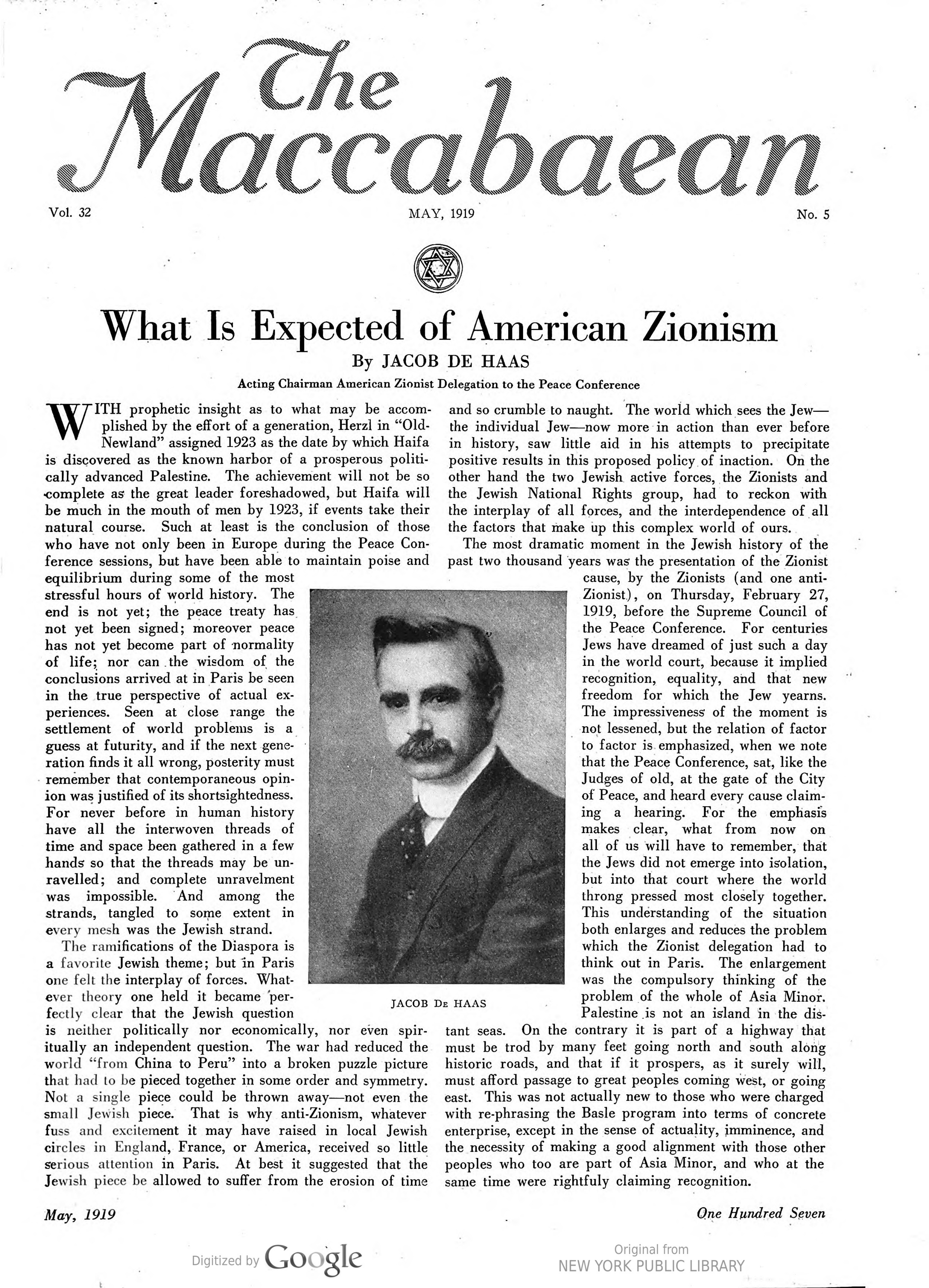
JACOB DE HAAS