A Workman's Palestinian Notebook
By JACQUES RENARD
ALL civilization\u2014with the exception, perhaps, of communistic hierarchies\u2014breed a goodly number of Sons of Ishmael, born rovers and nomads incapable of permanent domestication. Most of these gypsies are lazy and worthless, but there are stray individuals among them whose exceptional energy and daring results in valuable feats of exploration. At highest reach, this type of super-tramp is embodied in men like Walter Raleigh and Richard Burton; on a somewhat lower scale of achievement, in globe-trotting American contemporaries like Josiah Flynt and Harry Frank.
UNO DE I TEE 3 The Amsterdam “Maatschappij voor goede on goedkoope Lectuur” (Society for the Spread of Good and Inexpensive Literature) introduces us to a _ Jewish member of the Illustrious Order of Super-Tramps, a =. youth named Abraham Mossel, i A whose Palestinian travel-record ers entitled “Als Daglooner in het w Heilige Land” (“As Journey- Wr Bi man-Laborer Through the Holy TE Land”) it publishes, as an item a of a Librarv of Travels. \ N
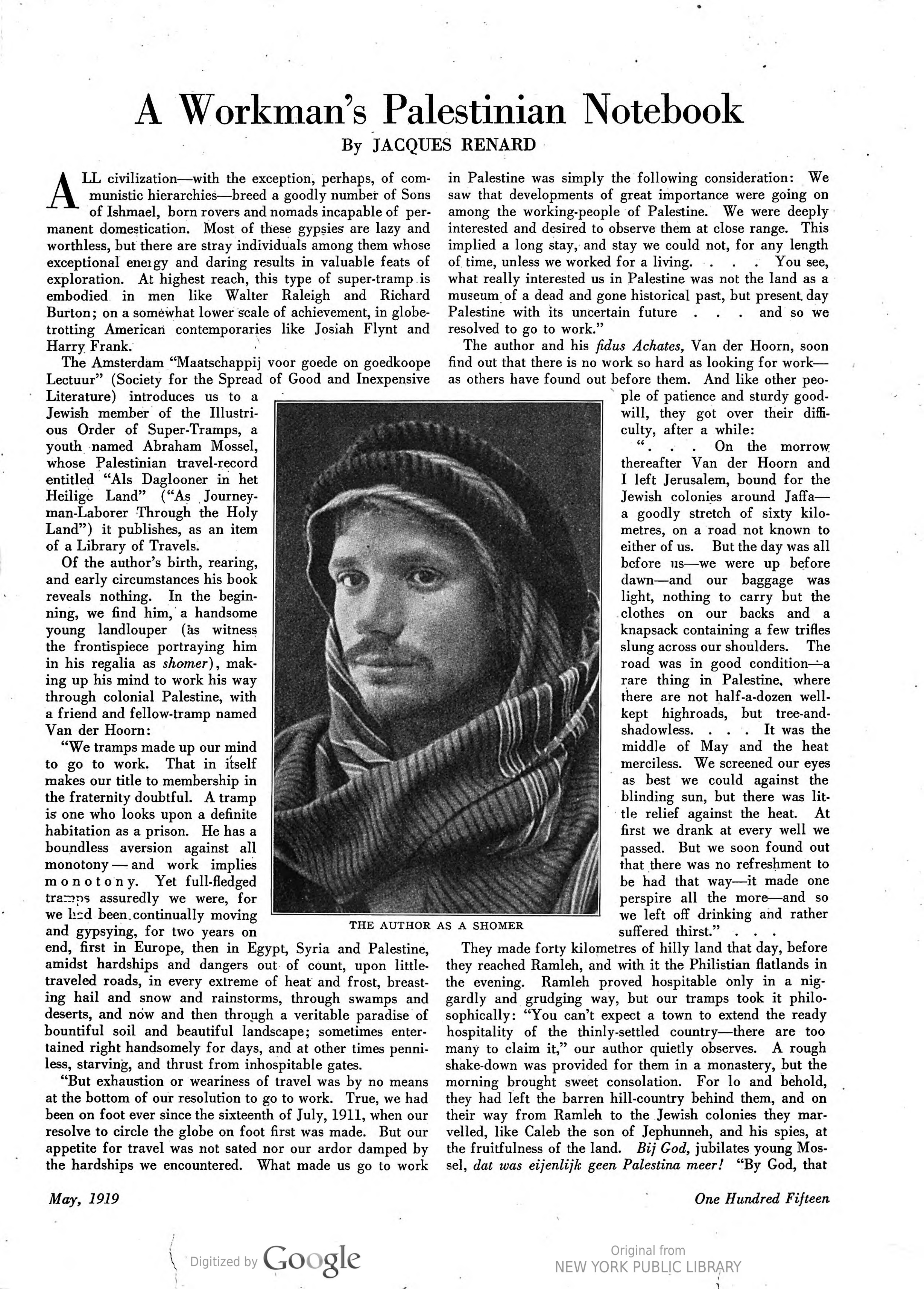
Of the author's birth, rearing, and early circumstances his book reveals nothing. In the beginning, we find him, a handsome young landlouper (as witness the frontispiece portraying him in his regalia as shomer), making up his mind to work his way through colonial Palestine, with a friend and fellow-tramp named Van der Hoorn:
“We tramps made up our mind to go to work. That in itself makes our title to membership in the fraternity doubtful. A tramp is one who looks upon a definite habitation as a prison. He has a boundless aversion against all monotony— and work implies monotony. Yet full-fledged tramps assuredly we were, for we had been continually moving THE AUTHOR and gypsying, for two years on end, first in Europe, then in Egypt, Syria and Palestine, amidst hardships and dangers out of count, upon littletraveled roads, in every extreme of heat and frost, breasting hail and snow and rainstorms, through swamps and deserts, and now and then through a veritable paradise of bountiful soil and beautiful landscape; sometimes entertained right handsomely for days, and at other times penniless, starving, and thrust from inhospitable gates.
"But exhaustion or weariness of travel was by no means at the bottom of our resolution to go to work. True, we had been on foot ever since the sixteenth of July, 1911, when our resolve to circle the globe on foot first was made. But our appetite for travel was not sated nor our ardor damped by the hardships we encountered. What made us go to work
in Palestine was simply the following consideration: We saw that developments of great importance were going on among the working-people of Palestine. We were deeply interested and desired to observe them at close range. This implied a long stay, and stay we could not, for any length of time, unless we worked for a living. . . . You see, what really interested us in Palestine was not the land as a museum of a dead and gone historical past, but present day Palestine with its uncertain future . . . and so we resolved to go to work."
The author and his fidus Achates, Van der Hoorn, soon find out that there is no work so hard as looking for work— as others have found out before them. And like other peo' ple of patience and sturdy gooda will, they got over their difhceultv. after 2 while:
THE AUTHOR AS A SHOMER
u mi AN nn a re ra Bike ra 2 “. 2... On the morrow thereafter Van der Hoorn and I left Jerusalem, bound for the Jewish colonies around Jaffa— a goodly stretch of sixty kilometres, on a road not known to either of us. Butthe day was all before us—we were up before dawn—and our baggage was light, nothing to carry but the clothes on our backs and a knapsack containing a few trifles slung across our shoulders. The road was in good condition—a rare thing in Palestine, where there are not half-a-dozen well-kept highroads, but tree-andshadowles. . . . It was the middle of May and the heat merciless. We screened our eyes as best we could against the blinding sun, but there was little relief against the heat. At first we drank at every well we passed. But we soon found out that there was no refreshment to be had that way—it made one perspire all the more—and so we left off drinking and rather suffered thirst.” . . .
They made forty kilometres of hilly land that day, before they reached Ramleh, and with it the Philistian flatlands in the evening. Ramleh proved hospitable only in a niggardly and grudging way, but our tramps took it philosophically: “You can’t expect a town to extend the ready hospitality of the thinly-settled country—there are too many to claim it,” our author quietly observes. A rough shake-down was provided for them in a monastery, but the morning brought sweet consolation. For lo and behold, they had left the barren hill-country behind them, and on their way from Ramleh to the Jewish colonies they marvelled, like Caleb the son of Jephunneh, and his spies, at the fruitfulness of the land. Bij God, jubilates young Mossel, dat was eijenlijk geen Palestina meer! “By God, that