The Maccabaean
which they went at it. The boys spend a mighty busy day in training. There are very few idle moments, and the training shows on every one of them. Such sun-browned faces and such well set up young fellows are not to be seen on East Broadway. And in spite of their hard work, I never saw a more beaming crowd of faces. Altogether they are a most contented lot. I met quite a number of old acquaintances and invariably they are more than pleased that they joined.
“A group of Americans and Canadians arrived at the Camp and we went with Col. Samuels to hear him greet them. He interviewed each man, asking him where he came from and occasionally some other question, and then addressed them all. In a straight-from-the-shoulder talk he told those men what was expected of them and the great purpose that they were to accomplish, and it was really inspiring to hear a Colonel address his men as ‘We Jews’ and then tell them that ‘We Jews’ must remember the additional responsibility that was upon us, and that each and every one of us was especially marked out.
led by the choir, and joined in by all present. There never was such a Hatikvah, and I remember the great audience in Mechanics Hall at the time of the Boston Convention rise and sing the Hatikvah when Mr. Brandeis came on to the platform. I always thought that that was the last word; but no, never was our national song sung with so much real vim and inspiration as by these boys of the Battalion, who are preparing to make the Hatikvah come true.
“The day closed with a visit to a boxing tournament, participated in by our boys and all the regiments quartered in the neighborhood. It would have done your eyes good, as it did mine, to see the way our fellows administered the medicine to their opponents. The night before our boys won eight out of eleven bouts, and they kept up their record the night we were there. Our boys ended so well that evening and they were so far ahead that they were sure of winning the silver cup of the boxing tournament.
“Thus ended what was, for me, a great day. I do not feel that I have put into words what I have lived through. It is one of those things that you have to really go through to feel what we all felt. The camp, the Battalion preparing to do what we all know about, the boys themselves and the way they went at their work, their fine soldierly Colonel and the other officers, and the other events we lived through have made an impression I will not forget. Oh, for the opportunity to take some of the doubters by the scruff of their necks and show them—‘Here the Jewish people live. Behold the sons of the Maccabaeans!’ I am sure that you will all back the boys up.”
At the Pittsburgh Convention last June, the Jewish Legionary was absent. Uniforms there were of various arms and nationalities; that of the Jewish Legionary was nowhere to be seen. Yet, despite this physical absence, the Jewish Legionary was ubiquitous at the convention. He was present at the moments of enthusiasm and solemnity. He was present even during the more matter-of-fact deliberations. The consciousness of our brave youth en route to Palestine to redeem the land of their fathers with their blood, lent a peculiar solemnity and elevation even to the business sessions of the convention. The absent Legionary was the real hero of that historic gathering. As at the convention, so at the present moment in the offices of the Zionist Organization. The room assigned to the Jewish Legion is the busiest and noisiest in the place. And yet, in spite of its apparent lightness of spirit, there is none who passes its room without a feeling of reverence, without the consciousness that all the greatness of soul which the present world crisis has evoked from the Jewish people is crystallized in that little room and what it represents.
Somehow the Jews do not think of themselves as a fighting race. Centuries of Golus and Ghetto life have made hazy in their minds the traditions of Joshua and Gideon and Saul and David and Judas Maccabeus. But strangely enough, to the cultured Gentile world and particularly to the Bible-loving Anglo-Saxons, the Jews are one of the world’s great fighting races. Just before the last contingent of American-Jewish Legionaries left their training camp at Egg Buckland, England, for the Palestine front, they received
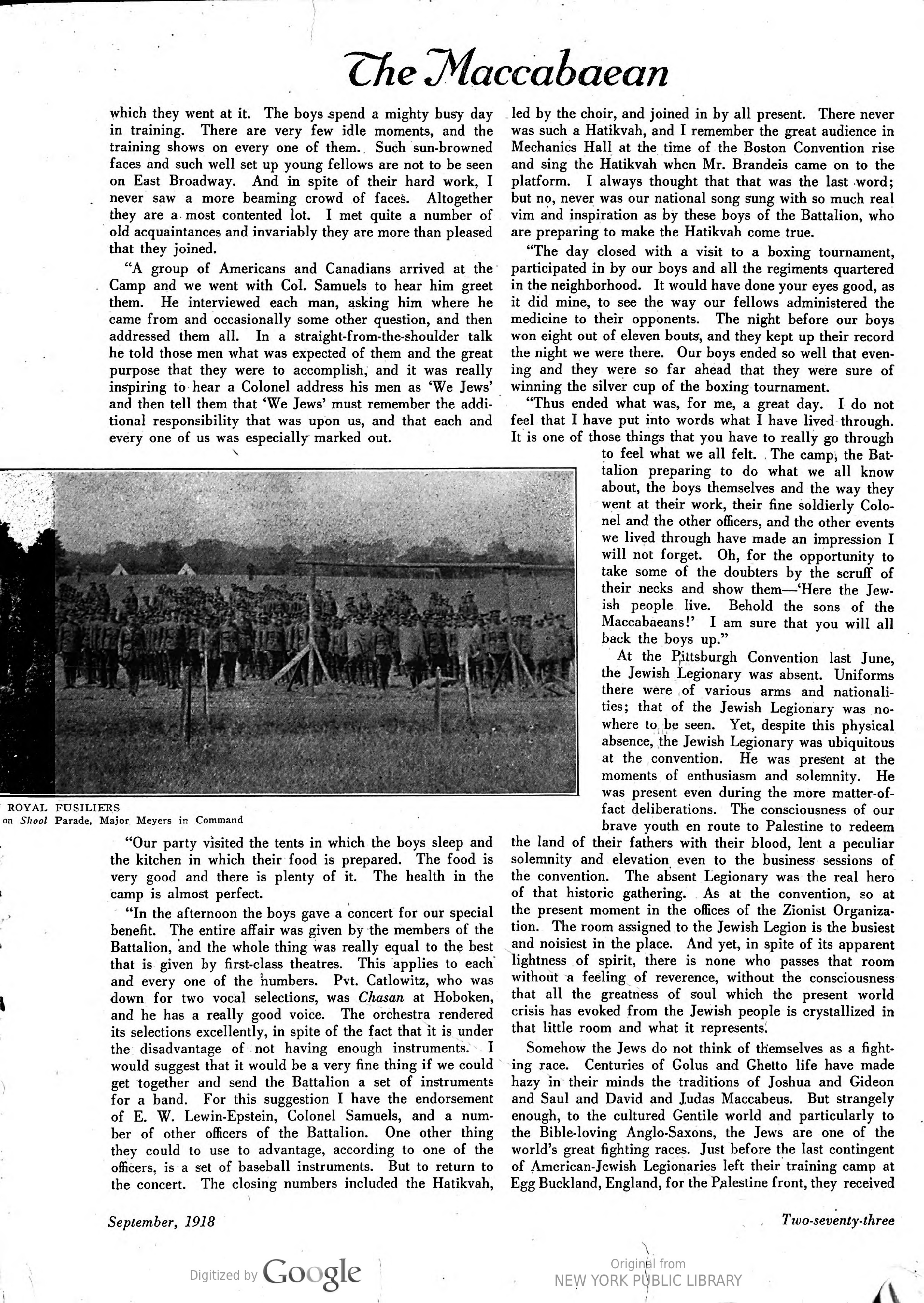
ROYAL FUSILIERS on School Parade, Major Meyers in Command
“Our party visited the tents in which the boys sleep and the kitchen in which their food is prepared. The food is very good and there is plenty of it. The health in the camp is almost perfect.
“In the afternoon the boys gave a concert for our special benefit. The entire affair was given by the members of the Battalion, and the whole thing was really equal to the best that is given by first-class theatres. This applies to each and every one of the numbers. Pvt. Catlowitz, who was down for two vocal selections, was Chasan at Hoboken, and he has a really good voice. The orchestra rendered its selections excellently, in spite of the fact that it is under the disadvantage of not having enough instruments. I would suggest that it would be a very fine thing if we could get together and send the Battalion a set of instruments for a band. For this suggestion I have the endorsement of E. W. Lewin-Epstein, Colonel Samuels, and a number of other officers of the Battalion. One other thing they could to use to advantage, according to one of the officers, is a set of baseball instruments. But to return to the concert. The closing numbers included the Hatikvah,