The Maccabaean
the most eminent of the world's Anti-Zionists. Mr. Claude G. Montefiore, who had been invited to this country by the Conference, in discussing "The Liberal Movement in English Jewry," went out of his way to contend that a Liberal Jew may be a Zionist; he even attempted to defend the combination, being, as he put it, "very anxious to keep all Liberal Jews together, whatever may be their opinions on other matters which may also affect the Jews."
It is worth while to recall that neither of the two presidents who followed (both of them uncompromising opponents of Zionism), felt it incumbent upon themselves to antagonize (or even so much as refer to) Zionism in their respective messages.
Meantime it must not be forgotten that the biennial
With the deep-furrowing tragedy of the world-war there came a fresh impetus to American Zionism which proved itself, out of all the factors in American Jewish life, at the same time the most vital, intense and popular, as also the most resourceful, efficient and prompt. The organization of the Provisional Committee, the agitation for a Jewish Congress, the enlistment of men like Justice Brandeis and Nathan Straus, Judge Mack and Professor Frankfurter, the effective propaganda by such speakers as Dr. Schmarya Levin, Dr. Ben Zion Mossinsohn, Dr. Stephen S. Wise, Dr. Mayer Berlin, Ben Avi, as Henrietta Szold, Mary Fels, Mary Antin, supported by the various journals, agencies, new organizations—all these set a new pace for rapid growth and, through the hot controversies ament the Congress, tended to
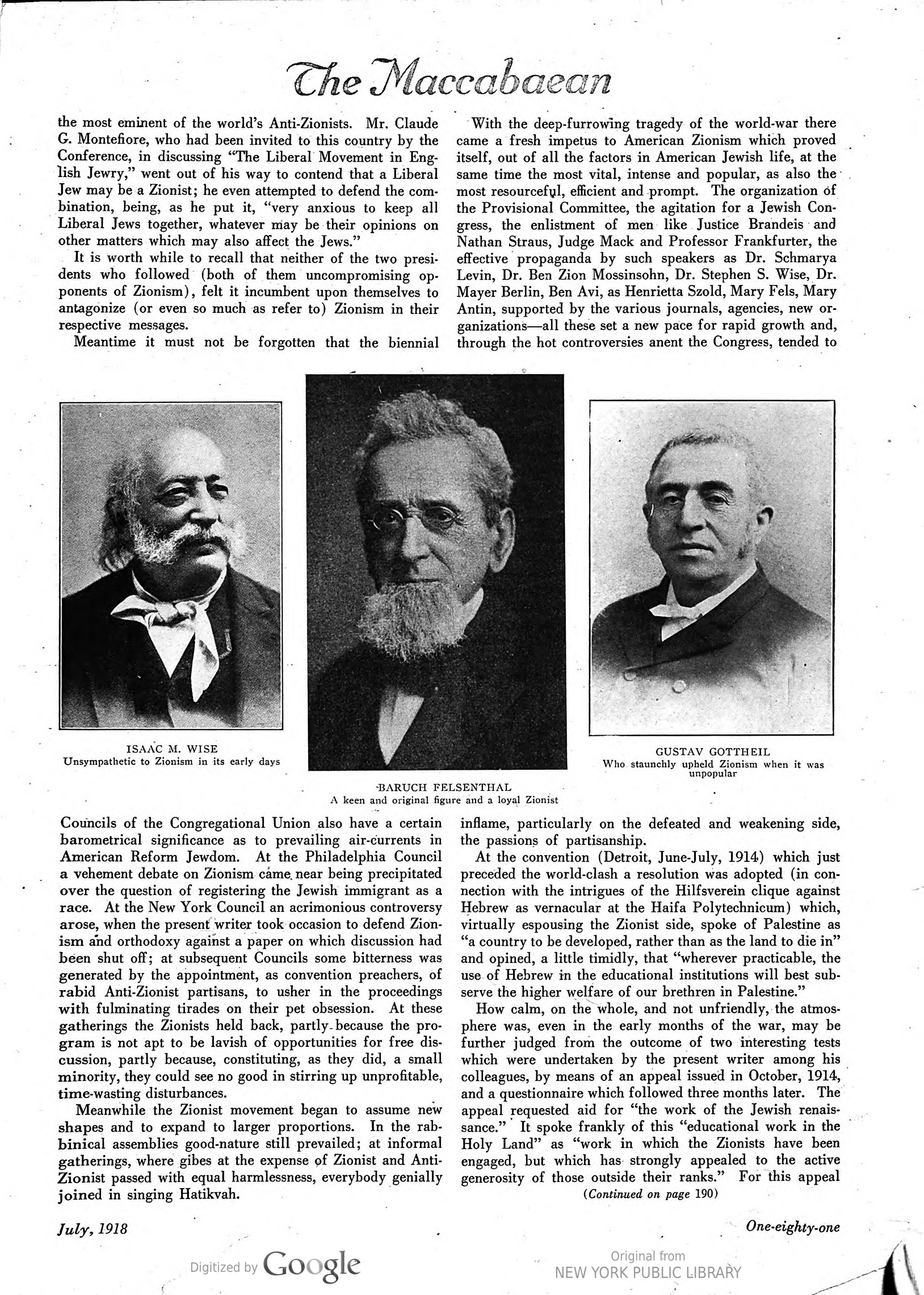
ISAAC M. WISEUnsympathetic to Zionism in its early days
~BARUCH FELSENTHAL A keen and original figure and a loyal Zionist
GUSTAV GOTTHEIL Who staunchly upheld Zionism when it was unpopular
Councils of the Congregational Union also have a certain barometrical significance as to prevailing air-currents in American Reform Jewdom. At the Philadelphia Council a vehement debate on Zionism came near being precipitated over the question of registering the Jewish immigrant as a race. At the New York Council an acrimonious controversy arose, when the present writer took occasion to defend Zionism and orthodoxy against a paper on which discussion had been shut off; at subsequent Councils some bitterness was generated by the appointment, as convention preachers, of rabid Anti-Zionist partisans, to usher in the proceedings with fulminating tirades on their pet obsession. At these gatherings the Zionists held back, partly because the program is not apt to be lavish of opportunities for free discussion, partly because, constituting, as they did, a small minority, they could see no good in stirring up unprofitable, time-wasting disturbances.
Meanwhile the Zionist movement began to assume new shapes and to expand to larger proportions. In the rabbinical assemblies good-nature still prevailed; at informal gatherings, where gibes at the expense of Zionist and Anti-Zionist passed with equal harmlessness, everybody genially joined in singing Hatikvah.
inflame, particularly on the defeated and weakening side, the passions of partisanship.
At the convention (Detroit, June-July, 1914) which just preceded the world-clash a resolution was adopted (in connection with the intrigues of the Hilfsverein clique against Hebrew as vernacular at the Haifa Polytechnicum) which, virtually espousing the Zionist side, spoke of Palestine as "a country to be developed, rather than as the land to die in" and opined, a little timidly, that "wherever practicable, the use of Hebrew in the educational institutions will best subserve the higher welfare of our brethren in Palestine."
How calm, on the whole, and not unfriendly, the atmosphere was, even in the early months of the war, may be further judged from the outcome of two interesting tests which were undertaken by the present writer among his colleagues, by means of an appeal issued in October, 1914, and a questionnaire which followed three months later. The appeal requested aid for "the work of the Jewish renaissance." It spoke frankly of this "educational work in the Holy Land" as "work in which the Zionists have been engaged, but which has strongly appealed to the active generosity of those outside their ranks." For this appeal
(Continued on page 190)