אני--אליעזר ב יהודה
מאת אתמר בן אכי
HUDAH in Jerusalem
and wander into foreign lands, abandoning his friends and disciples of the new Hebrew generation, that was largely his own creation, to an uncertain fate, an hundred episodes have run through his life of unprecedented struggle, episodes which all read like fairy tales. Today it is almost unbelievable that all the accomplishments of rejuvenated Judaea, in which my father took so prominent a part, began only thirty-seven years ago. To thousands of our best Zionists, who look upon Zionism as upon something
quite natural, imbibed as it was by them in their schooldays, it would seem fantastic if I told them that when my father was still in Paris, listening to the preachings of a Renan and a Gambetta, Hebrew was not spoken even in Jerusalem and the national ideal of the return to Zion was not believed in even by a man so great as our Smolensky. And still, such was the case. So that when this young idealist—emaciated by a severe lung disease he had contracted in Paris, and which even beautiful and paradiselike Algiers could not heal—at last landed on the soil of his forefathers, greeted by the rocks and the spray of picturesque Jaffa, he found in the Palestinian Jews only critics, scoffers and cynics. What did he come to do, this “silly skeleton” (he looked indeed extremely weak), in the sacred Zion of old? Did he believe himself a Messiah? Or did he assume that they, the Jews of holy Palestine, who had been led to think that they were representing, at the Wailing Wall, the whole Jewry in prayer, had nothing else to do than listen to the empty warnings of this blasphemous man, uttered in a most “unintelligible” Hebrew? He had rather embark again in the ship which dared bring him hither! . . .
He certainly was a man of iron will, this, my wonderful father, if he could withstand the laughter and
the scorn of the whole Jewish population, the ecclesiastic ban decreed against him three times in black-draped synagogues, and the terrible pronouncement of the rabbis that the “imposter Ben Yehudah” was “dead” for all time, never to be received back as a member of the holy Jewish community.
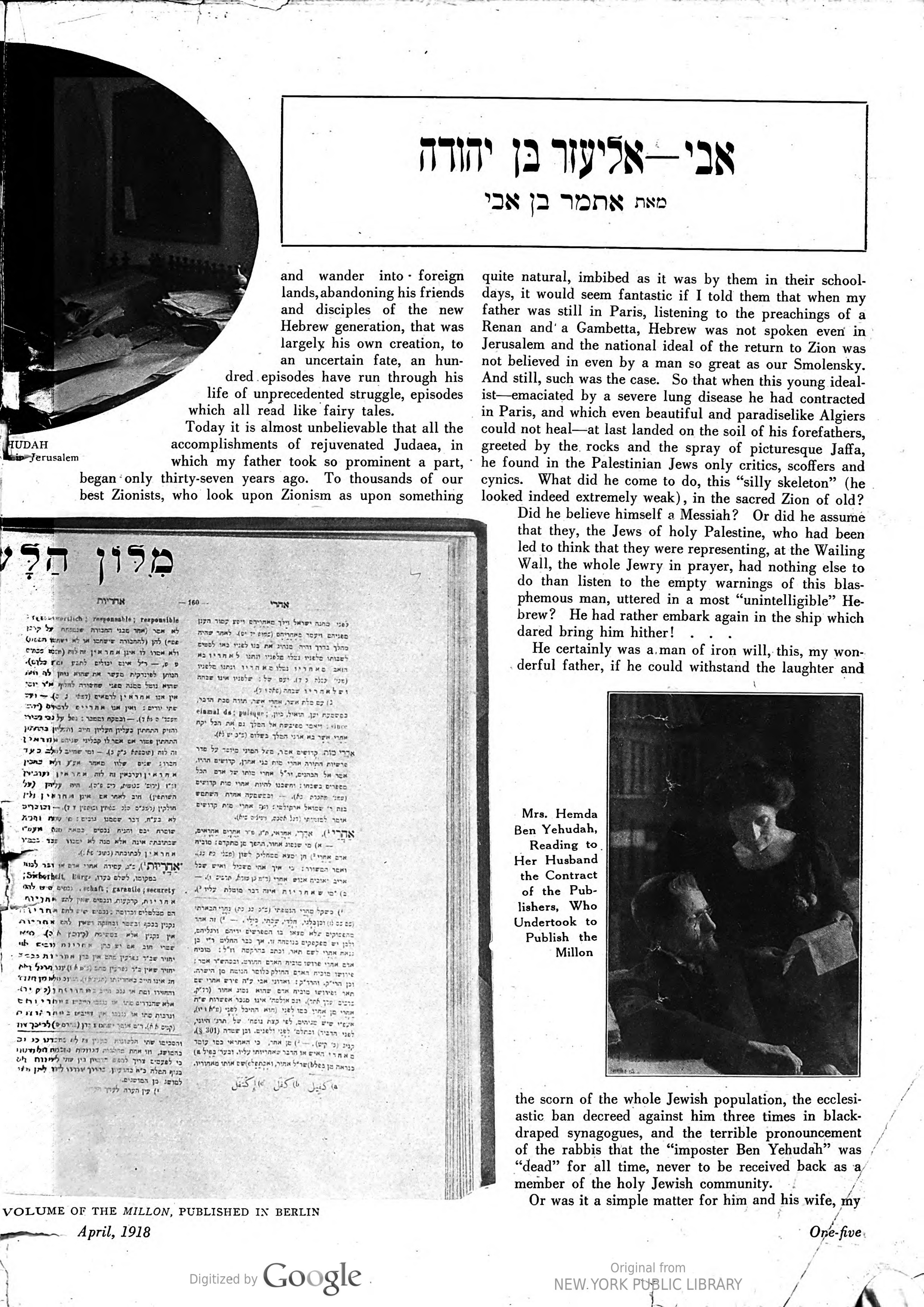
Mrs. Hemda Ben Yehudah, Reading to Her Husband the Contract of the Publishers, Who Undertook to Publish the Millon
Or was it a simple matter for him and his wife, my
Volume of the Millon, Published in Berlin