THE MACCABAEAN
It was not until the nineteenth century that Jerusalem began to rouse itself from its long lethargy. Did the breezes which blow over the city whisper that the awakening was at hand? Did the nations, in their realization that Palestine was to have its political as well as its religious significance, lend a purely secular energy to their solicitude for the sacred precincts? It is certain that during the last hundred years Palestinian societies of a religious, philanthropic, and scientific nature have multiplied with noticeable rapidity. The rebellion of El Jazzar, the invasion of Napoleon, the exploits of Mehemet Ali—these things undoubtedly did much to focus the attention of Western Europe upon the Levant, and thus upon Jerusalem. The journeys of Moses Montefiore and others, and their accounts of the pitiable plight of the population aroused Jew and Gentile alike to a sense of responsibility toward the Holy City. Missions, schools, and hospitals were established, consulates were founded, associations for archeological research in England, Germany, America, and Russia sent commissions to Jerusalem, whose reports did much to familiarize the world with the thought of a Jerusalem that was corporeal, so to speak, instead of spiritual. Moreover land was bought by institutions as well as by individuals, and foreign colonies of a semi-religious, semi-secular nature grew up. All this did not happen in a day. But it suffices to compare any work on Jerusalem dating from the end of the eighteenth century with a modern description to grasp how immense the transformation has been. As a matter of fact, the population, which was estimated as being 35,000 in 1880 and rose to 70,000 in 1913. While this tremendous increase was due mainly to the Jewish immigration, there was a steady if small influx of all nationalities.
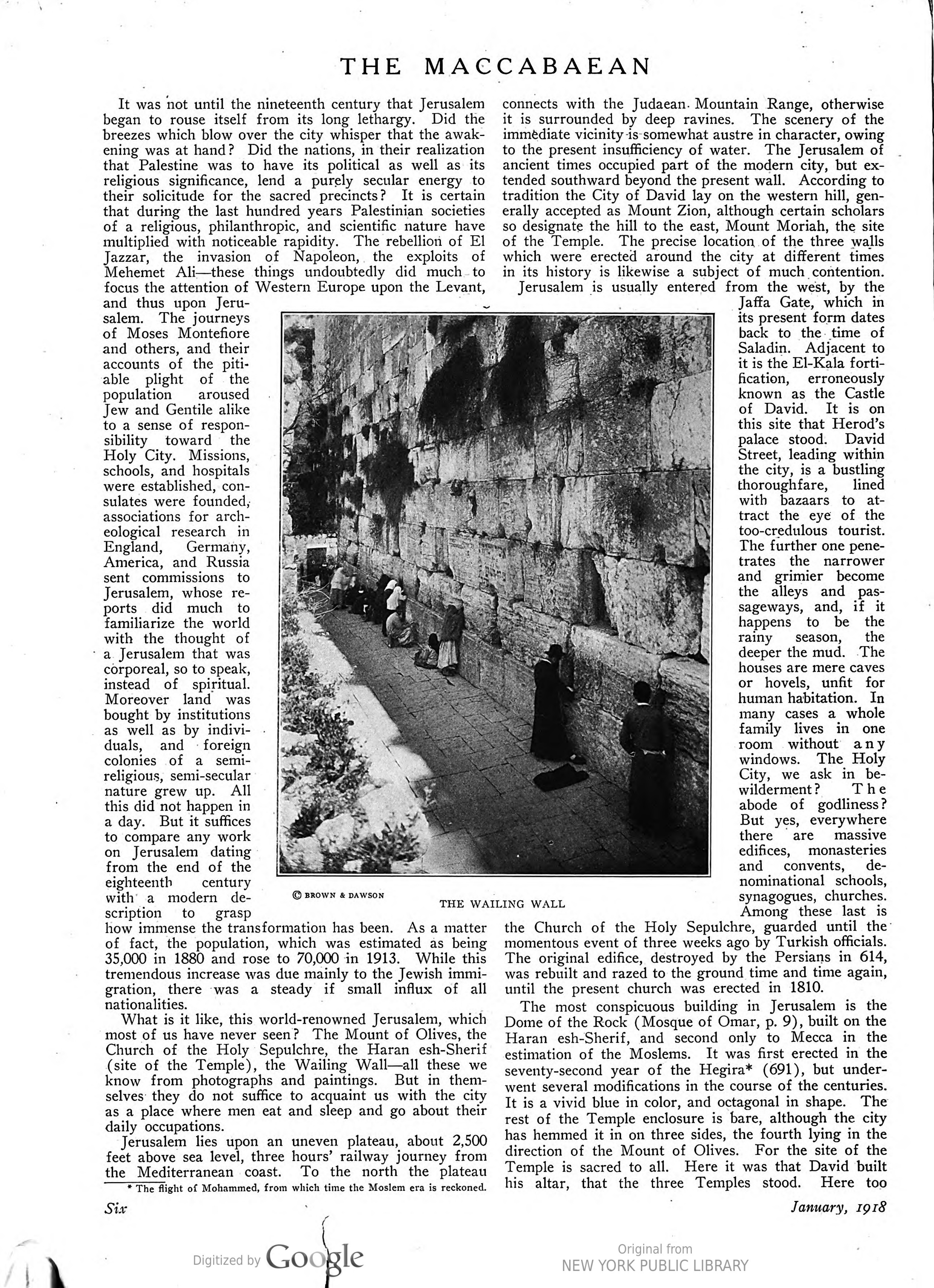
What is it like, this world-renowned Jerusalem, which most of us have never seen? The Mount of Olives, the Church of the Holy Sepulchre, the Haran esh-Sherif (site of the Temple), the Wailing Wall—all these we know from photographs and paintings. But in themselves they do not suffice to acquaint us with the city as a place where men eat and sleep and go about their daily occupations. 2
Jerusalem lies upon an uneven plateau, about 2,500 feet above sea level, three hours' railway journey from the Mediterranean coast. To the north the plateau
* The flight of Mohammed, from which time the Moslem era is reckoned.
Six
© BROWN & DAWSON
THE WAILING WALL
connects with the Judaean. Mountain Range, otherwise it is surrounded by deep ravines. The scenery of the immediate vicinity 1s-somewhat austre in character, owing to the present insufficiency of water. The Jerusalem of ancient times occupied part of the modern city, but extended southward beyond the present wall. According to tradition the City of David lay on the western hill, generally accepted as Mount Zion, although certain scholars so designate the hill to the east, Mount Moriah, the site of the Temple. The precise location of the three walls which were erected around the city at different times in its history is likewise a subject of much contention.
Jerusalem is usually entered from the west, by the Jaffa Gate, which in its present form dates back to the time of Saladin. Adjacent to it is the El-Kala fortification, erroneously known as the Castle of David. It is on this site that Herod’s palace stood. David Street, leading within the city, is a bustling thoroughfare, lined with bazaars to attract the eye of the too-credulous tourist. The further one penetrates the narrower and grimier become the alleys and passageways, and, if it happens to be the rainy season, the deeper the mud. The houses are mere caves or hovels, unfit for human habitation. In many cases a whole family lives in one room without any windows. The Holy City, we ask in bewilderment ? The abode of godliness? But yes, everywhere there are massive edifices, monasteries and convents, denominational schools, synagogues, churches. Among these last is
the Church of the Holy Sepulchre, guarded until the: momentous event of three weeks ago by Turkish officials. The original edifice, destroyed by the Persians in 614, was rebuilt and razed to the ground time and time again, until the present church was erected in 1810.
The most conspicuous building in Jerusalem is the Dome of the Rock (Mosque of Omar, p. 9), built on the Haran esh-Sherif, and second only to Mecca in the estimation of the Moslems. It was first erected in the seventy-second year of the Hegira* (691), but underwent several modifications in the course of the centuries. It is a vivid blue in color, and octagonal in shape. The rest of the Temple enclosure is bare, although the city has hemmed it in on three sides, the fourth lying in the direction of the Mount of Olives. For the site of the Temple is sacred to all. Here it was that David built his altar, that the three Temples stood. Here too