Zionism in English Diplomacy
By DR. MAX HELLER
T is not so long ago that an Anti-Zionist of the rabid variety informed the world that, with Russia in revolution, two things had come to pass: the Jewish problem was solved and the bottom had: dropped out of Zionism. In these days of the Russian chaos a person needs only to repeat the childish prophecy to pity the rash” and shallow mind that could utter it. As little as the. Jewish problem is susceptible of a lightning solution, just so little is the Zionist movement in danger of a sudden and complete collapse. Only a few months have passed and the Jewish problem, in revolutionized Russia itself, reverts to pogrom conditions, while, at exactly the same time, the greatest empire / in the world, the government of which responds most closely to the .wishes of its people, the nation which a has reached the highest political a maturity, declares itself, officially, in = full accord with the aims and aspira- 9 tions of the Zionist movement. ,
To ‘those who have watched the drifting currents of popular feeling as the world-war pursued its changeful course, to those who have studied the psychology of the national temperaments which were struggling for ascendency, this triumph, so little expected a few years ago, comes as an inevitable consummation, rather than as a sudden surprise. Before the war began, Zionism had been making friends among open-minded political thinkers who were not of our race far more rapidly than it was gaining ground among ourselves; among all of them England’s offer of Uganda furnished unmistakable proof that advanced English statesmen had come nearer to a sympathetic comprehension of Jewish needs than the political leaders of any other people. From time to time one or the other statesman or leading scholar came forward to profess friendliness toward Zionism, though it was the complications, disclosures and rivalries of ‘the war which, more than all previous factors, opened the eyes of wide-awake people to the justice, to the feasibility, to the inevitableness of Zionism. Careful readers will readily recall that almost at the same time when Mr. Asquith’s organ, the Manchester Guardian, discussed the important bearings, on the future of a Jewish Palestine, of the proclamation of General Maude on his occupation of Bagdad, General Archibald Murray, as he invested Gaza, in a statement as to the disposition of Palestine, boldly contended that “there can be little doubt that we should revive the Jewish Palestine of old and allow the Jews to realize their dreams of Zion in their homeland.”
We rubbed our eyes, then, to find our longings of so many centuries put forward openly as practical solutions by the seasoned soldier; but that the coincidence was no mere accident, that these men acted as the spokesmen of English diplomacy, there could be little doubt.
Since then there has been a steady and continuous accession, on the part of public men, scholars, journals, to the company of those who had come more and more to see in Zionism the principal lever toward the solution of
the Jewish problem, until, in the last few weeks, it almost looked as if there were a race between German and English diplomacy as to which was to cross the Rubicon first with an outspoken, irrevocable declaration in. official
Nor should we be guilty, for one moment, of the short-sighted injustice of underestimating this unique espousal of our cause, as if it constituted a mere shrewd move on the diplomatic checker-board, an open bid for Jewish support, whether military, financial, or by way of grateful appreciation.
The unreserved recognition of our rights to a homeland, of our precedence in Palestine is in complete accord, not only with English tradition and temperament, but with the professed and consistent aims of the Allies. The restoration of Palestine, the dream of Israel’s return has found its most eloquent and convincing advocates in English literature ; both its romance and its justice has, time and again, waked cordial echoes in the English heart; the English people, consequently, have never viewed the sacred soil with the hungry eyes of the exploiter, or the greedy passions of the conqueror; nor have they ever looked upon the Jew, as other nations came to regard him, as if he were the predestined victim of an all-devouring assimilation.
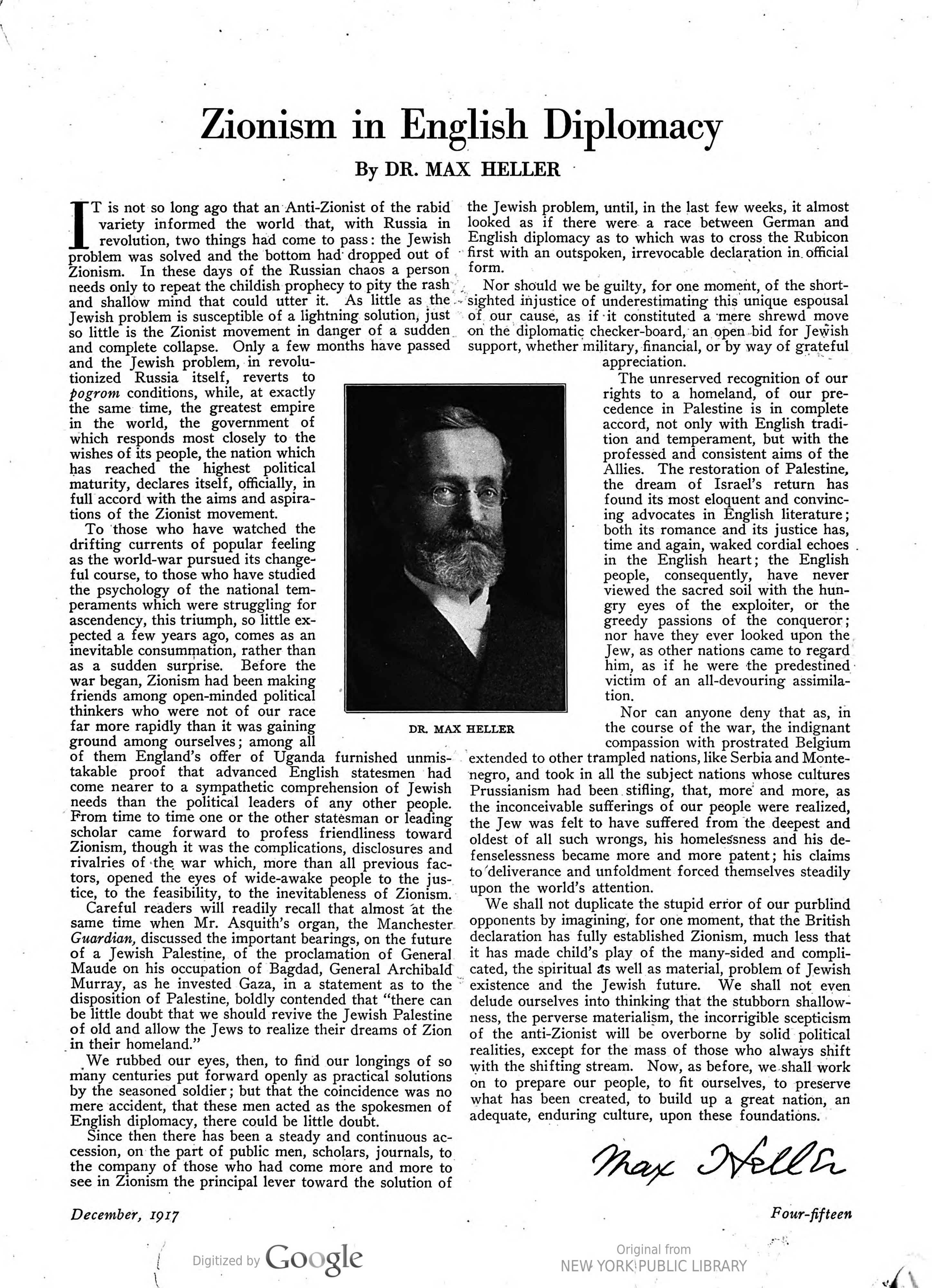
—E Nor can anyone deny that as, in HELLER the course of the war, the indignant compassion with prostrated Belgium extended to other trampled nations, like Serbia and Montenegro, and took in all the subject nations whose cultures Prussianism had been stifling, that, more and more, as the inconceivable sufferings of our people were realized, the Jew was felt to have suffered from the deepest and oldest of all such wrongs, his homelessness and his defenselessness became more and more patent; his claims to‘deliverance and unfoldment forced themselves steadily upon the world’s attention.
We shall not duplicate the stupid error of our purblind opponents by imagining, for one moment, that the British declaration has fully established Zionism, much less that it has made child’s play of the many-sided and complicated, the spiritual 45 well as material, problem 01 Jewish existence and the Jewish future. We shall not even delude ourselves into thinking that the stubborn shallowness, the perverse materialism, the incorrigible scepticism of the anti-Zionist will be overborne by solid political realities, except for the mass of those who always shift with the shifting stream. Now, as before, we.shall work on to prepare our people, to fit ourselves, to preserve what has been created, to build up a great nation, an adequate, enduring culture, upon these foundations.