THE ZIONIST MOVEMENTA Monthly Review of the Zionist World
Conducted by A. H. Fromenson
News From The Homeland
DETAILED REPORT OF CONDITIONS IN PALESTINE
Reports received from Palestine by the Provisional Committee during the past month throw further light on the actual existing conditions there. However, Palestine, having become the scene of important military operations, the general situation is rapidly changing. Everything is being subordinated to the needs of the Turkish army and consequently conditions are growing worse.
Since the publication of the statement in the May issue of THE MACCABAEAN, reporting the evacuation of the Jews from Jaffa and the threatened massacres by Djemal Pasha, military governor of Palestine, various reports have been received, which, though widely contradicting each other, agree in that the Jewish colonies have remained intact.
We give here a number of cablegrams received by the Provisional Committee, which will give the reader a fairly accurate account, under the circumstances, as to what conditions in Palestine are. The following cablegram gives the details of the evacuation of the Jews from Jaffa:
"Between eight and nine thousand Jews were compelled to leave Jaffa. Of these more than 3,000 are now in lower Galilee; more than 1,000 in Petach Tikwah, and 1,000 in Keferseba, the remainder having been dispersed in the colonies of Judea and Samaria, in the towns of Upper Galilee. Upon the first issuance of the order to evacuate Jaffa, an attempt was made to concentrate the people in the refuges in Petach Tikwah, but this could not be done successfully, as transportation means were lacking. Thirty Jews have received special permission to remain in Jaffa. Among
these are twelve guards, who are in charge of Tel Aviv, and so far everything is intact. The gardens are being attended to.
"According to the evacuation order, the married colonists in the Jewish colonies were permitted to remain on their plantations with their families, but the regulations were not strictly adhered to, so that most of the colonists were able to obtain permission to remain on the estates and only about 600 persons were compelled to leave the farms. The deaths, incidental to the evacuation, were due to insufficient nourishment of the refugees and the hardships of the journey.
"The appeal from the Palestine Amt for help in this emergency explains that emergency work on a large scale is necessary in order to prevent the degradation of the refugees, who are capable workers, and who, unless provided with work on the
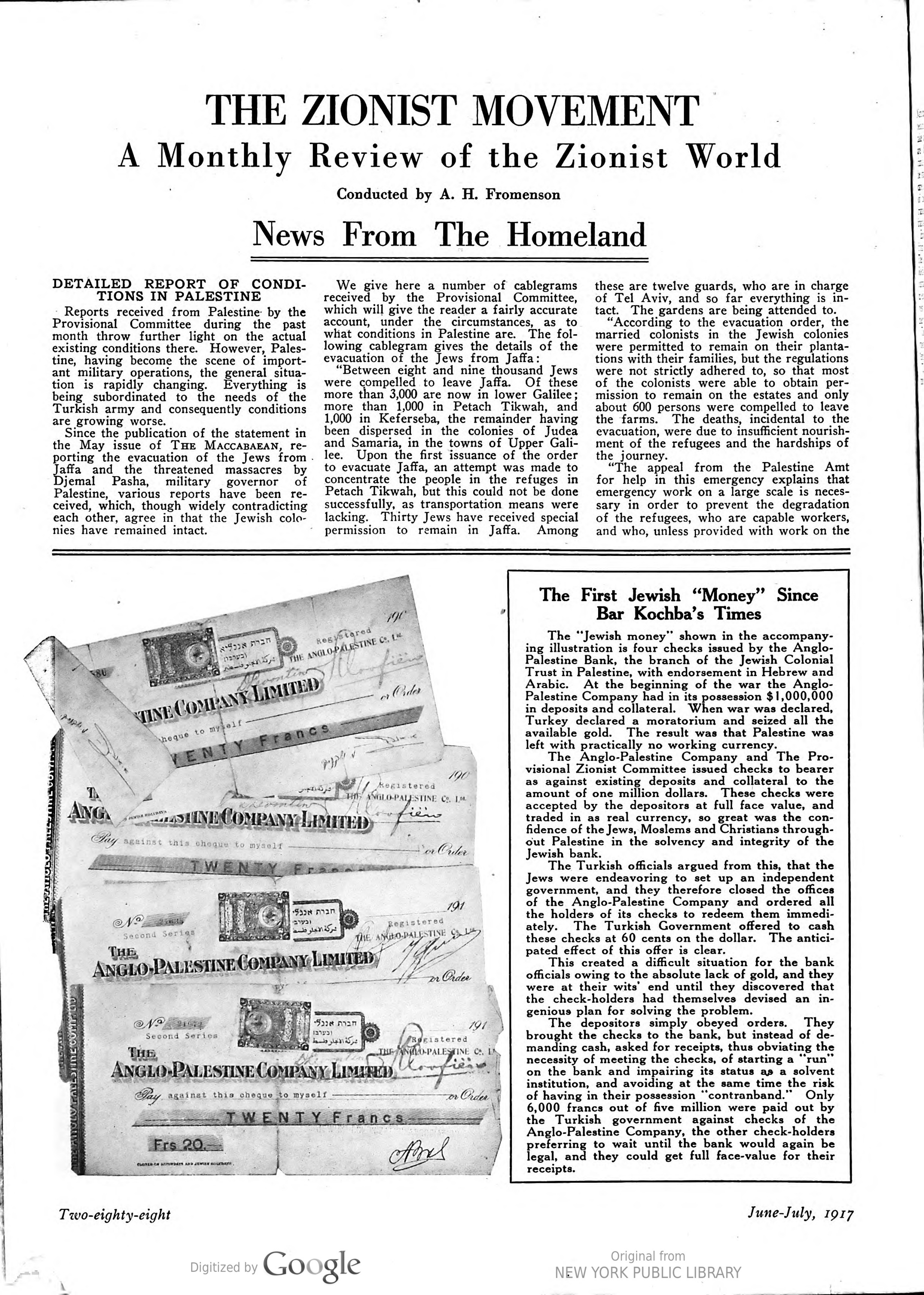
The First Jewish "Money" Since Bar Kochba's Times
The “Jewish money” shown in the accompanying illustration is four checks issued by the Anglo-Palestine Bank, the branch of the Jewish Colonial Trust in Palestine, with endorsement in Hebrew and Arabic. At the beginning of the war the Anglo-Palestine Company had in its possession $1,000,000 in deposits and collateral. When war was declared, Turkey declared a moratorium and seized all the available gold. The result was that Palestine was left with practically no working currency.
The Anglo-Palestine Company and The Provisional Zionist Committee issued checks to bearer as against existing deposits and collateral to the amount of one million dollars. These checks were accepted by the depositors at full face value, and traded in as real currency, so great was the confidence of the Jews, Moslems and Christians throughout Palestine in the solvency and integrity of the Jewish bank.
The Turkish officials argued from this, that the Jews were endeavoring to set up an independent government, and they therefore closed the offices of the Anglo-Palestine Company and ordered all the holders of its checks to redeem them immediately. The Turkish Government offered to cash these checks at 60 cents on the dollar. The anticipated effect of this offer is clear.
This created a difficult situation for the bank officials owing to the absolute lack of gold, and they were at their wits' end until they discovered that the check-holders had themselves devised an ingenious plan for solving the problem.
The depositors simply obeyed orders. They brought the checks to the bank, but instead of demanding cash, asked for receipts, thus obviating the necessity of meeting the checks, of starting a "run" on the bank and impairing its status as a solvent institution, and avoiding at the same time the risk of having in their possession "contranband." Only 6,000 francs out of five million were paid out by the Turkish government against checks of the Anglo-Palestine Company, the other check-holders preferring to wait until the bank would again be legal, and they could get full face-value for their receipts.