The Russian Revolution And The National Question
By LEO MOTZKIN
T is not my purpose to discuss the effect which the liberation of Russian Jewry will have upon the further development of Zionism. As a consequence of my analysis of the Jewish question, I am firmly convinced that under new conditions the Zionist Movement will henceforth assume infinitely greater dimensions, especially if unrestricted economic possibilities finally manifest themselves in Palectine itcelf.
There is no doubt that Russian Jewry, once freed from acute oppression, will contribute undreamed-of forces to the realization of Zionism, and will try to accomplish a territorial concentration in Zion with all the material and spiritual means at the disposal of a free people —but more of this at another time.
The point under discussion is: To what extent are the prospects for the realization of the nationalistic claims 4 the Russian Jews favor.able? Twelve years ago all the Jewish factions in Russia stated their platform in clear and concise terms. They proclaimed that the acquisition of national rights as well as of civil equality was of vital importance to Russian Jewry. These theoretic demands, however, seemed mere dreams and illusions to those not intimately acquainted with the situation, since these superlatively democratic recommendations were made to that country which was furthest from freedom.
The catastrophic nature of the Russian revolution and its glorious success will give an entirely new aspect to the Jewish question in Eastern Europe— an aspect which nothing in the course of the world war gave us reason to hope for. In a truly liberated Russia, the demands of the Jews which have been formulated for untold years and presented at countless occasions assume a concrete shape and become an actual casus belli. Today nothing more than a resolute effort is needed to transform “illusions” into realities.
As long as the Russian autocracy underwent
changes in form, but continued to stand firm in political and judicial life, the whole clumsy and seemingly hopeless struggle for the emancipation of the .millions of Eastern European Jews depended in increasing measure on isolated efforts. After a number of desperate and. useless attempts had been made, the outbreak of the world war brought with it the hope that the subsequent peace would be attended by
internal reforms in Russia. This hope did not include anything more than the granting of favors on part of the monarchy. The majority of Jewish politicians rejoiced at this possibility and prepared to content themselves with the abolition of the most heinous restrictions against their people in the Russia that was to be.. If only, they said, the Pale of Settlement and the system of percentage in educational institutions were done away with! For surely one cannot expect an autocracy to pass in a single day from discriminatory laws to equality and even to the granting of national autonomy. It was an immutable policy of the Romanoffs to foster and utilize the antagonism of the various ethnic groups in Russia on the one hand, and on the other hand to carry out a system of compulsory Russification. These methods seemed to them not only a political requisite for the continued existence of the empire, but primarily a concrete expression of their autocratic régime. How could anyone, even
the most confirmed optimist, hope that such a dynastywould consent to national emancipation.
And now circumstances are quite different—now that the present moment has shaken off the burden of reactionary tradition and inscribed the principle of democracy on its standard. Among the heads of the present Russian Government are men who long ago made national autonomy a plank in their platforms, men like Milyukov, Shingariev, Nekrassov, Kerensky, Tschcheidze, who, as they acknowledged the validity of this claim during the first Russian
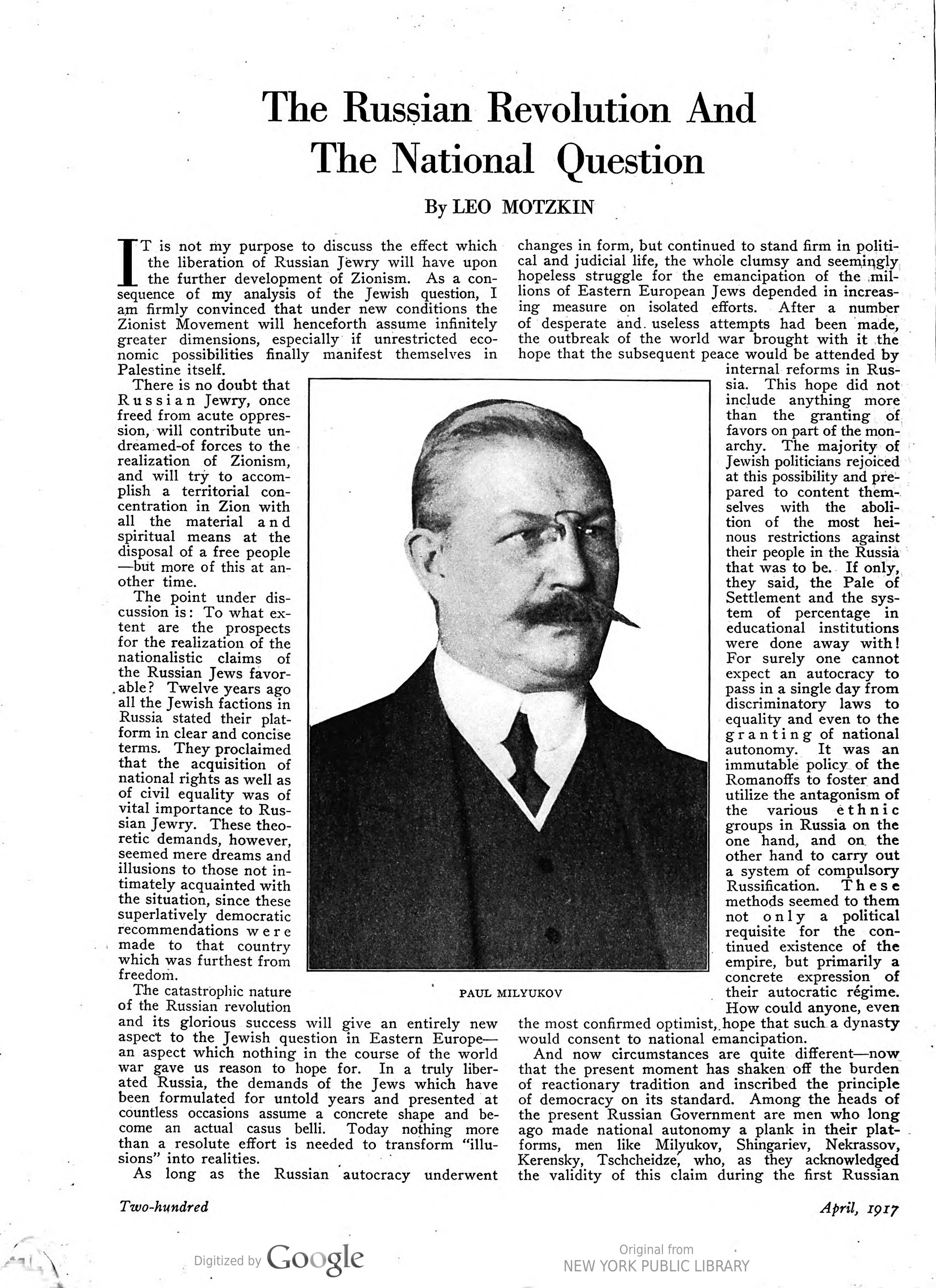
PAUL MILYUKOV