THE MACCABAEAN
parison with that to North America should be considered. The journey to Odessa on Russian railroads is on the average 5 rubles. Emigrants are conceded special benefits by the Russian railroads. From Odessa to Jaffa travellers are mulcted 5 to 10 rubles on deck. Trietsch is right in saying that a primitive dwelling could be constructed on the difference in the fares to America and Palestine.
Now there comes the question of organizing such a
large colonization. It is of course impossible simply
to send Eastern Jewry to Palestine and leave it to its
fate. Careful preparations, the organization of the
land and the solution of its problems are pre-essentials.
It must be admitted that in the face of the complicated
Turkish legal code this is not at alleasy. Colonization
is possible only on the conditions that to a large Jewish colonial company (1) the entire state land would be
ceded in return for definite payments; (2) that church
lands be leased out (they need not be sold) ; (3) that
private landowners be expropriated under the conditions of compensation customary in the country. The
demands seem to be too great. The question as to
what would happen to the population now settled in
Palestine, the fellaheen, in case they are expropriated,
now confronts us. This problem sounds more difhcult than it is in reality. The expropriation of the
Fellaheen has already been looked after by the Arabian
city usurers. It is said that in the better parts of
Palestine—in Galilea and East Jordan—only 20% and
15% respectively of the land is in the hands of the
peasants. For the greater part it would be possible
to buy land from the owners of large estates, without
compulsory expropriation, as soon as good prices could
be offered which the Fellahs, because of their backward methods of cultivation, would never be able to
equal. It would hardly be necessary to pay more than
200 to 250 marks per hectare for soil used for tilling
and grazing. In other words, the entire land of 700 to
750 thousand hectares needed for extensive cultivation
could be purchased for 140-180 million marks. The
average price of the mountainous land used until now
for grazing would be even lower. Even if it were necessary to pay even 150 marks per hectare there, the
total cost of all the land needed by the settlers would
amount to 300-350 million marks. The acquirement of
the wine and tree gardens, and especially of the costly
orange plantations must, of course, not be considered,
for the new East-Jewish settlement should create new
<ultivations ‚and not engage in current speculations.
At first the fellah could give valuable assistance to
colonial activities; later, as soon as the recultivation of
old Babylonia is begun he could find highly profitable
labor and land outside of Palestine. For the recultivation of Babylonia conditions could be offered to the Fellahs which would be more profitable than those of their
present position, in which not only the tenants but
even the owners have to suffer because of the intolerable methods of Turkish taxation. A reform of the
Turkish tax rates is inevitable. At the same time the
Turkish Government could receive double or treble
its former tax revenues. Next must be considered the
cost of making the plains suitable for agricultural
work. The irrigation installation could be set up for
250 marks per hectare, to which would have to be
added a row of dams and of artificial basins. Water
installations for 800,000 hectares would cost 400,000,-
000 marks. Cement for the dams would have to be
produced in Palestine itself. A number of cement
works would have to be established.
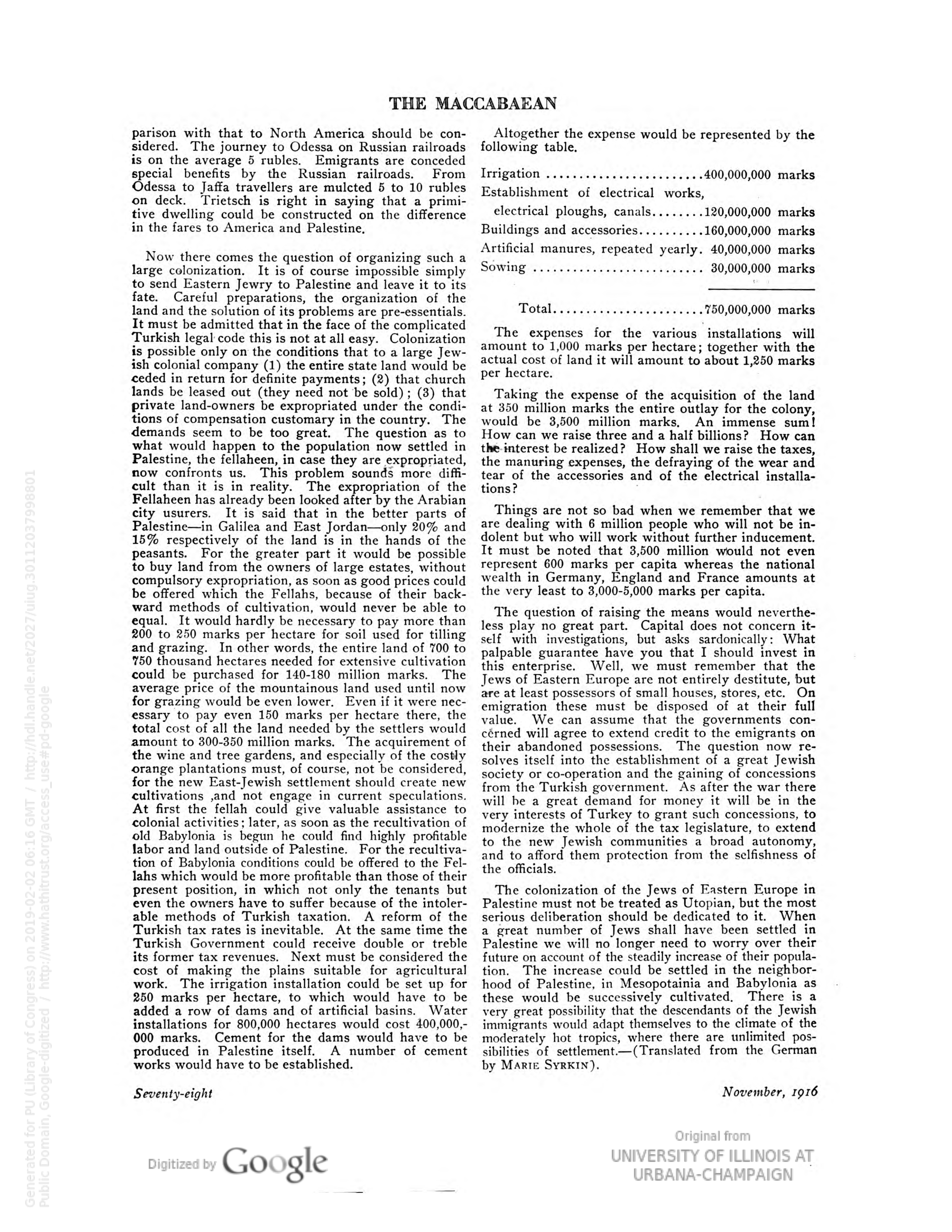
Altogether the expense would be represented by the following table.
Irrigation400,000,000
marksEstablishment of electrical works,electrical ploughs, canals120,000,000
marksBuildings and accessories160,000,000
marksArtificial manures, repeated yearly. 40,000,000 marksSowing30,000,000
marksTotal750,000,000
The expenses for the various installations will amount to 1,000 marks per hectare; together with the actual cost of land it will amount to about 1,250 marks per hectare.
Taking the expense of the acquisition of the land at 350 million marks the entire outlay for the colony, would be 3,500 million marks. An immense sum! How can we raise three and a half billions? How can the interest be realized? How shall we raise the taxes, the manuring expenses, the defraying of the wear and tear of the accessories and of the electrical installations?
Things are not so bad when we remember that we are dealing with 6 million people who will not be indolent but who will work without further inducement. It must be noted that 3,500 million would not even represent 600 marks per capita whereas the national wealth in Germany, England and France amounts at the very least to 3,000-5,000 marks per capita.
The question of raising the means would nevertheless play no great part. Capital does not concern itself with investigations, but asks sardonically: What palpable guarantee have you that I should invest in this enterprise. Well, we must remember that the Jews of Eastern Europe are not entirely destitute, but are at least possessors of small houses, stores, etc. On emigration these must be disposed of at their full value. We can assume that the governments concerned will agree to extend credit to the emigrants on their abandoned possessions. The question now resolves itself into the establishment of a great Jewish society or co-operation and the gaining of concessions from the Turkish government. As after the war there will be a great demand for money it will be in the very interests of Turkey to grant such concessions, to modernize the whole of the tax legislature, to extend to the new Jewish communities a broad autonomy, and to afford them protection from the selfishness of the officials.
The colonization of the Jews of Eastern Europe in Palestine must not be treated as Utopian, but the most serious deliberation should be dedicated to it. When a great number of Jews shall have been settled in Palestine we will no longer need to worry over their future on account of the steadily increase of their population. The increase could be settled in the neighborhood of Palestine, in Mesopotainia and Babylonia as these would be successively cultivated. There is a very great possibility that the descendants of the Jewish immigrants would adapt themselves to the climate of the moderately hot tropics, where there are unlimited possibilities of settlement.—(Translated from the German bv MARIE SYRKIN),
Seventy-eight
November, 1916