driven out of the fields after being forced to give up their plunder, and were commanded not to show themselves until sent for. Together with the soldiers there had arrived the stationmaster, Enver, an intelligent young Turk, and it was from him that the settlers learned how the Turkish soldiers had come to save them. Enver had always liked the brave band of settlers, their Spartan ways of life, and their agreeable manners. He had taken them under his protection and was at all times ready to be of service to them. He used to let them pay at their leisure the expressage on the goods which was sent to them by a merchant in Haifa. Sometimes, when they came to buy a ticket and did not have change for a lira he gave them the ticket on trust. And he put everything down to Meir's account. His book was full of such items as "Meirke —one ticket....Meirke—three tickets."
As soon as he had heard of Selim's death he hurried to the settlement. On the way he came upon a group of Arabs gathered around the dead body. He tried to persuade them not to attack the settlement, because, as he assured them, the Jews were heroes and armed to the teeth. When he realized that words were of no avail he ran to the station as fast as he could and wrote out a telegram: "Merchaviah large attack." But then he hesitated, perplexed. To whom should he send the telegram? He did not know any of the Jews in Haifa. Then suddenly he remembered the name of the merchant from whom the settlers got their provisions. But the merchant did not receive the telegram until the next morning. (In Turkey they think there is no valid reason why the peace of the night should be disturbed by such unimportant things as telegrams.)
He immediately passed the news on to the head of the Galilean Shomerim. The head of the Shomerim tried to get help from the Kaimakam, but the latter declared that Merchaviah was not in his district, and that he would therefore not be able to give any assistance ; he suggested that the matter be brought before the chief of the gendarmes. This man was a Young Turk who had lived in Palestine for a long time, and had made a study of the Yishub. He was quite aware of the fact that the Jews would not take the initiative in a quarrel with the Arabs, and that the latter were undoubtedly at faul. He ordered a small company of gendarmes to hasten to Merchaviah to restore order. But by the time all the formalities had been gone through they found that the train had already left; so the gendarmes climbed into a large wagon, and arrived in Merchaviah after jogging along “the road for five hours.
"Where is the murderer?", demanded the Zabed (officer) as soon as they had entered the settlement.
"He must be in hiding in the fields," answered the Merchavians. "The wheat is high, and there are deep valleys between the hills."
He ordered his men to search for the murderer—but they did not even find the firearms.
"The murderer must be somewhere in the settlement, and we shall not leave until he is found," declared the Zabel. And as he had spoken, so it was done. The gendarmes put up two tents, one for the officer and one for themselves, and put the settlement under guard.
A week passed, and Yigael was not able to stand the stifling atmosphere in the barn any longer, nor the cramped position in which he was forced to hold himself. One night he crept out into the open air. It was very dark,
and he hoped to escape observation. But on sooner had he come to the passageway which was still barricaded, than one of the gendarmes perceived him.
"Who goes there?"
"I am going to the fields. It seems to me that I hear something rustling in the wheat, a jackal or a thief."
"We are here to guard the settlement. Rest easy, there are no thieves abroad." But the gendarme had his suspicions aroused, and reported the incident to the Zabed.
“Yigael turned back and went into the living-room, where his comrades received him with a glad cry of “Heidad!” In the fulness of their joy they forgot the danger that was hanging over them. They made him sit down in the middle of the long bench and crowded around him. But he silenced them with a wave of his hand. And only then did they remark how pale he was, and how much he had, aged in that short time. It was not tlıe thought of death that had filled him with terror, but the prospect of spending fifteen years in a Turkish prison. For a moment there was an uncomfortable pause. The Merchavians felt that they were all accountable for the sufferines which he alone had undergone.
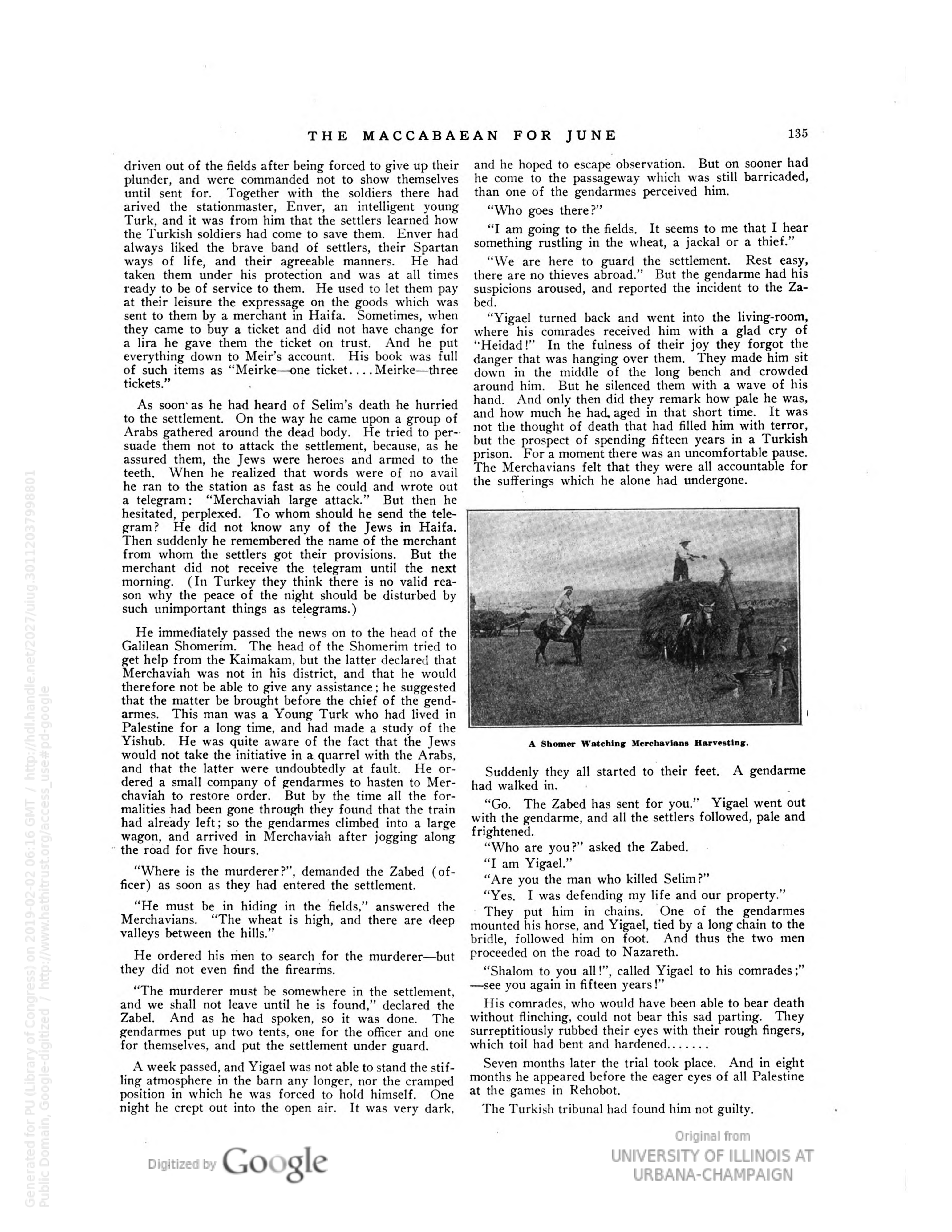
A Shomer Watching Merchavians Harvesting.
Suddenly they all started to their feet. A gendarme had walked in.
"Go. The Zabed has sent for you." Yigael went out with the gendarme, and all the settlers followed, pale and frightened.
"Who are you?" asked the Zabed.
"I am Yigael."
"Are you the man who killed Selim?"
"Yes. I was defending my life and our property."
They put him in chains. One of the gendarmes mounted his horse, and Yigael, tied by a long chain to the bridle, followed him on foot. And thus the two men proceeded on the road to Nazareth.
"Shalom to you all!", called Yigael to his comrades; —see you again in fifteen years!"
His comrades, who would have been able to bear death without flinching, could not bear this sad parting. They surreptitiously rubbed their eyes with their rough fingers, which toil had bent and hardened.....
Seven months later the trial took place. And in eight months he appeared before the eager eyes of all Palestine at the games in Rehobot.
The Turkish tribunal had found him not guilty.