Arab. And best of all, he is brave. He will never put us to shame."
"Who will go with me?" asked Yigael quietly, wholly unconcerned by both the laughter and the praise.
"There ought to be two watchmen next to the mill, and two others on the opposite side of the settlement," said the head of the "Vaad."
"Only two need go with me. I'll watch on the one side alone."
"I'll go, I'll go," responded two of the settlers. The older ones had been put to shame by the determination of the boy.
"All right," said the head of the "Vaad." "You two will patrol the mill and the highway on the further side of the settlement, and he will watch on the nearer side."
"No," cried Yigael, "I myself will patrol near the mill and the highway; it is there that the sheikh will attack us, and I want to deal with him myself."
The settlers then dispersed, each one to his work, satisfied with this solution of the problem, and proud of the courage of their comrades.
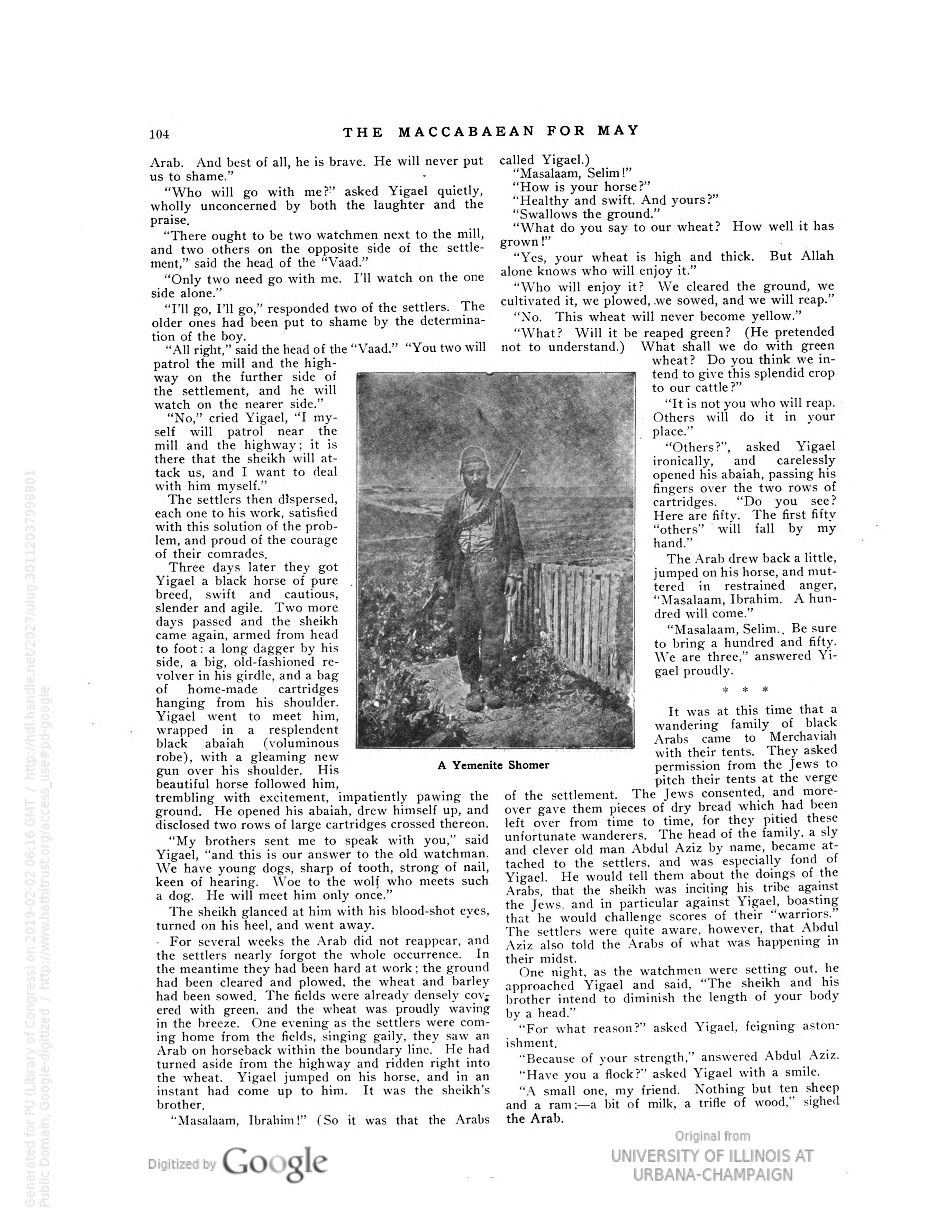
Three days later they got Yigael a black horse of pure breed, swift and cautious, slender and agile. Two more days passed and the sheikh came again, armed from head to foot: a long dagger by his side, a big, old-fashioned revolver in his girdle, and a bag of home-made cartridges hanging from his shoulder. Yigael went to meet him, wrapped in a resplendent black abaiah (voluminous robe), with a gleaming new gun over his shoulder. His beautiful horse followed him, trembling with excitement, impatiently pawing the ground. He opened his abaiah, drew himself up, and disclosed two rows of large cartridges crossed thereon.
"My brothers sent me to speak with you," said Yigael, "and this is our answer to the old watchman. We have young dogs, sharp of tooth, strong of nail, keen of hearing. Woe to the wolf who meets such a dog. He will meet him only once."
The sheikh glanced at him with his blood-shot eyes, turned on his heel, and went away.
- For several weeks the Arab did not reappear, and the settlers nearly forgot the whole occurrence. In the meantime they had been hard at work; the ground had been cleared and plowed, the wheat and barley had been sowed. The fields were already densely cov; ered with green, and the wheat was proudly waving in the breeze. One evening as the settlers were coming home from the fields, singing gaily, they saw an Arab on horseback within the boundary line. He had turned aside from the highway and ridden right into the wheat. Yigael jumped on his horse, and in an instant had come up to him. It was the sheikh’s brother.
"Masalaam, Ibrahim!" (So it was that the Arabs
called Yigael.)
"Masalaam, Selim!"
"How is your horse?"
"Healthy and swift. And yours?"
"Swallows the ground."
"What do you say to our wheat? How well it has grown!"
"Yes, your wheat is high and thick. But Allah alone knows who will enjoy it."
"Who will enjoy it? We cleared the ground, we cultivated it, we plowed, we sowed, and we will reap."
"No. This wheat will never become yellow."
"What? Will it be reaped green? (He pretended not to understand.) What shall we do with green
wheat? Do you think we intend to give this splendid crop to our cattle?"
"It is not you who will reap. Others will do it in your place."
"Others?", asked Yigael ironically, and carelessly opened his abaiah, passing his fingers over the two rows of cartridges. "Do you see? Here are fifty. The first fifty "others" will fall by my hand."
The Arab drew back a little, jumped on his horse, and muttered in restrained anger, "Masalaam, Ibrahim. A hundred will come."
"Masalaam, Selim. Be sure to bring a hundred and fifty. We are three," answered Yigael proudly.
* * *
It was at this time that a wandering family of black Arabs came to Merchaviah with their tents. They asked permission from the Jews to pitch their tents at the verge
of the settlement. The Jews consented, and moreover gave them pieces of dry bread which had been left over from time to time, for they pitied these unfortunate wanderers. The head of the family, a sly and clever old man Abdul Aziz by name, became attached to the settlers, and was especially fond of Yigael. He would tell them about the doings of the Arabs, that the sheikh was inciting his tribe against the Jews, and in particular against Yigael, boasting that he would challenge scores of their “warriors.” The settlers were quite aware, however, that Abdul Aziz also told the Arabs of what was happening in their midst.
One night, as the watchmen were setting out, he approached Yigael and said, "The sheikh and his brother intend to diminish the length of your body by a head."
“For what reason?” asked Yigael, feigning astonichment.
"Because of your strength," answered Abdul Aziz.
"Have you a flock?" asked Yigael with a smile.
"A small one, my friend. Nothing but ten sheep and a ram;—a bit of milk, a trifle of wood," sighed the Arab.