it was to buy flour, fuel, sugar and provisions, also to hire mills to grind the wheat into flour.
The Bread Committee consisted of Mr. Leo and Mr. Dunewitch. Their duty was to hire baker's shops to bake the flour into bread and to deliver the loaves at a low price to the various relief shops and institutions.
After that, we organized a committce to open American relief stores, which worked in conjunction with the bread and food supplies committees. On this committee were Mr. S. Rokeach, Mr. Idelson and myself. These stores sold goods on a 10% basis of profit to cover expenses and losses, and this brought down the price of food considerably. At the beginning, the government had commandeered so much food from the stores, that the storekeepers raised the price of food. These relief stores also accepted bank checks. Not having any small change for bank checks and not wishing to sell to one family more goods than were actually needed, we organized a system of selling in the American relief stores only on Books.
Each customer would receive a book, with which he could get supplies up to a certain amount weekly, according to the size of his family. If he paid in on his book a check of 20 franc, he would be credited with eighteen franc and the balance of two franc would remain standing with the committee until after the war. In those days, a twenty franc check was accepted all over at 14 and 16 franc gold value. At this point, I must mention that most of our supplies had to be bought with gold from the Arabs. At first, the government did not commandeer any of our relief supplies but later, it took fifty-four bags of sugar from the last sixty we had, and left us with four bags and when we, Mr. Haidegg, American Consul Agent, Mr. Idelson and I, as American citizens, protested in behalf of the American Relief Committee and told the Kaimakan of Jaffa that this sugar must be left for hospitals, the sick and babies, he replied that the army needed it more than these. The provisions were never returned, to my knowledge.
Then there was the Distributing Committee, which distributed flour and other necessities to the poor without money. Mr. Bezalel, Lapin and others attended to this work.
The amount of work done by these committees was tremendous, as with the little funds we had, and with such a big and hungry and chronically poverty-stricken population drawing on them, it was absolutely impossible to satisfy everybody. Of course, it may be that if such organizations had been created under normal conditions, they could have done better, but because the chain of calamities came on so suddenly, it took a great deal of self-denial and hard work on the part of all the workers to do as well as they did. Often they worked until they were exhausted, and they forgot their sleep and their meals.
There was also a bread and tea house, of which the ladies took charge which catered to several hundreds daily. Then there was a cheap restaurant which was in existence a number of years and which was under the direction of Messrs. Goldberg and Diskin of Tel Abib, where one could get a clean, wholesome meal for four metalik. The drain on this institution had become very great, and the relief committee had to appropriate money monthly to help it maintain itself. Of course, all this was not done with American Relief money. Local residents contributed most of the money, but it all went under the name of American Relief so that the Government should not commandeer it. The Anglo-Palestine Bank gave most of the money for the loan association and helved in other wavs.
There were quite a number of American citizens at that time in Jaffa who came to me for help. I consulted with Dr. Ruppin and he left it to me to investigate to find out what they needed and I would issue orders to them, which would be filled by the various committees as best they were able.
Most of the people active in this work were affiliated with the Zionist movement.
Annual Convention of Zionist Council of Greater New York
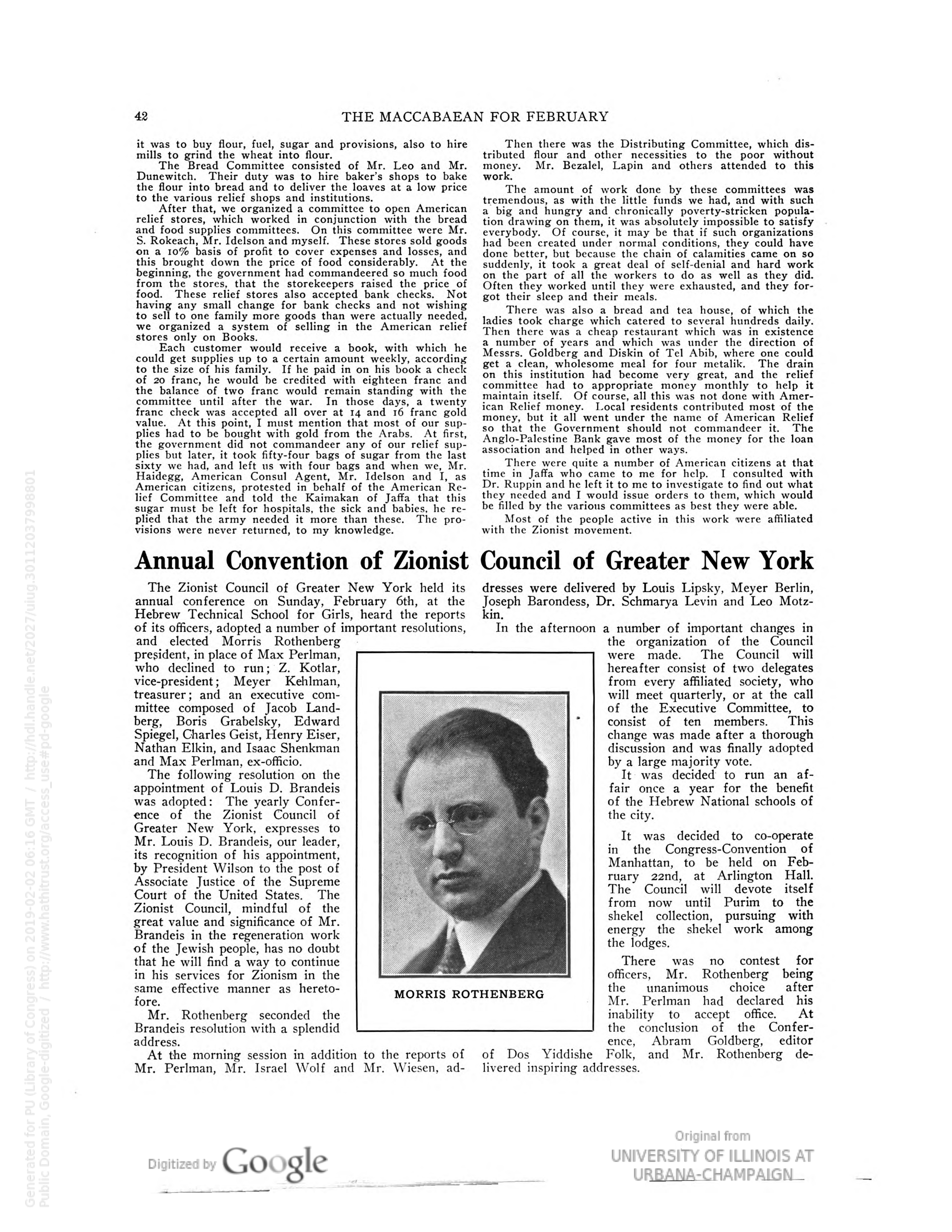
The Zionist Council of Greater New York held its annual conference on Sunday, February 6th, at the Hebrew Technical School for Girls, heard the reports of its officers, adopted a number of important resolutions, and elected Morris Rothenberg president, in place of Max Perlman, who declined to run; Z. Kotlar, vice-president; Meyer Kehlman, treasurer; and an executive committee composed of Jacob Landberg, Boris Grabelsky, Edward Spiegel, Charles Geist, Henry Eiser, Nathan Elkin, and Isaac Shenkman and Max Perlman, ex-officio.
The following resolution on the appointment of Louis D. Brandeis was adopted: The yearly Conference of the Zionist Council of Greater New York, expresses to Mr. Louis D. Brandeis, our leader, its recognition of his appointment, by President Wilson to the post of Associate Justice of the Supreme Court of the United States. The Zionist Council, mindful of the great value and significance of Mr. Brandeis in the regeneration work of the Jewish people, has no doubt that he will find a way to continue in his services for Zionism in the same effective manner as heretofore.
Mr. Rothenberg seconded the Brandeis resolution with a splendid address.
At the morning session in addition to the reports of Mr. Perlman, Mr. Israel Wolf and Mr. Wiesen, ad-
dresses were delivered by Louis Lipsky, Meyer Berlin, Joseph Barondess, Dr. Schmarya Levin and Leo Motzkin.
In the afternoon a number of important changes in the organization of the Council were made. The Council will hereafter consist of two delegates from every affiliated society, who will meet quarterly, or at the call of the Executive Committee, to consist of ten members. This change was made after a thorough discussion and was finally adopted by a large majority vote.
It was decided to run an affair once a year for the benefit of the Hebrew National schools of the city.
It was decided to co-operate in the Congress-Convention of Manhattan, to be held on February 22nd, at Arlington Hall. The Council will devote itself from now until Purim to the shekel collection, pursuing with energy the shekel work among the lodges.
There was no contest for officers, Mr. Rothenberg being the unanimous choice after Mr. Perlman had declared his inability to accept office. At the conclusion of the Conference, Abram Goldberg, editor of Dos Yiddishe Folk, and Mr. Rothenberg delivered inspiring addresses.