your brethren shall you choose a king," he burst into tears, for he felt his unworthiness. But the people, moved, shouted, "Thou art our brother! Thou are our brother!" and wept with him; and thus the people crowned their king.
Judaeacus gazed and listened entranced; for it seemed to him that he was the king asking for pardon
and he was the people pardoning. And at the end of the service when the people gave each other the usual greetings, he kissed his father on both cheeks and he kissed the stern old man Rabbi Ben Ezra and he picked up little Eli, kissed him and carried him forth in his arms as he passed out of the great temple with the Congregation.
Farming In Palestine
By Earnest F. Beaumont
Reprinted by Courtesy of the Scientific American
THE tourist generally enters Palestine by the open port of Jaffa and goes up to Jerusalem by the single narrow gage railway which connects these two places. He crosses the Plain of Sharon, and then the train slowly climbs the mountains of Judea to Jerusalem. In spring, the Plain of Sharon is green with fine wheat fields studded with gorgeous red anemones, and they give the impression of a land of fertility. This, however, is soon lost after the traveler has been in the mountain country for a time. Unless he is a close observer and somewhat familiar with conditions in semi-arid regions, his question would probably be: Where is the land flowing with milk and honey? To really understand the agricultural possibilities of Palestine one must remain some time in the country and study the conditions that here obtain.
The country is decidedly unique in its physical formation. The deep depression or geological fault known as the Jordan Valley, formed in prehistoric times by volcanic action, divides it throughout its entire length. The formation is of various
Notwithstanding the fact that the soil is in many places thin, in most cases the limestone rock below is full of large crevices and pockets, where the rotts of trees find
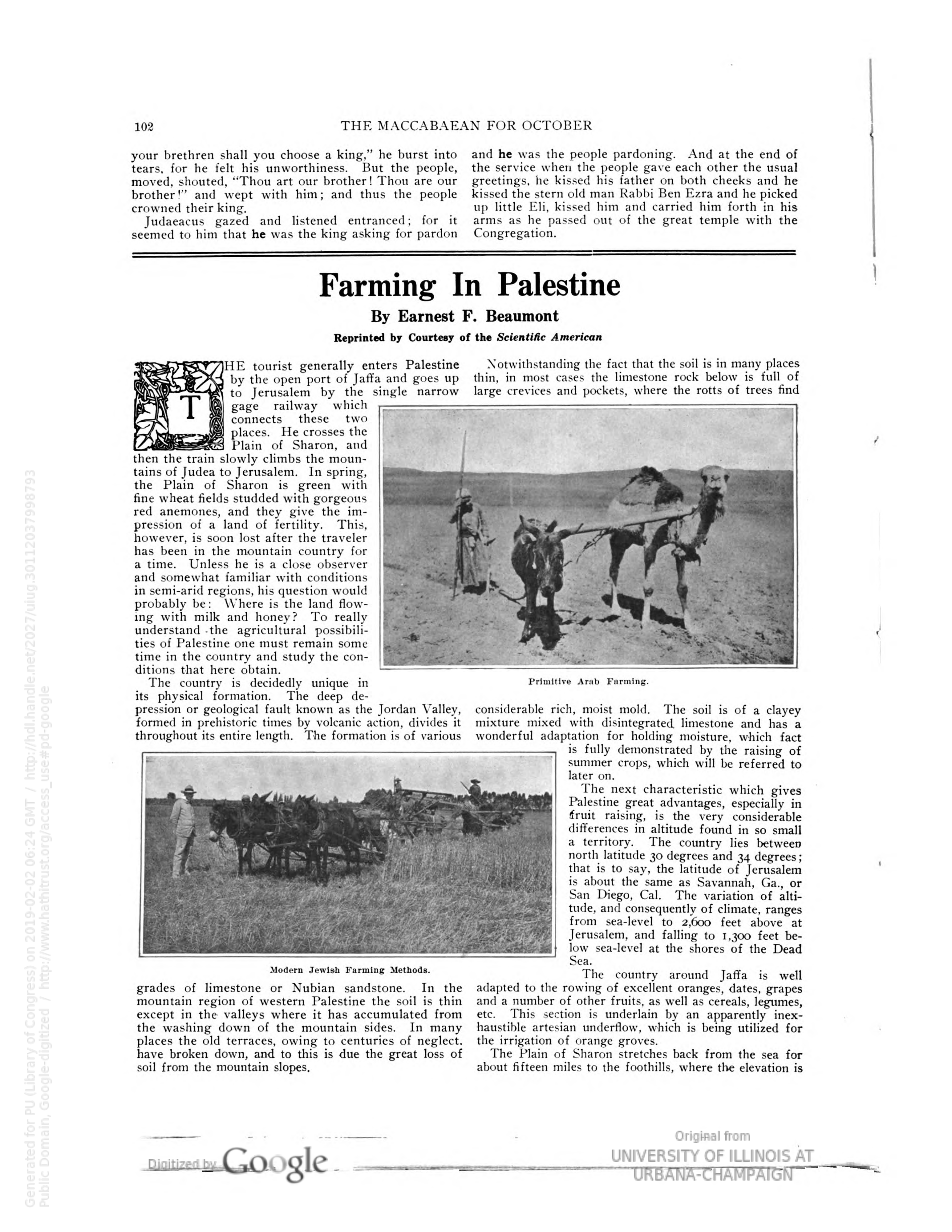
Primitive Arab Farming.
considerable rich, moist mold. The soil is of a clayey mixture mixed with disintegrated limestone and has a wonderful adaptation for holding moisture, which fact is fully demonstrated by the raising of summer crops, which will be referred to later on.
The next characteristic which gives Palestine great advantages, especially in fruit raising, is the very considerable differences in altitude found in so small a territory. The country lies between north latitude 30 degrees and 34 degrees; that is to say, the latitude of Jerusalem is about the same as Savannah, Ga., or San Diego, Cal. The variation of altitude, and consequently of climate, ranges from sea-level to 2,600 feet above at Jerusalem, and falling to 1,300 feet below sea-level at the shores of the Dead Sea.
The country around Jaffa is well adapted to the growing of excellent oranges, dates, grapes and a number of other fruits, as well as cereals, legumes, etc. This section is underlain by an apparently inexhaustible artesian underflow, which is being utilized for the irrigation of orange groves.
The Plain of Sharon stretches back from the sea for about fifteen miles to the foothills, where the elevation is
Modern Jewish Farming Methods.
grades of limestone or Nubian sandstone. In the mountain region of western Palestine the soil is thin except in the valleys where it has accumulated from the washing down of the mountain sides. In many places the old terraces, owing to centuries of neglect. have broken down, and to this is due the great loss of soil from the mountain sloves.