The Jewish Problem—How To Solve It
By LOUIS D. BRANDEIS
THE suffering of the Jews due to injustices continuing throughout nearly twenty centuries is the greatest tragedy in history. Never was the aggregate of such suffering larger then today. Never were the injustices more glaring. Yet the present is preeminently a time for hopefulness. The current of worldthought is at last preparing the way for our attaining justice. The war is developing opportunities which may make possible the solution of the Jewish problem. But to avail of these opportunities we must understand both them and ourselves. We must recognize and accept facts. We must consider our course with statesmanlike calm. We must pursue resolutely the course we shall decide upon; and be ever ready to make the sacrifices which a great cause demands.
WHAT THE PROBLEM IS.
For us the Jewish Problem means this: How can we secure for Jews, wherever they may live, the same rights and opportunities enjoyed by non-Jews? And how can we secure for the world the full contribution which Jews can make if unhampered by artificial limitations?
The problem has two aspects: That of the individual Jew, and that of Jews collectively. Obviously, no individual should be subjected anywhere, by reason of the fact that he is a Jew, to a denial of any common rights or opportunity enjoyed by non-Jews. But Jews collectively should likewise enjoy the same right and opportunity to live and develop as do other groups of people. This right of development on the part of the group is essential to the full enjoyment of rights by the individual. For the individual is dependent for his development (and his happiness), in large part upon the development of the group of which he forms a part. We can scarcely conceive of an individual German or Frenchman living and developing without some relation to the contemporary German or French life and culture. And since death is not a solution of the problem of life, the solution of the Jewish Problem necessarily involves the continued existence of the Jews as Jews.
Councils of Rabbis and others have undertaken at times to prescribe by definition that only those shall be deemed Jews who professedly adhere to the orthodox or reformed faith. But in the connection in which we are considering the term, it is not in the power of any single body of Jews—or indeed of all Jews collectively—to establish the effective definition. The meaning of the word
Jewish in the term Jewish Problem must be accepted as coextensive with the disabilities which it is our problem to remove. It is the non-Jews who create the disabilities and in so doing give definition to the term Jew. Those disabilities extend substantially to all of Jewish blood. The disabilities do not end with a renunciation of faith, however sincere. They do not end with the elimination, however complete, of external Jewish mannerisms. The disabilities do not end ordinarily until the Jewish blood has been so thoroughly diluted by repeated intermarriages as to result in practically obliterating the Jew.
And we Jews, by our own acts, give a like definition to the term Jew. When men and women of Jewish blood suffer—because of that fact—and even if they suffer from quite different causes, our sympathy and our help goes out to them instinctively in whatever country they may live and without ınquiring into the shades of their beliet or unbelief. When those of Jewish blood exhibit moral or intellectual superiority, genius or special talent, we feel pride in them, even if they have abjured the faith like Spinoza, Marx, Disraeli or Heine. Despite the meditations of pundits or the decrees of councils, our own instincts and acts, and those of others, have defined for us the term Tew.
LIBERALISM AND ANTI-SEMITISM
Half a century ago the belief was still general that Jewish disabilities would disappear before growing liberalism. When religious toleration was proclaimed, the solution of the Jewish Problem seemed in sight.
When the so-called rights of man became widely recognized, and the equal right of all citizens to life, liberty and the pursuit of happiness began to be enacted into positive law, the complete emancipation of the Jew seemed at hand. The concrete gains through liberalism were indeed large. Equality before the law was established throughout the western hemisphere. The Ghetto walls crumbled; the ball and chain of restraint were removed in central and western Europe. Compared with the cruel discrimination to which Jews are now subjected in Russia and Roumania, their advanced condition in other parts of Europe seems almost ideal.
But Anti-Jewish prejudice was not exterminated even in those countries of Europe in which the triumph of
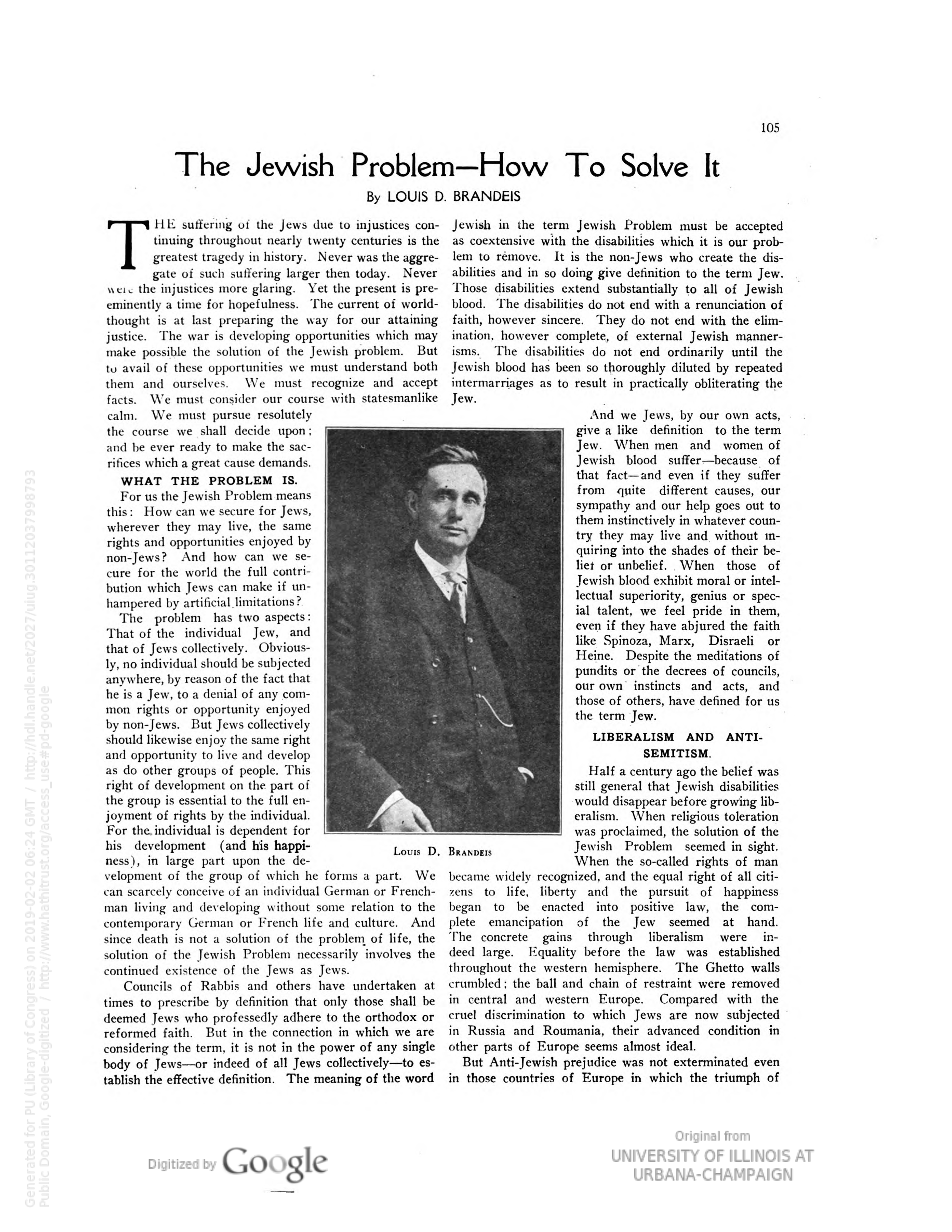
LOUIS D. BRANDEIS