traders and factors, the latter being compelled to join the ranks of beggars or to wander to far America. And the more the peasant becomes póorer, the populátion increases and the land-ownings of the peasants go on decreasing; thus the smáller the productive forces of the peasant actually become, the more he takes refuge in the region of consuming and endeavors to place the league in the place of the middlemen. Moreover, these leagues are subsidized and secure loans without interest from the autonomous institutions.
The same is the case with trade in money. The time was, when this trade was exclusively carried on by Jews, but now they are driven out by the hypotecateshouses and partly by the institutions of mutual aid. That this movement of the Galician peasant towards economic self-help, which bears in itself the final destruction of Jewish economic activity, should be inspired and assisted by the ruling “Szlachta” is only self-evident. Being conscious enough of the terrible conditions of the peasants and of the consequences that might thereby occur of the possibility of bitter outrages on the part of the latter— the “Szlachta” carries on an intensive activeness on behalf of the described movement, to ruin the Jew and thus “regenerate” the peasant. Not only has the autonomous government taken away from the Jews the small salt-traffic and the trade in tobacco, excluded them from the right to furnish commodities for public enterprises, etc., but it is also acting directly to create and sustain a native class of traders, the policy being that of giving the Christian traders privileges and substantial aid in money. Taking then into consideration that out of 811,371 the Jewish
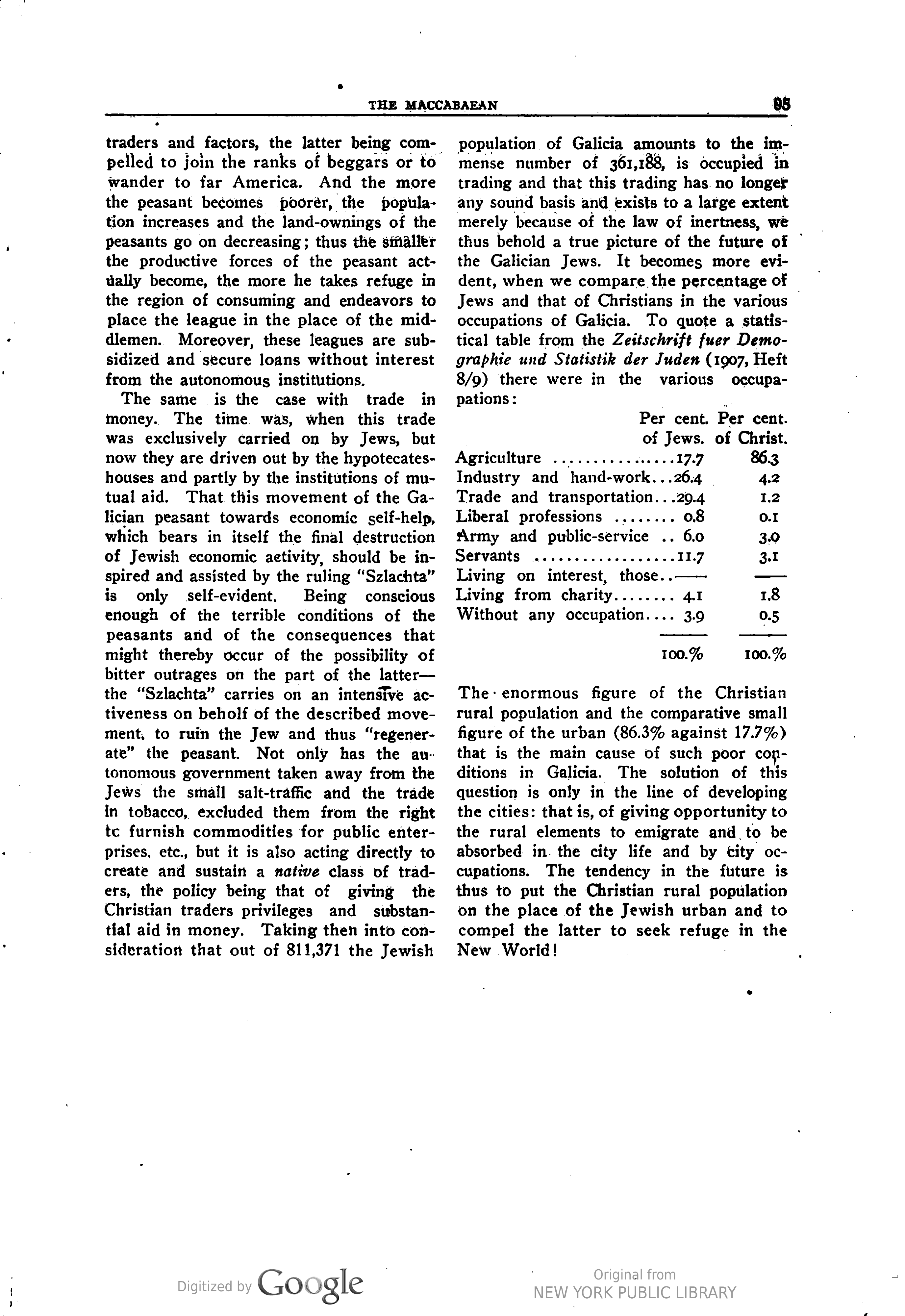
population of Galicia amounts to the immense number of 361,188, is occupied in trading and that this trading has no longer any sound basis and exists to a large extent merely because of the law of inertness, we thus behold a true picture of the future of the Galician Jews. It becomes more evident, when we compare the percentage of Jews and that of Christians in the various occupations of Galicia. To quote a statistical table from the Zeitschrift fuer Demographie und Statistik der Juden (1907, Heft 8/9) there were in the various occupapations:
The enormous figure of the Christian rural population and the comparative small figure of the urban (86.3% against 17.7%) that is the main cause of such poor conditions in Galicia. The solution of this question is only in the line of developing the cities: that is, of giving opportunity to the rural elements to emigrate and to be absorbed in. the city life and by city occupations. The tendency in the future is thus to put the Christian rural population on the place of the Jewish urban and to compel the latter to seek refuge in the New World!