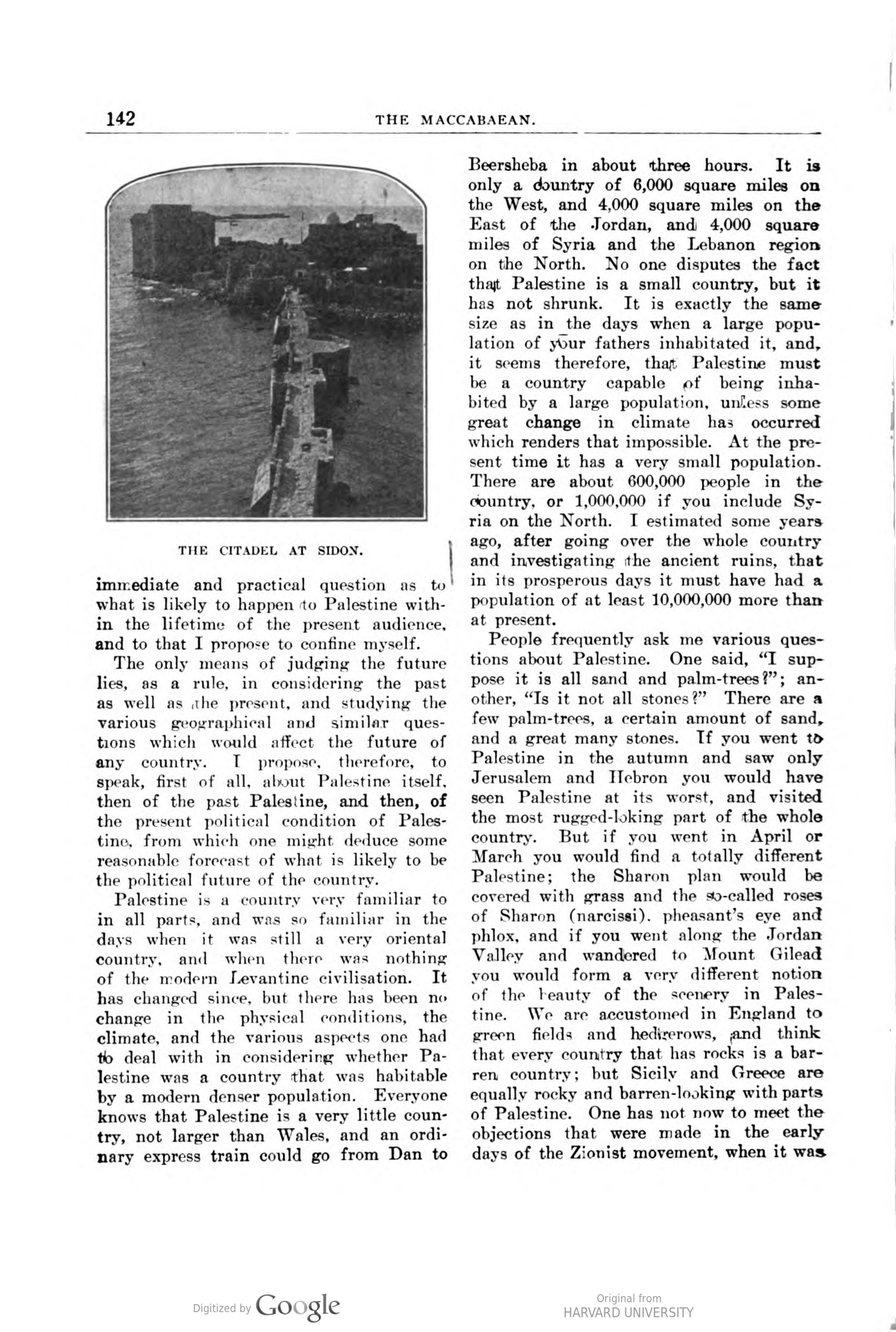
THE CITADEL AT SIDON.
immediate and practical question as to what is likely to happen to Palestine within the lifetime of the present audience, and to that I propose to confine myself.
The only means of judging the future lies, as a rule, in considering the past as well as the present, and studying the various geographical and similar questions which would affect the future of any country. I propose, therefore, to speak, first of all, about Palestine itself, then of the past Palestine, and then, of the present political condition of Palestine, from which one might deduce some reasonable forecast of what is likely to be the political future of the country.
Palestine is a country very familiar to in all parts, and was so familiar in the days when it was still a very oriental country, and when there was nothing of the modern Levantine civilisation. It has changed since, but there has been no change in the physical conditions, the climate, and the various aspects one had to deal with in considering whether Palestine was a country that was habitable by a modern denser population. Everyone knows that Palestine is a very little country, not larger than Wales, and an ordinary express train could go from Dan to
Beersheba in about three hours. It isonly a country of 6,000 square miles onthe West, and 4,000 square miles on theEast of the Jordan, and 4,000 squaremiles of Syria and the Lebanon regionon the North. No one disputes the factthat Palestine is a small country, but ithas not shrunk. It is exactly the samesize as in the days when a large population of your fathers inhabited it, and,it seems therefore, that Palestine mustbe a country capable of being inhabited by a large population, unless somegreat change in climate has occurredwhich renders that impossible. At the present time it has a very small population.There are about 600,000 people in thecountry, or 1,000,000 if you include Syria on the North. I estimated some yearsago, after going over the whole countryand investigating the ancient ruins, thatin its prosperous days it must have had apopulation of at least 10,000,000 more thanat present.
People frequently ask me various questions about Palestine. One said, "I suppose it is all sand and palm-trees?"; another, "Is it not all stones?" There are a few palm-trees, a certain amount of sand, and a great many stones. If you went to Palestine in the autumn and saw only Jerusalem and Hebron you would have seen Palestine at its worst, and visited the most rugged-looking part of the whole country. But if you went in April or March you would find a totally different Palestine; the Sharon plain would be covered with grass and the so-called roses of Sharon (narcissi). pheasant's eye and phlox, and if you went along the Jordan Valley and wandered to Mount Gilead you would form a very different notion of the beauty of the scenery in Palestine. We are accustomed in England to green fields and hedgerows, and think that every country that has rocks is a barren country; but Sicily and Greece are equally rocky and barren-looking with parts of Palestine. One has not now to meet the objections that were made in the early days of the Zionist movement, when it was