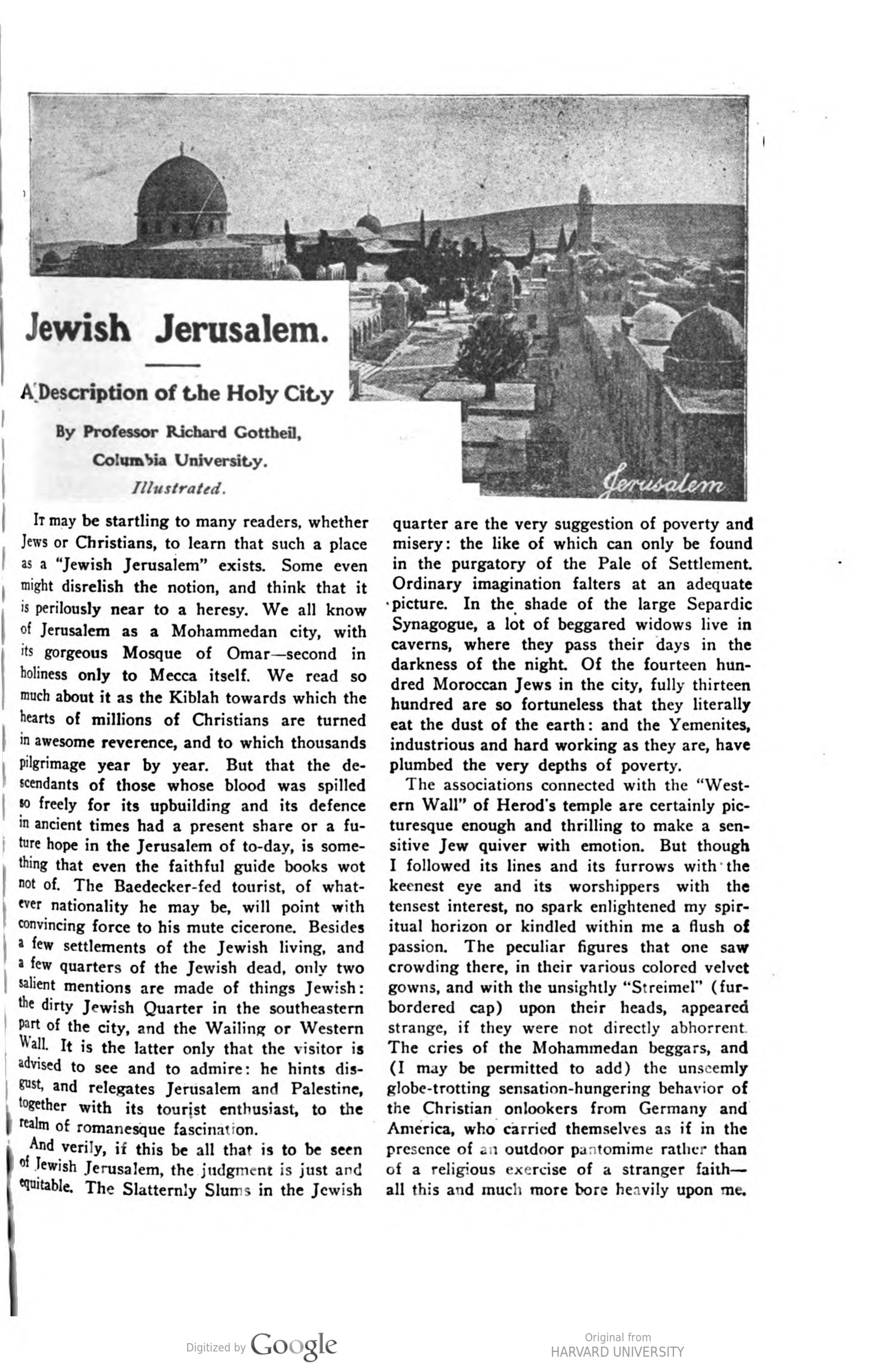
Jewish Jerusalem.
A Description of the Holy City
By Professor Richard Gottheil, Columbia University.
Illustrated.
IT may be startling to many readers, whether Jews or Christians, to learn that such a place as a “Jewish Jerusalem” exists. Some even might disrelish the notion, and think that it is perilously near to a heresy. We all know of Jerusalem as a Mohammedan city, with its gorgeous Mosque of Omar—second in holiness only to Mecca itself. We read so much about it as the Kiblah towards which the hearts of millions of Christians are turned in awesome reverence, and to which thousands pilgrimage year by year. But that the descendants of those whose blood was spilled so freely for its upbuilding and its defence in ancient times had a present share or a future hope in the Jerusalem of to-day, is something that even the faithful guide books wot not of. The Baedecker-fed tourist, of whatever nationality he may be, will point with convincing force to his mute cicerone. Besides a few settlements of the Jewish living, and a few quarters of the Jewish dead, only two salient mentions are made of things Jewish: the dirty Jewish Quarter in the southeastern part of the city, and the Wailing or Western Wall. It is the latter only that the visitor is advised to see and to admire: he hints disgust, and relegates Jerusalem and Palestine, together with its tourist enthusiast, to the realm of romanesque fascination.
And verily, if this be all that is to be seen of Jewish Jerusalem, the judgment is just and equitable. The Slatternly Slums in the Jewish
quarter are the very suggestion of poverty and misery: the like of which can only be found in the purgatory of the Pale of Settlement. Ordinary imagination falters at an adequate picture. In the shade of the large Separdic Synagogue, a lot of beggared widows live in caverns, where they pass their days in the darkness of the night. Of the fourteen hundred Moroccan Jews in the city, fully thirteen hundred are so fortuneless that they literally eat the dust of the earth: and the Yemenites, industrious and hard working as they are, have plumbed the very depths of poverty.
The associations connected with the “Western Wall” of Herod’s temple are certainly picturesque enough and thrilling to make a sensitive Jew quiver with emotion. But though I followed its lines and its furrows with the keenest eye and its worshippers with the tensest interest, no spark enlightened my spiritual horizon or kindled within me a flush of passion. The peculiar figures that one saw crowding there, in their various colored velvet gowns, and with the unsightly “Streimel” (furbordered cap) upon their heads, appeared strange, if they were not directly abhorrent. The cries of the Mohammedan beggars, and (I may be permitted to add) the unseemly globe-trotting sensation-hungering behavior of the Christian onlookers from Germany and America, who carried themselves as if in the presence of an outdoor pantomime rather than of a religious exercise of a stranger faith— all this and much more bore heavily upon me.