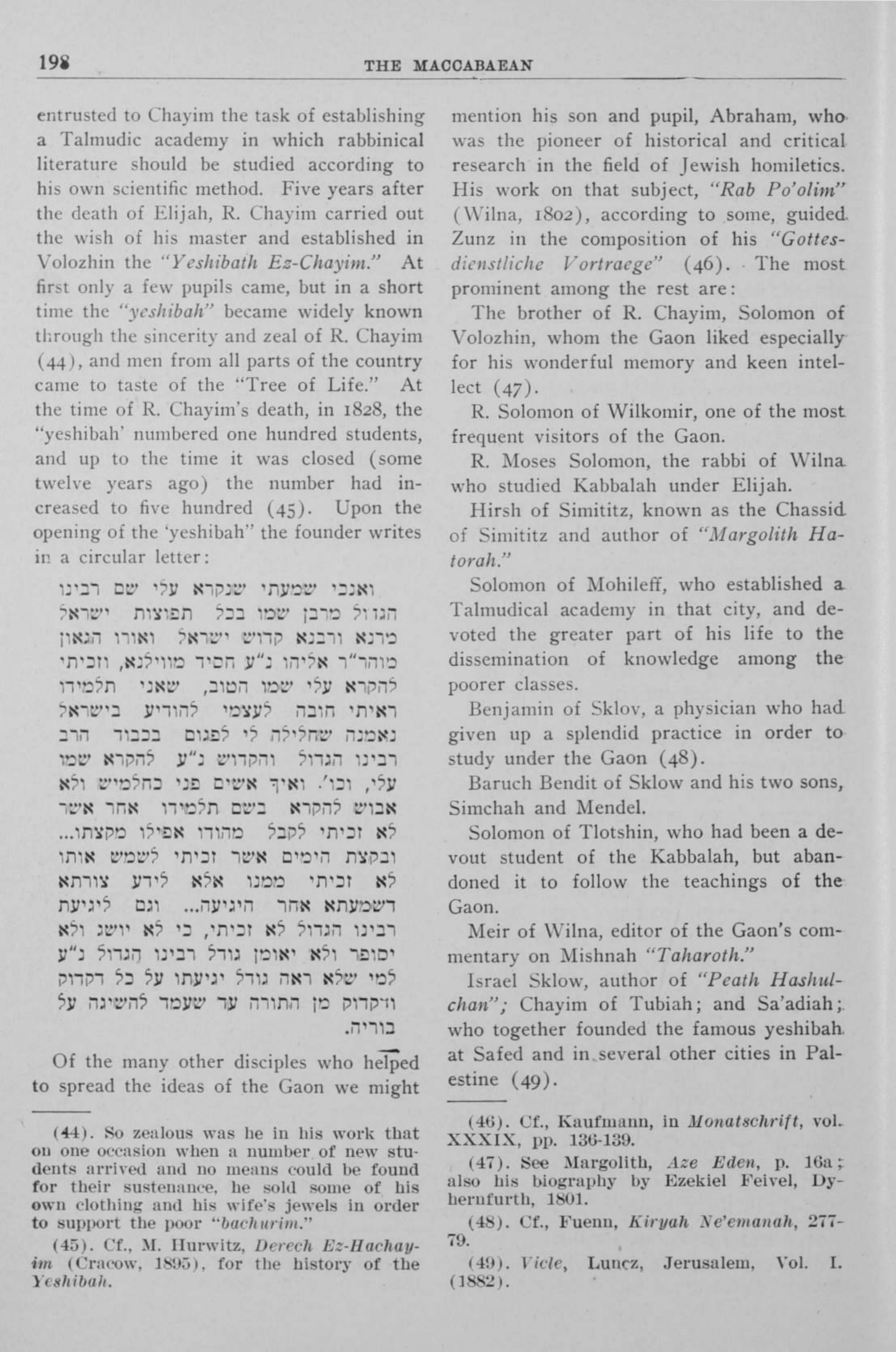
entrusted to Chayim the task of establishing a Talmudic academy in which rabbinical literature should be studied according to his own scientific method. Five years after the death of Elijah, R. Chayim carried out the wish of his master and established in Volozhin the "Yeshibath Ez-Chayim." At first only a few pupils came, but in a short time the "yeshibah" became widely known through the sincerity and zeal of R. Chayim (44), and men from all parts of the country came to taste of the "Tree of Life." At the time of R. Chayim's death, in 1828, the "yeshibah" numbered one hundred students, and up to the time it was closed (some twelve years ago) the number had increased to five hundred (45). Upon the opening of the "yeshibah" the founder writes in a circular letter:
ואנכי שמעתי שנקרא עלי שם רבינו הגוול מרבן שמו בכל תפוצות ישראל מרנא ורבנא קדוש ישראל ואורו הגאון מוהר"ר אליהו נ"ע חסיד מווילנא, וזכיתי להקרא עלי שמו הטוב, שאני תלמידו ראיתי חובה לעצמי להודיע בישראל נאמנה שחלילה לי לפגום בכבוד הרב רבינו הגדול והקדוש נ"ע להקרא שמו עלי, וכו' ואיך אשים פני כחלמיש ולא אבוש להקרא בשם תלמידו אחר אשר לא זכיתי לקבל מהודו אפילו מקצתו... ובקצת הימים אשר זכיתי לשמש אותו לא זכיתי ממנו אלא לידע צורתא דשמעתא אחר היגיעה... וגם ליגיעת רבינו הגדול לא זכיתי, כי לא יושג ולא יסופר ולא יאומן גודל רבינו הגדול נ"ע למי שלא ראה גודל יגיעתו על כל דקדוק ויקדוק מן התורה עד שעמד להשיגה על בוריה.
Of the many other disciples who helped to spread the ideas of the Gaon we might
(44). So zealous was he in his work that on one occasion when a number of new students arrived and no means could be found for their sustenance, he sold some of his own clothing and his wife's jewels in order to support the poor "bachurim."
(45). Cf., M. Hurwitz, Derech Ez-Hachayim (Cracow, 1895), for the history of the Yeshibath.
mention his son and pupil, Abraham, who was the pioneer of historical and critical research in the field of Jewish homiletics. His work on that subject, "Rab Po'olim" (Wilna, 1802), according to some, guided Zunz in the composition of his "Gottesdienstliche Vortraege" (46). The most prominent among the rest are:
The brother of R. Chayim, Solomon of Volozhin, whom the Gaon liked especially for his wonderful memory and keen intellect (47).
R. Solomon of Wilkomir, one of the most frequent visitors of the Gaon.
R. Moses Solomon, the rabbi of Wilna who studied Kabbalah under Elijah.
Hirsh of Simititz, known as the Chassid of Simititz and author of "Margolith Hatorah."
Solomon of Mohileff, who established a Talmudical academy in that city, and devoted the greater part of his life to the dissemination of knowledge among the poorer classes.
Benjamin of Sklov, a physician who had given up a splendid practice in order to study under the Gaon (48).
Baruch Bendit of Sklow and his two sons, Simchah and Mendel.
Solomon of Tlotshin, who had been a devout student of the Kabbalah, but abandoned it to follow the teachings of the Gaon.
Meir of Wilna, editor of the Gaon’s commentary on Mishnah “Taharoth.”
Israel Sklow, author of "Peath Hashulchan"; Chayim of Tubiah; and Sa'adiah; who together founded the famous yeshibah at Safed and in several other cities in Palestine (49).
(46). Cf., Kaufmann, in Monatschrift, vol. XXXIX, pp. 136-139.
(47). See Margolith, Aze Eden, p. 16a; also his biography by Ezekiel Feivel, Dyhernfurth, 1801.
(48). Cf., Fuenn, Kiryah Ne'emanah, 277-79.
(49). Vicle, Luncz, Jerusalem, Vol. I. (1882).