Italian, Spanish, Dutch, French and English schools. The expression of art is bounded by environment and temperament. The Jewish environment has been dark and gloomy; the Jewish temperament is optimistic, whilst the Jewish mind is both realistic and agreeable to the symbolistic. In the Jargon poetry, where the Jewish heart speaks to and of the people, we have a full expression of the dark environment and this mournful hope —there is a Jewish note in poetry, though there is not more than the suggestion of Jewish feeling in music. But in painting and sculpture we have to scan carefully for something that might be cited as Jewish. Antokolsky was a Jew, but his sculptures exhibit nothing peculiarly Jewish; and the Jewish painters generally have followed the mode of the countries in which they lived. Nor is this to be wondered at; only a Jewish consciousness could seek to express in art something deliberately Jewish; and artists for the most part have lacked such an attitude. The Jewish artist has been rather more cosmopolitan than his non-Jewish brother of the brush; or as is the case of Israel, have been the most intense representatives of the art mode of the country in which they live.
In the last few years, however, a deliberate attempt has been made to span the gulf between a possible Jewish art and Jewish artists. Beer, as related in a
former issue of THE MACCABÆAN, has in bronze and marble sought to give expression in a Jewish attitude, though the medal he designed for the Second Basle Congress was Greek in every line of its conception. In the East of Europe a few Jewish artists have found a Jewish material upon which they could work. The Jew in Russia or Galicia has proved as fascinating as the Italian padrone; and if more squalid, is more realistic. The thought has spread so that we have now a complete series of cartoons caricaturing the life of the Galician Chassid, all more real and vital than the placid collection of Jewish pictures by Oppenheim, which depicted Jewish scenes in the method of the ordinary illustrator. The Jew, as a Jew sees him is somewhat different, often less picturesque but generally more pathetic, than even Rembrandt's great "Rabbi," that masterpiece of the medieval Jew. Alphonse Levy in France, too, has attempted to set forth the life of the Alsatian Jew; and a curiously homely set of pictures they are, faithful to Jewish life as a Jew knows it. Artists adopting this attitude may frankly be recognized as founding a Jewish school of art, but one or two have flown higher, and to these have been attributed the "Jewish art."
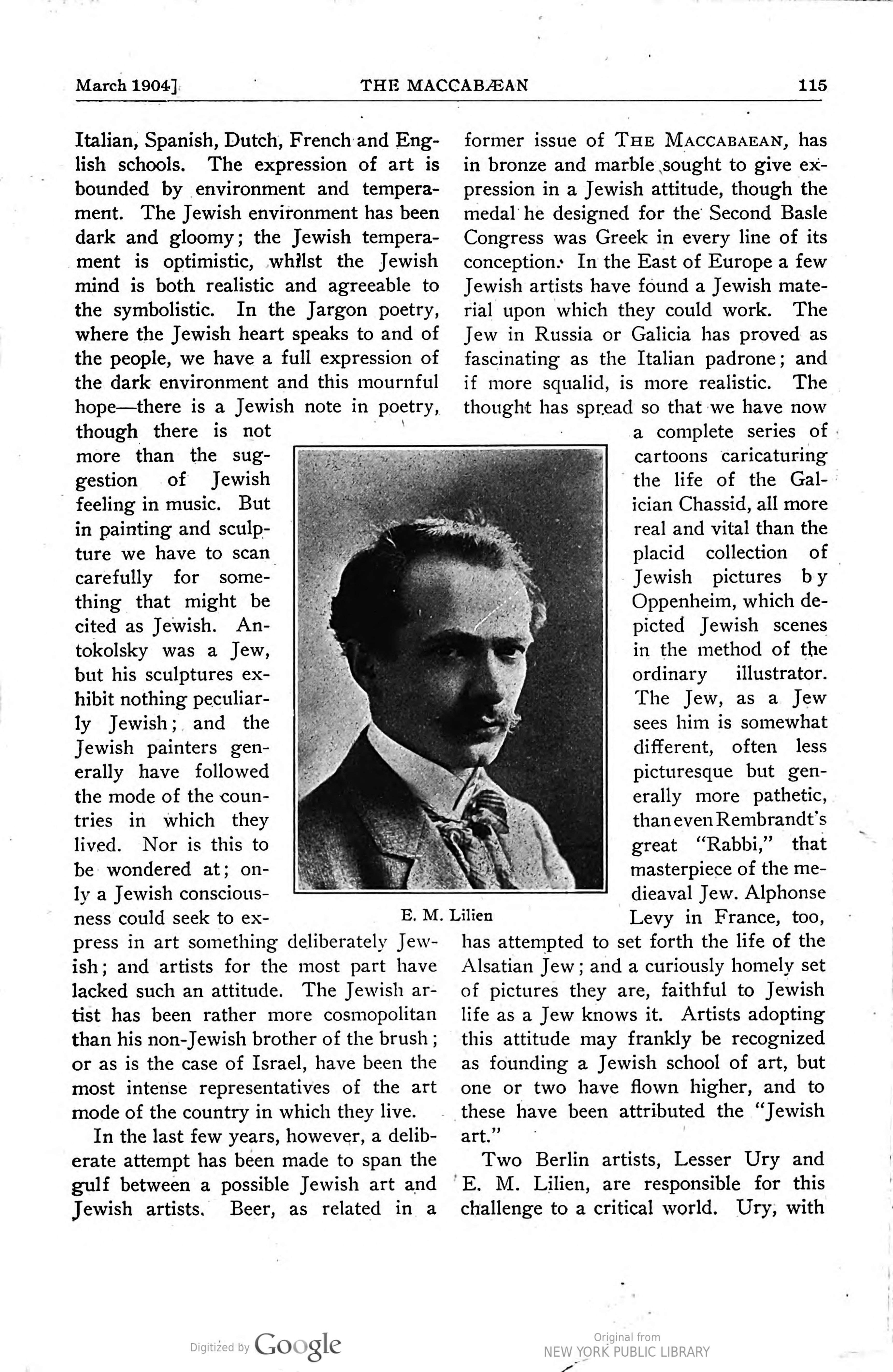
Two Berlin artists, Lesser Ury and E. M. Lilien, are responsible for this challenge to a critical world. Ury, with
E. M. Lilien