Russian delegates had come to after a long discussion, to the effect that the Congress, recognizing the great value of the offer of the British Government, begs to express to it the thanks of the Jewish people, but since the Congress wishes to remain true to its programme, it regrets that it cannot entertain the offer.
The flow of language went on until the Chairman announced that one hundred and twelve speakers were on the list, and it was thereupon decided to elect ten "general" speakers from them.
After a short interval the arguments and appeals pro and con East Africa were again proceeded with. The strongest efforts were made by fervent appeals to the Zionist ideals of a Jewish home in Palestine. The friends of East Africa only went so far as to advocate the formation of the proposed Commission, so as to at least know what was before them.
At midnight it was decided to adjourn the debate until the following day.
WEDNESDAY MORNING SITTING.
At this morning's sitting Herr Oppenheim spoke on the general aspect of the Colonization Question.
On the resumption of the debate on East Africa, Mr. Herbert Bentwich said: I address you not simply as an English Delegate, but as a selected representative speaker for those who, like myself, view with apprehension and disfavor the proposed East African scheme, and in that representative capacity I feel bound to give it my entire and uncompromising opposition.
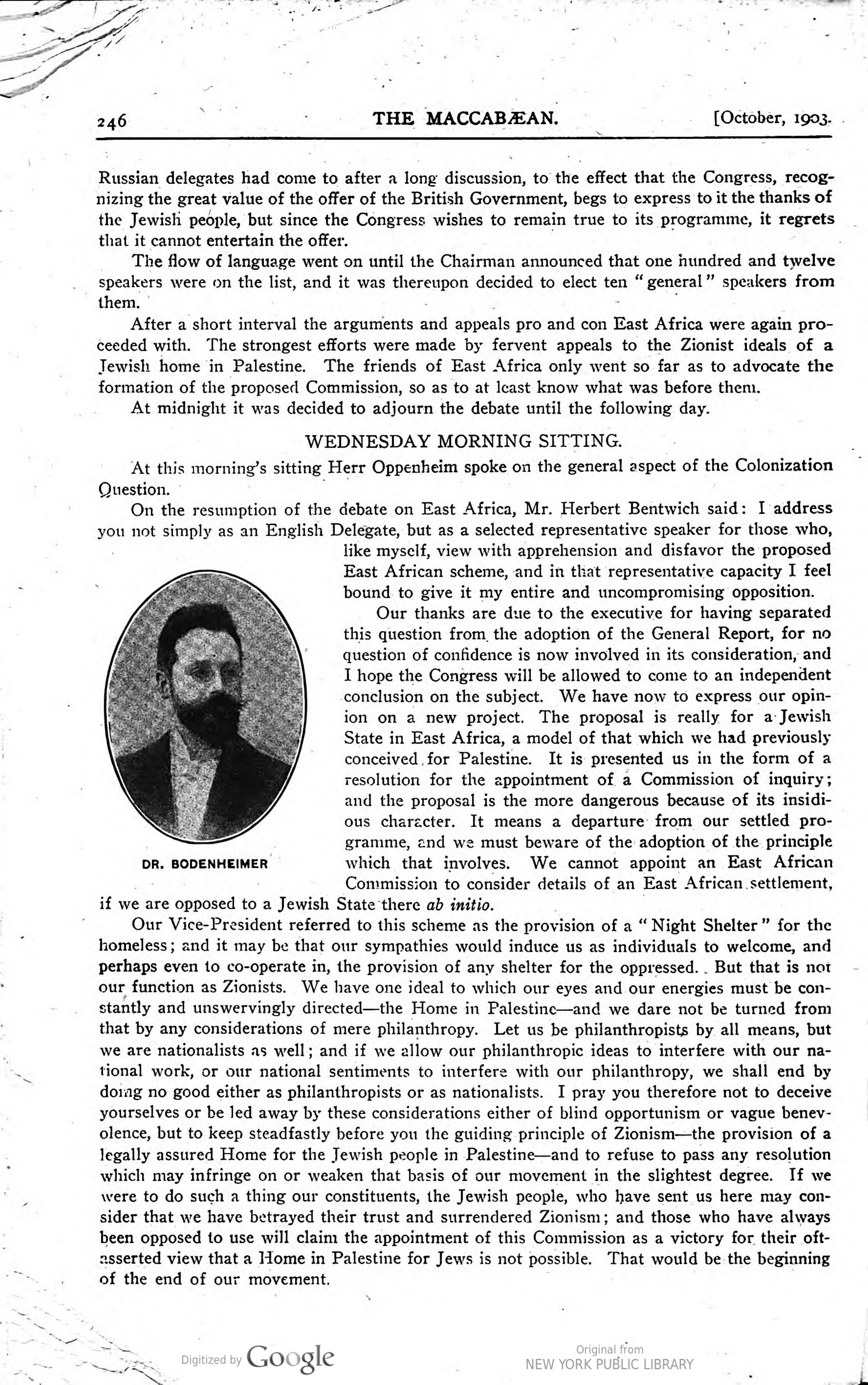
DR. BODENHEIMER
Our thanks are due to the executive for having separatedthis question from the adoption of the General Report, for noquestion of confidence is now involved in its consideration, andI hope the Congress will be allowed to come to an independentconclusion on the subject. We have now to express our opinion on a new project. The proposal is really for a JewishState in East Africa, a model of that which we had previouslyconceived for Palestine. It is presented us in the form of aresolution for the appointment of a Commission of inquiry;and the proposal is the more dangerous because of its insidious character. It means a departure from our settled programme, and we must beware of the adoption of the principlewhich that involves. We cannot appoint an East AfricanCommission to consider details of an East African settlement,
if we are opposed to a Jewish State there ab initio.
Our Vice-President referred to this scheme as the provision of a "Night Shelter" for the homeless; and it may be that our sympathies would induce us as individuals to welcome, and perhaps even to co-operate in, the provision of any shelter for the oppressed. But that is not our function as Zionists. We have one ideal to which our eyes and our energies must be constantly and unswervingly directed—the Home in Palestine—and we dare not be turned from that by any considerations of mere philanthropy. Let us be philanthropists by all means, but we are nationalists as well; and if we allow our philanthropic ideas to interfere with our national work, or our national sentiments to interfere with our philanthropy, we shall end by doing no good either as philanthropists or as nationalists. I pray you therefore not to deceive yourselves or be led away by these considerations either of blind opportunism or vague benevolence, but to keep steadfastly before you the guiding principle of Zionism—the provision of a legally assured Home for the Jewish people in Palestine—and to refuse to pass any resolution which may infringe on or weaken that basis of our movement in the slightest degree. If we were to do such a thing our constituents, the Jewish people, who have sent us here may consider that we have betrayed their trust and surrendered Zionism; and those who have always been opposed to us will claim the appointment of this Commission as a victory for their oft-asserted view that a Home in Palestine for Jews is not possible. That would be the beginning of the end of our movement.